Problem 2
edit
Solution 2
edit
Key steps
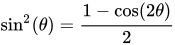
sin
2
(
θ
)
=
1
−
cos
(
2
θ
)
2
{\displaystyle \sin ^{2}(\theta )={\frac {1-\cos(2\theta )}{2}}\!\,}
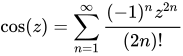
cos
(
z
)
=
∑
n
=
1
∞
(
−
1
)
n
z
2
n
(
2
n
)
!
{\displaystyle \cos(z)=\sum _{n=1}^{\infty }{\frac {(-1)^{n}z^{2n}}{(2n)!}}\!\,}
Problem 4
edit
Solution 4
edit
Showing G 1:1 conformal mapping
edit
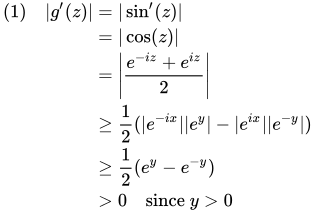
First note that
(
1
)
|
g
′
(
z
)
|
=
|
sin
′
(
z
)
|
=
|
cos
(
z
)
|
=
|
e
−
i
z
+
e
i
z
2
|
≥
1
2
(
|
e
−
i
x
|
|
e
y
|
−
|
e
i
x
|
|
e
−
y
|
)
≥
1
2
(
e
y
−
e
−
y
)
>
0
since
y
>
0
{\displaystyle {\begin{aligned}(1)\quad |g^{\prime }(z)|&=|\sin ^{\prime }(z)|\\&=|\cos(z)|\\&=\left|{\frac {e^{-iz}+e^{iz}}{2}}\right|\\&\geq {\frac {1}{2}}(|e^{-ix}||e^{y}|-|e^{ix}||e^{-y}|)\\&\geq {\frac {1}{2}}(e^{y}-e^{-y})\\&>0\quad {\mbox{since }}y>0\end{aligned}}}
trigonometric identity , we have for all
z
1
,
z
2
∈
H
{\displaystyle z_{1},z_{2}\in H\!\,}
(
2
)
sin
z
1
−
sin
z
2
=
2
sin
(
z
1
−
z
2
2
)
cos
(
z
1
+
z
2
2
)
{\displaystyle (2)\quad \sin z_{1}-\sin z_{2}=2\sin \left({\frac {z_{1}-z_{2}}{2}}\right)\cos \left({\frac {z_{1}+z_{2}}{2}}\right)\!\,}
sin
z
1
=
sin
z
2
{\displaystyle \sin z_{1}=\sin z_{2}\!\,}
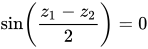
sin
(
z
1
−
z
2
2
)
=
0
{\displaystyle \sin \left({\frac {z_{1}-z_{2}}{2}}\right)=0\!\,}
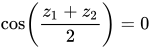
cos
(
z
1
+
z
2
2
)
=
0
{\displaystyle \cos \left({\frac {z_{1}+z_{2}}{2}}\right)=0\!\,}
H
{\displaystyle H\!\,}
|
g
′
(
z
)
|
=
|
cos
(
z
)
|
>
0
{\displaystyle |g^{\prime }(z)|=|\cos(z)|>0\!\,}
sin
(
z
1
−
z
2
2
)
=
0
{\displaystyle \sin \left({\frac {z_{1}-z_{2}}{2}}\right)=0\!\,}
z
1
=
z
2
{\displaystyle z_{1}=z_{2}\!\,}
sin
(
z
)
=
sin
(
x
+
i
y
)
{\displaystyle \sin(z)=\sin(x+iy)\!\,}
x
=
k
π
,
k
∈
Z
{\displaystyle x=k\pi ,k\in \mathbb {Z} \!\,}
cos
(
z
)
=
cos
(
x
+
i
y
)
{\displaystyle \cos(z)=\cos(x+iy)\!\,}
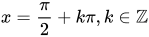
x
=
π
2
+
k
π
,
k
∈
Z
{\displaystyle x={\frac {\pi }{2}}+k\pi ,k\in \mathbb {Z} \!\,}
(
1
)
{\displaystyle (1)\!\,}
(
2
)
{\displaystyle (2)\!\,}
g
{\displaystyle g\!\,}
1
:
1
{\displaystyle 1:1\!\,}
Finding the domain D
edit
To find
D
{\displaystyle D\!\,}
C
3
=
{
z
=
x
+
i
y
|
x
=
π
2
,
y
>
0
}
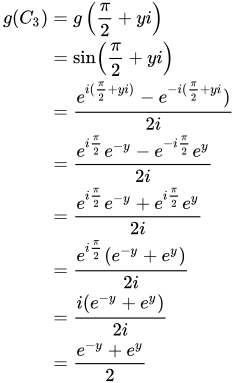
{\displaystyle C_{3}=\{z=x+iy|x={\frac {\pi }{2}},y>0\}\!\,}
g
(
C
3
)
=
g
(
π
2
+
y
i
)
=
sin
(
π
2
+
y
i
)
=
e
i
(
π
2
+
y
i
)
−
e
−
i
(
π
2
+
y
i
)
2
i
=
e
i
π
2
e
−
y
−
e
−
i
π
2
e
y
2
i
=
e
i
π
2
e
−
y
+
e
i
π
2
e
y
2
i
=
e
i
π
2
(
e
−
y
+
e
y
)
2
i
=
i
(
e
−
y
+
e
y
)
2
i
=
e
−
y
+
e
y
2
{\displaystyle {\begin{aligned}g(C_{3})&=g\left({\frac {\pi }{2}}+yi\right)\\&=\sin \left({\frac {\pi }{2}}+yi\right)\\&={\frac {e^{i({\frac {\pi }{2}}+yi)}-e^{-i({\frac {\pi }{2}}+yi})}{2i}}\\&={\frac {e^{i{\frac {\pi }{2}}}e^{-y}-e^{-i{\frac {\pi }{2}}}e^{y}}{2i}}\\&={\frac {e^{i{\frac {\pi }{2}}}e^{-y}+e^{i{\frac {\pi }{2}}}e^{y}}{2i}}\\&={\frac {e^{i{\frac {\pi }{2}}}(e^{-y}+e^{y})}{2i}}\\&={\frac {i(e^{-y}+e^{y})}{2i}}\\&={\frac {e^{-y}+e^{y}}{2}}\\\end{aligned}}}
y
>
0
{\displaystyle y>0\!\,}
g
(
C
3
)
=
(
1
,
∞
)
{\displaystyle g(C_{3})=(1,\infty )\!\,}
C
2
=
{
z
=
x
+
i
y
|
x
=
−
π
2
,
y
>
0
}
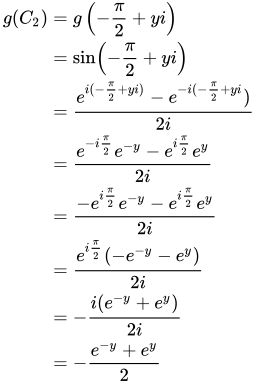
{\displaystyle C_{2}=\{z=x+iy|x=-{\frac {\pi }{2}},y>0\}\!\,}
g
(
C
2
)
=
g
(
−
π
2
+
y
i
)
=
sin
(
−
π
2
+
y
i
)
=
e
i
(
−
π
2
+
y
i
)
−
e
−
i
(
−
π
2
+
y
i
)
2
i
=
e
−
i
π
2
e
−
y
−
e
i
π
2
e
y
2
i
=
−
e
i
π
2
e
−
y
−
e
i
π
2
e
y
2
i
=
e
i
π
2
(
−
e
−
y
−
e
y
)
2
i
=
−
i
(
e
−
y
+
e
y
)
2
i
=
−
e
−
y
+
e
y
2
{\displaystyle {\begin{aligned}g(C_{2})&=g\left(-{\frac {\pi }{2}}+yi\right)\\&=\sin \left(-{\frac {\pi }{2}}+yi\right)\\&={\frac {e^{i(-{\frac {\pi }{2}}+yi)}-e^{-i(-{\frac {\pi }{2}}+yi})}{2i}}\\&={\frac {e^{-i{\frac {\pi }{2}}}e^{-y}-e^{i{\frac {\pi }{2}}}e^{y}}{2i}}\\&={\frac {-e^{i{\frac {\pi }{2}}}e^{-y}-e^{i{\frac {\pi }{2}}}e^{y}}{2i}}\\&={\frac {e^{i{\frac {\pi }{2}}}(-e^{-y}-e^{y})}{2i}}\\&=-{\frac {i(e^{-y}+e^{y})}{2i}}\\&=-{\frac {e^{-y}+e^{y}}{2}}\\\end{aligned}}}
y
>
0
{\displaystyle y>0\!\,}
g
(
C
2
)
=
(
−
∞
,
−
1
)
{\displaystyle g(C_{2})=(-\infty ,-1)\!\,}
C
1
=
{
z
=
x
+
i
y
|
−
π
2
<=
x
<=
π
2
,
y
=
0
}
{\displaystyle C_{1}=\{z=x+iy|-{\frac {\pi }{2}}<=x<={\frac {\pi }{2}},y=0\}\!\,}
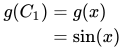
g
(
C
1
)
=
g
(
x
)
=
sin
(
x
)
{\displaystyle {\begin{aligned}g(C_{1})&=g(x)\\&=\sin(x)\end{aligned}}}
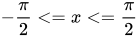
−
π
2
<=
x
<=
π
2
{\displaystyle -{\frac {\pi }{2}}<=x<={\frac {\pi }{2}}\!\,}
g
(
C
2
)
=
[
−
1
,
1
]
{\displaystyle g(C_{2})=[-1,1]\!\,}
H
{\displaystyle H\!\,}
z
=
i
{\displaystyle z=i\!\,}
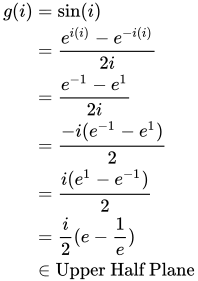
g
(
i
)
=
sin
(
i
)
=
e
i
(
i
)
−
e
−
i
(
i
)
2
i
=
e
−
1
−
e
1
2
i
=
−
i
(
e
−
1
−
e
1
)
2
=
i
(
e
1
−
e
−
1
)
2
=
i
2
(
e
−
1
e
)
∈
Upper Half Plane
{\displaystyle {\begin{aligned}g(i)&=\sin(i)\\&={\frac {e^{i(i)}-e^{-i(i)}}{2i}}\\&={\frac {e^{-1}-e^{1}}{2i}}\\&={\frac {-i(e^{-1}-e^{1})}{2}}\\&={\frac {i(e^{1}-e^{-1})}{2}}\\&={\frac {i}{2}}(e-{\frac {1}{e}})\\&\in {\mbox{Upper Half Plane}}\end{aligned}}}
D
=
g
(
H
)
=
Upper Half Plane
{\displaystyle D=g(H)={\mbox{Upper Half Plane}}\!\,}
Problem 6
edit
Suppose that for a sequence
a
n
∈
R
{\displaystyle a_{n}\in R\!\,}
z
,
ℑ
(
z
)
>
0
{\displaystyle z,\Im (z)>0\!\,}
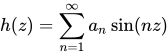
h
(
z
)
=
∑
n
=
1
∞
a
n
sin
(
n
z
)
{\displaystyle h(z)=\sum _{n=1}^{\infty }a_{n}\sin(nz)\!\,}
h
{\displaystyle h\!\,}
{
ℑ
(
z
)
>
0
}
{\displaystyle \{\Im (z)>0\}\!\,}
C
{\displaystyle C\!\,}
Solution 6
edit
Summation a_n Convergent
edit
We want to show that
∑
n
=
1
∞
a
n
{\displaystyle \sum _{n=1}^{\infty }a_{n}\!\,}
∑
n
=
1
∞
a
n
{\displaystyle \sum _{n=1}^{\infty }a_{n}\!\,}
∑
n
=
1
∞
a
n
=
∞
{\displaystyle \sum _{n=1}^{\infty }a_{n}=\infty \!\,}
h
(
z
)
{\displaystyle h(z)\!\,}
z
=
i
{\displaystyle z=i\!\,}
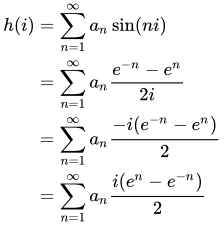
h
(
i
)
=
∑
n
=
1
∞
a
n
sin
(
n
i
)
=
∑
n
=
1
∞
a
n
e
−
n
−
e
n
2
i
=
∑
n
=
1
∞
a
n
−
i
(
e
−
n
−
e
n
)
2
=
∑
n
=
1
∞
a
n
i
(
e
n
−
e
−
n
)
2
{\displaystyle {\begin{aligned}h(i)&=\sum _{n=1}^{\infty }a_{n}\sin(ni)\\&=\sum _{n=1}^{\infty }a_{n}{\frac {e^{-n}-e^{n}}{2i}}\\&=\sum _{n=1}^{\infty }a_{n}{\frac {-i(e^{-n}-e^{n})}{2}}\\&=\sum _{n=1}^{\infty }a_{n}{\frac {i(e^{n}-e^{-n})}{2}}\end{aligned}}}
h
(
i
)
{\displaystyle h(i)\!\,}
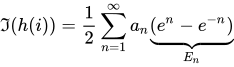
ℑ
(
h
(
i
)
)
=
1
2
∑
n
=
1
∞
a
n
(
e
n
−
e
−
n
)
⏟
E
n
{\displaystyle \Im (h(i))={\frac {1}{2}}\sum _{n=1}^{\infty }a_{n}\underbrace {(e^{n}-e^{-n})} _{E_{n}}\!\,}
The sequence
{
E
n
}
{\displaystyle \{E_{n}\}\!\,}
E
1
<
E
2
<
…
<
E
n
<
E
n
+
1
{\displaystyle E_{1}<E_{2}<\ldots <E_{n}<E_{n+1}\!\,}
e
n
+
1
>
e
n
{\displaystyle e^{n+1}>e^{n}\!\,}
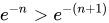
e
−
n
>
e
−
(
n
+
1
)
{\displaystyle e^{-n}>e^{-(n+1)}\!\,}
e
n
{\displaystyle e^{n}\!\,}
e
−
n
{\displaystyle e^{-n}\!\,}
n
{\displaystyle n\!\,}
ℑ
(
h
(
i
)
)
≥
1
2
(
e
1
−
e
−
1
)
∑
n
=
1
∞
a
n
⏟
=
∞
ℑ
(
h
(
i
)
)
≥
∞
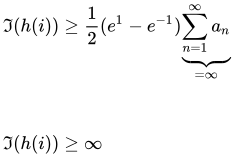
{\displaystyle {\begin{aligned}\Im (h(i))&\geq {\frac {1}{2}}(e^{1}-e^{-1})\underbrace {\sum _{n=1}^{\infty }a_{n}} _{=\infty }\\\\\\\Im (h(i))&\geq \infty \end{aligned}}}
h
(
i
)
{\displaystyle h(i)\!\,}
Show that h is analytic
edit
In order to prove that
h
{\displaystyle h\!\,}
Theorem Let
h
n
{\displaystyle {h_{n}}\!\,}
U
{\displaystyle U\!\,}
K
{\displaystyle K\!\,}
U
{\displaystyle U\!\,}
K
{\displaystyle K\!\,}
h
{\displaystyle h\!\,}
h
{\displaystyle h\!\,}
Proof See Theorem 1.1 in Chapter V, Complex Analysis Fourth Edition, Serge Lang.
h
n
(
z
)
=
∑
k
=
1
n
a
k
sin
(
k
z
)
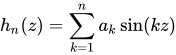
{\displaystyle h_{n}(z)=\sum _{k=1}^{n}a_{k}\sin(kz)\!\,}
K
{\displaystyle K\!\,}
U
=
{
ℑ
z
>
0
}
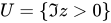
{\displaystyle U=\{\Im {z}>0\}\!\,}
sin
(
k
z
)
{\displaystyle \sin(kz)\!\,}

























![{\displaystyle g(C_{2})=[-1,1]\!\,}](https://wikimedia.org/api/rest_v1/media/math/render/svg/55bd08ec41a7fa85662b6e66156ba3d1e3e2553a)