
Trigonometry/Vectors in the Plane
In practice, one of the most useful applications of trigonometry is in calculations related to vectors, which are frequently used in Physics. A vector is a quantity which has both magnitude (such as three or eight) and direction (such as north or 30 degrees south of east). It is represented in diagrams by an arrow, often pointing from the origin to a specific point.
A plane vector can be expressed in two ways -- as the sum of a horizontal vector of magnitude and a vertical vector of magnitude , or in terms of its angle and magnitude (or simply A). These two methods are called "rectangular" and "polar" respectively.


Rectangular to Polar conversion edit
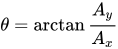
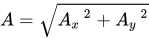
For simplicity, assume is in the first quadrant and has x-component and y-component (which will necessarily be positive). Given these components, we want to find the angle and the magnitude .

If we draw all three of these vectors, they form a right triangle. It is easy to see that , or (A vector with an angle of zero is defined to be pointing directly to the right.) Furthermore, by the Pythagorean Theorem, , or .


Polar to Rectangular conversion edit
This is essentially the same problem as above, but in reverse. Here, and are known and we want to calculate the values of and .
Using the same triangle as above, we can see that , or . Also, , or .




