
Trigonometry/Cosh, Sinh and Tanh
The functions cosh x, sinh x and tanh xhave much the same relationship to the rectangular hyperbola y2 = x2 - 1 as the circular functions do to the circle y2 = 1 - x2. They are therefore sometimes called the hyperbolic functions (h for hyperbolic).
|
Notation and pronunciation is an abbreviation for 'cosine hyperbolic', and is an abbreviation for 'sine hyperbolic'. is pronounced sinch, is pronounced 'cosh', as you'd expect, and is pronounced tanch. |


[Diagram of rectangular hyperbola to illustrate]
Definitions edit
They are defined as

Equivalently,

Reciprocal functions may be defined in the obvious way:

1 - tanh2(x) = sech2(x); coth2(x) - 1 = cosech2(x)
It is easily shown that , analogous to the result In consequence, sinh(x) is always less in absolute value than cosh(x).


sinh(-x) = -sinh(x); cosh(-x) = cosh(x); tanh(-x) = -tanh(x).
Their ranges of values differ greatly from the corresponding circular functions:
- cosh(x) has its minimum value of 1 for x = 0, and tends to infinity as x tends to plus or minus infinity;
- sinh(x) is zero for x = 0, and tends to infinity as x tends to infinity and to minus infinity as x tends to minus infinity;
- tanh(x) is zero for x = 0, and tends to 1 as x tends to infinity and to -1 as x tends to minus infinity.
[Add graph]
Addition formulae edit
There are results very similar to those for circular functions; they are easily proved directly from the definitions of cosh and sinh:
- sinh(x±y) = sinh(x)cosh(y) ± cosh(x)sinh(y)
- cosh(x±y) = cosh(x)cosh(y) ± sinh(x)sinh(y)
Inverse functions edit
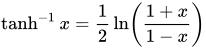
If y = sinh(x), we can define the inverse function x = sinh-1y, and similarly for cosh and tanh. The inverses of sinh and tanh are uniquely defined for all x. For cosh, the inverse does not exist for values of y less than 1. For y = 1, x = 0. For y > 1, there will be two corresponding values of x, of equal absolute value but opposite sign. Normally, the positive value would be used. From the definitions of the functions,


Simplifying a cosh(x) + b sinh(x) edit
If a > |b| then
- where :

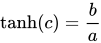
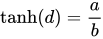
If |a| < b then
- where :

Relations to complex numbers edit






The addition formulae and other results can be proved from these relationships.
The gudermannian edit
The gudermannian (named after Christoph Gudermann, 1798–1852) is defined as gd(x) = tan-1(sinh(x)). We have the following properties:
- gd(0) = 0;
- gd(-x) = -gd(x);
- gd(x) tends to 1⁄2π as x tends to infinity, and -1⁄2π as x tends to minus infinity.
The inverse function gd-1(x) = sinh-1(tan(x)) = ln(sec(x)+tan(x)).
Differentiation edit
As can be proved from the definitions above,

We also have
.
