
Trigonometry/Addition Formula for Sines
Sine Formulas edit
The addition formula for sines is as follows:

This is an important tool that allows us to relate the sines and cosines of angles of different sizes.
There is a related formula for cosines, discussed in the next section:

|
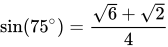
Worked Example: Sine of
Answer: Using the first formula: |

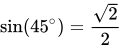
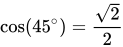
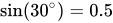
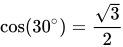



|
Exercise: Check the worked example
|
|
Exercise: Sines and Cosines of
|



The addition formulas are very useful.
Here is a geometric proof of the sine addition formula. The proof also shows how someone could have discovered it.
Proof edit
We want to prove:
About the Diagram edit
First, a word about the diagram used in the proof. How on earth would you come up with a diagram like that?
Well,
- We need a diagram with right triangles and we need to show an angle of , so having is a must.
- We want to express the lengths in this triangle in terms of lengths of two right triangles, one with angle and one with angle , so adding points like and is essential.
- Having got that far we could start trying to solve the problem, and we'd find we ran into a problem when calculating the distance . That's why we split into and . We can calculate the distance . It is the same length as . Also is a length we can calculate using Soh-Cah-Toa.


Be aware that there is nothing really special about the diagram we chose. It's possible, for example, to calculate using a diagram where the right triangle has its right angle at rather than at . You might like to try that.


We've chosen this digram and this lettering because it is exactly the same as used in the Khan Academy video on proving addition formula for sine so if you have trouble with the proof presented here, you can follow it on video instead.
Video Link edit
There is a video of the proof which may be easier to follow at the Khan Academy.
The Proof edit

First check that the really is the same as . That's going to be important to the proof. We're just using the fact that angles in a triangle add up to 180° to make that check, noting that we know the 90 degree angles.


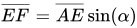
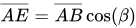
Now an expression for . Here we're using Soh-Cah-Toa. We're going to be using Soh-Cah-Toa a lot.
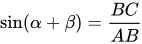
Looking at the diagram we can replace by and we also have so:



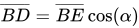
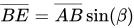
Let's work out another way to express and another way to express . You'll need to look at the diagram to see which triangles we are using.
|
An expression for and so |
An expression for and so |



Putting it all Together edit

The 's cancel.

We're done!
Exercises edit
|
Exercise: Make one of the sides 'one' When we drew the diagram we said nothing about its size. That means we could still choose to make one of the sides be of whatever length we like. We can do this for just one edge. Once we've done that all the other sides lengths are determined. Fixing one length to be a nice value can shorten the proof. So, let us decide that is 1 km. Actually we'll not worry about the units whether km, m or cm and just write '1'. is a right triangle and: Your task is to simplify the entire proof of the addition formula by replacing the lengths like with the actual values assuming that we've set . You're effectively removing and multiplication and division by from the proof. It should become a lot shorter and clearer. You should also mark up the lengths on the diagram, assuming . |




|
Exercise: Use a different diagram Read the description About the Diagram of how the diagram was constructed again. Make your own diagram that is different to the one shown, with right angles in different places to the diagram shown, and do the proof using it instead.
|

