
TI-Basic Z80 Programming/Mathematical Finance Programming
TI-BASIC is a simple programming language used on Texas Instruments graphing calculators. This module shows you how to program some standard financial calculations:
TI-BASIC programs edit
Ito's lemma edit
Let's begin defining a stochastic process through its Ito's definition:
:defsto(t,x)
:Func
:{t,x}
:EndFunc
So for our TI-calculator, a diffusion process formally defined by:

is defined by a set of two terms:
{ f(S,t), g(S,t) }
For an exponential brownian motion, we define:
defsto(m*s, sigma*s) → ds(s)
Now we want to use Ito's lemma on functions of and :


:dsto(f,x,t,ds)
:Func
:{d(f,t)+ds[1]*d(f,x)+ds[2]^2*d(d(f,x),x)/2 , ds[2]*d(f,x)}
:EndFunc
This can now be used to apply Ito's lemma to :

dsto(ln(S),S,t,ds(S))
>> { m - sigma^2/2 , sigma }
this tell us that:

Black-Scholes Equation edit
Now we can try to prove the Black-Scholes equation.
Define a portfolio with an option and shares of :

V(S,t) - Delta * S → Pi
and apply Ito's lemma to obtain :

dsto(Pi, S, t, ds(S)) → dPi
we now want to nullify the stochastic part of by chosing an appropriate value for :
solve( dPi[2]=0, Delta)
>> Delta = d(V(S,t), S) or sigma S = 0
we now know that the correct value for is:
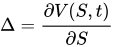
On another side, we have:

which leads us to the equation:

At first we need to replace by its value into , and then equalize with
solve( dPi[2]=0, Delta) | sigma > 0 and S > 9 → sol
>> Delta = d(V(S,t), S)
dPi | sol → dPi
>> {sigma^2 d^2(V(S,t), S^2) S^2 /2 + d(V(S,t), t) , 0 }
dPi = defsto( r(V(S,t) - Delta S) ) | sol → BS
>> { BS_equation , true }
and now we've got the Black-Schole Differential Equation into the variable BS_equation[1]!