
Solutions to Hartshorne's Algebraic Geometry/Separated and Proper Morphisms
The reference for this section is EGA II.5, EGA II.6, EGA II.7. For the discrete vaulation ring questions at the end see Samula and Zariski's Commutative Algebra II.
Exercise II.4.1 edit
Let be the finite morphism. Finite implies finite type so we only need to show that is universally closed and separated.


is separated. We want to show that is a closed immersion. To check that a morphism is a closed immersion it is enough to check for each element of an open cover of the target. Let be an open affine cover of . The pull-back of along each is where . The ring homomorphism corresponding to these morphisms of affine schemes is surjective, and so they are all closed immersions according to Exercise II.2.18(c).






is universally closed. The proof of Exercise II.3.13(d) goes through to show that finite morphisms are stable under base change (in fact, the proof becomes easier). Secondly, we know that finite morphisms are closed (Exercise II.3.5) and therefore finite morphisms are universally closed.
Exercise II.4.2 edit
Let be the dense open subset of on which and agree. Consider the pullback square(s):


Since is separated, the lower horizontal morphism is a closed immersion. Closed immersions are stable under base extension (Exercise II.3.11) and so is also a closed immersion. Now since and agree on , the image of in is contained in the diagonal and so the pullback is, again (at least topologically. But this means that factors through , whose image is a closed subset of . Since is dense, this means that . Since is a closed immersion, the morphism of sheaves is surjective. Consider an open affine of . Restricted to , the morphism continues to be a closed immersion and so is an affine scheme, homeomorphic to , determined by an ideal . Since is a homeomorphism, is contained in the nilradical. But is reduced and so . Hence, and therefore .





- Consider the case where , the affine line with nilpotents at the origin, and consider the two morphisms , one the identity and the other defined by , i.e. killing the nilpotents at the origin. These agree on the complement of the origin which is a dense open subset but the sheaf morphism disagrees at the origin.
- Consider the affine line with two origins, and let and be the two open inclusions of the regular affine line. They agree on the complement of the origin but send the origin two different places.
![{\displaystyle X=Y=Spec\ k[x,y]/(x^{2},xy)}](https://wikimedia.org/api/rest_v1/media/math/render/svg/29182b971222efc4d94925e6fff67755e9a15da3)


Exercise II.4.3 edit
Consider the pullback square

Since is separated over the diagonal is a closed immersion. Closed immersions are stable under change of base (Exercise II.3.11(a)) and so is a closed immersion. But is affine since all of are. So is a closed immersion into an affine scheme and so itself is affine (Exercise II.3.11(b)).




For an example when is not separated consider the affine plane with two origins and the two copies of the usually affine plane inside it as open affines. The intersection of and is which is not affine.


Exercise II.4.4 edit
Since is proper and separated it follows from Corollary II.4.8e that is proper. Proper morphisms are closed and so is closed.


is finite type. This follows from it being a closed subscheme of a scheme of finite type over (Exercise II.3.13(a) and (c)).

is separated. This follows from the change of base square and the fact that closed immersions are preserved under change of base.
<math>\xymatrix{
f(Z) \ar[d]^\Delta \ar[r] & Y \ar[d]^\Delta \\
f(Z) \times_S f(Z) \ar[r] & Y \times_S Y
 } </math>
is universally closed. Let be some other morphism and consider the following diagram

\xymatrix{
T \times_S Z \ar[r] \ar[d]^{f'} & Z \ar[d]^f \\
T \times_S f(Z) \ar[r] \ar[d]^{s'} & f(Z) \ar[d]^s \\
T \ar[r] & S
 }
Our first task will be to show that is surjective. Suppose is a point with residue field . Following it horizontally we obtain a point with residue field and this lifts to a point with residue field . Let be a field containing both and . The inclusions give morphisms and which agree on and therefore lift to a morphism giving a point in the preimage of . So is sujective.




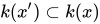

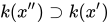







Now suppose that is a closed subset of . Its vertical preimage is a closed subset of and since is universally closed the image in is closed. As is surjective, and so . Hence, is closed in .








Exercise II.4.5 edit
- Let be the valuation ring of a valuation on . Having center on some point is equivalent to an inclusion (such that ) which is equivalent to a diagonal morphism in the diagram




<math>\xymatrix{
Spec\  K \ar[r] \ar[d] & X \ar[d] \\
Spec\  R \ar[r] \ar[ur] & Spec\  k
</math>
But by the valuative criterion for separability this diagonal morphism (if it exists) is unique. Therefore, the center, if it exists, is unique.
- Same argument as the previous part.
- The argument for the two cases is the same so we will prove: Suppose that every valuation ring of has a unique center in , then is proper. This is clearly true for integral -schemes of finite type of dimension zero. Suppose that it is true for integral -schemes of dimension less than and that is an integral -scheme of dimension . We will use the valuative criteria. Suppose that we have a diagram

 \xymatrix{
Spec\  L \ar[r] \ar[d] & X \ar[d] \\
Spec\  S \ar[r] & Spec\  k
with a valuation ring of function field . If the image of the unique point of is not the generic point of then let be the closure of its image with the reduced structure. We have a diagram


 \xymatrix{
Spec\  L \ar[r] \ar[d] & Z \ar[r] & X \ar[d] \\
Spec\  S \ar[r] & Spec\  k \ar@{=}[r] & Spec\  k
The scheme is an integral -scheme of dimension less than and so the square on the lest admits a lifting, which gives a lifting for the outside rectangle. Moreover, as closed immersions are proper, any lifting of the outside rectangle factors uniquely through by the valuative criteria and so the lifting is unique.
Now suppose that the image of the point of is the generic point of . Then we have a tower of field extensions and the valuation on induces a valuation on . We then have the following diagram.

 \xymatrix{
Spec\  L \ar[r] \ar[d] & Spec\  K \ar[r] & X \ar[d] \\
Spec\  S \ar[r] & Spec\  R \ar[r] & Spec\  k
By assumption the valuation ring has a unique center on and so there is a unique extension of the diagram above
 \xymatrix{
Spec\  L \ar[r] \ar[d] & Spec\  K \ar[r] & Spec\  \mathcal{O}_{X,x} \ar[r] & X \ar[d] \\
Spec\  S \ar[r] & Spec\  R \ar[rr] \ar[ur] && Spec\  k
Hence, there is a unique lifting of our original square. By the valuative criteria, the scheme is then proper.
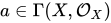
- Suppose that there is some such that . Consider the image . Since is algebraically closed, is transcendental over and so is a polynomial ring. Consider the localization . This is a local ring contained in and therefore there is a valuation ring that dominates it. Since we see that .


![{\displaystyle k[a^{-1}]}](https://wikimedia.org/api/rest_v1/media/math/render/svg/37f500ef2ccf7fde192dd309738003b0d4412aaf)
![{\displaystyle k[a^{-1}]_{(a^{-1})}}](https://wikimedia.org/api/rest_v1/media/math/render/svg/e1bc9bab35745bc5ca688979c790e0ee10fe1d81)

![{\displaystyle {\mathfrak {m}}_{R}\cap k[a^{-1}]_{(a^{-1})}=(a^{-1})}](https://wikimedia.org/api/rest_v1/media/math/render/svg/2316d9bf4f40e8bd3a83fc51e96c6125174dfabf)

Now since is proper, there exists a unique dashed morphism in the diagram on the left.
 \xymatrix{
Spec\  K \ar[r] \ar[d] & X \ar[d] && K & \Gamma(X, \mathcal{O}_X) \ar[l] \ar@{-->}[dl] \\
Spec\  R \ar[r] \ar@{-->}[ur] & Spec\  k && R \ar[u] & k \ar[l] \ar[u]
Taking global sections gives the diagram on the right which implies that and so . But and so This gives a contradiction since .



Exercise II.4.6 edit
Since and are affine varieties, by definition they are integral and so comes from a ring homomorphism where and are integral. Let . Then for valuation ring of that contains we have a commutative diagram


 \xymatrix{
Spec\  K \ar[r] \ar[d] &  X \ar[d] \\
Spec\  R \ar[r] \ar@{-->}[ur]^{\exists !} & Y
Since is proper, the dashed arrow exists (uniquely, but we don't need this). From Theorem II.4.11A the integral closure of in is the intersection of all valuation rings of which contain . As the dashed morphism exists for any valuation ring containing so it follows that is contained in the integral closure of in . Hence every element of is integral over , and this together with the hypothesis that is of finite type implies that is finite.

Exercise II.4.7 edit
Exercise II.4.8 edit
- Let and be the morphisms. The morphism is a composition of base changes of and as follows:


\tbd{\mathfrak{m}arginpar{Should really check that the all the claims made about pullbacks in here are true.}}
 \xymatrix@R=6pt{
& X \ar[dd] \\
X \times X' \ar[ur] \ar[dd]  \\
& Y \\
Y \times X' \ar[ur] \ar[dd] \ar[dr] \\
& X' \ar[dd] \\
Y \times Y' \ar[dr] \\
& Y'
Therefore has property .

- Same argument as above but we should also note that since is separated the diagonal morphism is a closed embedding and therefore satisfies .

 \xymatrix@R=6pt{
& Y \ar[dd] \\
X \ar[ur] \ar[dd]  \\
& Y\times_Z Y \\
X \times_Z Y \ar[ur] \ar[dd] \ar[dr] \\
& X \ar[dd] \\
Y \ar[dr] \\
& Z
- Consider the factorization
 \xymatrix{
X_{red} \ar@/^/[drr]^{id} \ar@/_/[ddr]_{f_{red}} \ar[dr]^{\Gamma_{f_{red}}} \\
& Y_{red} \times_Y X_{red} \ar[r] \ar[d] & X_{red} \ar[d] \\
& Y_{red} \ar[r] & Y
The morphism is a composition of a closed immersion and a morphism with property and therefore it has property . Therefore the vertical morphism out of the fibre product is a base change of a morphism with property and therefore, itself has property . To se that has property it therefore remains only to see that the graph has property for then will be a composition of morphisms with property . To see this, recall that the graph is following base change



 \xymatrix{
X_{red} \ar[r] \ar[d]^\Gamma & Y_{red} \ar[d]^\Delta \\
X_{red} \times_Y Y_{red} \ar[r] & Y_{red} \times_Y Y_{red}
But and and so is a closed immersion. Hence, is a base change of a morphism with property .



Exercise II.4.9 edit
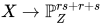
Let be two projective morphisms. This gives rise to a commutative diagram

 \xymatrix{
X \ar[r]^{f'} \ar[dr]_f & \mathbb{P}^r \times Y \ar[d] \ar[r]^{id \times g'} & \mathbb{P}^r \times \mathbb{P}^s \times Z \ar[d]  \\
& Y \ar[r]^{g'} \ar[dr]_g & \mathbb{P}^s \times Z \ar[d] \\
& & Z }
where and (and therefore ) are closed immersions. Now using the Segre embedding the projection factors as
So since the Segre embedding is a closed immersion then we are done since we have found a closed immersion which factors .





Exercise II.4.10 edit
Chow's Lemma is in EGA II.5.6.
Exercise II.4.11 edit
See Samula and Zariski's Commutative Algebra II.
Suppose that . Then define:
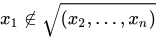
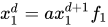
The ring is a discrete noetherian local domain with maximal ideal and quotient field . By induction then, we can reduce to the case when is a finite field extension of . Now consider a set of generators of such that \mathfrak{m}arginpar{does such a set always exist?} (if is principal wait for the next step). We claim that the ideal is not the unit ideal in . If it were then there would be some polynomial of degree, say , in the such that . Let be the degree 0 part of and be the higher degree part. Since the element has an inverse, say . Now with this in mind, our equality implies that which then implies that . Since is made up of terms of degree higher than zero, the element which implies that contradicting our assumption. So is not the unit ideal in . Now let be a minimal prime ideal of , and consider the localization .

![{\displaystyle {\mathfrak {m}}_{R}=\{a_{0}+a_{1}t+\dots +a_{n}t^{n}\in {\mathcal {O}}[t]:a_{0}\in {\mathfrak {m}}\}}](https://wikimedia.org/api/rest_v1/media/math/render/svg/bf34efa160c78c09772f77f942ec8c4efc1490e3)
![{\displaystyle {\mathcal {O}}[t]}](https://wikimedia.org/api/rest_v1/media/math/render/svg/c85f013cf2fe8b70b0c8c40c725040ffa0847ab9)



![{\displaystyle {\mathcal {O}}'={\mathcal {O}}[{\frac {x_{2}}{x_{1}}},\dots ,{\frac {x_{n}}{x_{1}}}]}](https://wikimedia.org/api/rest_v1/media/math/render/svg/3448f7cfabe948ced7262801c1803a74c12a02b4)







Exercise II.4.12 edit
See Samuel and Zariski's Commutative Algebra II.