Solutions To Mathematics Textbooks/Principles of Mathematical Analysis (3rd edition) (ISBN 0070856133)/Chapter 1
Unless the contrary is explicitly stated, all numbers that are mentioned in these exercises are understood to be real.
Chapter 1 edit
1 edit
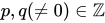
If is rational ( ) and is irrational, prove that and are irrational.


Solution. Let . If was rational then would be too. Similarly is irrational.


2 edit
Prove that there is no rational number whose square is 12.
Solution. Let, if possible, such that and . Now . By the fundamental theorem of arithmetic and therefore has both 2 and 3 in its factorization. So for some . But now and so , a contradiction.


3 edit
Prove Proposition 1.15.
Solution. The results follow from using the facts related to being a field.

4 edit
Let be a nonempty subset of an ordered set; suppose is a lower bound of and is an upper bound of . Prove that .


Solution. For note that and the result follows.


5 edit
Let be a nonempty set of real numbers which is bounded below. Let be the set of all numbers , where . Prove that inf =-sup .


Solution. Let inf and sup . We need to show that . We first show that is the upper bound of . Let . Then and so or follow. We now show that is the least upper bound of . Let be an upper bound of . Then , or . So is a lower bound of . Since inf so or .


6 edit
Fix .

(a) If are integers, , , and , prove that . Hence it makes sense to define .





(b) Prove that if and are rational.


(c) If is real, define to be the set of all numbers , where is rational and . Prove that sup when r is rational. Hence it makes sense to define sup for every real .


(d) Prove that for all real and .

Solution. (a) Suppose . Then and the fundamental theorem of arithmetic imply that and where . So and so we are done. If then reduce to lowest factors, say . Clearly now by the already worked out case when the ratios are coprime.






(b) We will let and and equivalently show that . Clearly . The last equality holds as the exponents are integers.




(c) Clearly . We need merely show that br is an upper bound for B(r) since being in B(r) it then automatically becomes its supremum.

Clearly b1/n>1. Now if r=m/n is any positive rational then br=(bm)1/n>1. Now let p,q be any rational numbers with p<q. As bq-p>1 so bpbq-p=bq>bp or in other words for every bt in B(r) we have t≤r and so bt≤br, i.e. br is the upper bound.
(d) Suppose r is a rational number with r<x+y. WLOG let x<y and set δ=x+y-r>0. Choose a rational p such that x-δ<p<x and put q=r-p. Then q<y. By parts (b) and (c) br=bp+q=bpbq≤bxby. So bxby is an upper bound for {br:r≤x+y} or bx+y≤bxby.
Now suppose p, q are rationals with p≤x and q≤y. Then bp+q is in B(x+y) and so bpbq=bp+q≤bx+y by (b) and so bp≤bx+y/bq. Now bp is in B(x). So for all q bx+y/bq is an upper bound for B(x) as p can be chosen arbitrarily. By definition bx≤bx+y/bq and so bq≤bx+y/bx. Again q can be chosen arbitarily so that bx+y/bx is an upper bound for B(y). As before this leads to by≤bx+y/bx or bxby≤bx+y.
7 edit
Fix b>1, y>0 and prove that there is a unique real x such that bx=y by completing the following outline. (This x is called the logarithm of y to the base b.)
(a) For any positive integer n, bn-1≥n(b-1).
(b) b-1≥n(b1/n-1)
(c) If t>1 and then b1/n<t.

(d) If w is such that bw<y then bw+(1/n)<y for sufficiently large n.
(e) If bw>y, then bw-(1/n)>y for sufficiently large n.
(f) Let A be the set of all w such that bw<y and show that x=sup A satisfies bx=y.
(g) Prove that this x is unique.
Solution. (a) Clearly each of bn-1, bn-2,...b is greater then 1 and summing them and applying the forumla of the finite sum of a geometric series gives the result.
(b) As b1/n > 1 so by (a), (b1/n)n - 1 ≥ n(b1/n - 1).
(c) b1/n = (b1/n - 1) + 1 ≤ (b - 1)/n + 1 < t.
(d) Note that 1 < b-wy = t (say). Choose n > (b - 1)/(t - 1) then by (c), b1/n < b-wy or bw + (1/n) < y for sufficiently large n.
(e) Choose t = bw/y > 1. The rest is similar.
(f) From (a), bn ≥ n(b - 1) + 1 for all n. For which each z in R choose an n so that n(b - 1) > z - 1 or n(b - 1) + 1 > z. Hence for all z we have an n such that bn ≥ n(b - 1) + 1 > z. Hence the set {bn : n ∈ N} is unbounded. Now consider the function f : R → R defined by f(x) = bx. If x < y then as B(x) ⊆ B(y) so bx < by; i.e. f is an increasing function.
Define A = {w : bw < y} as in the problem. The set {bn : n ∈ N} being unbounded gaurantees the existence of a n such that bn > y. Thus n is an upper bound for A. Let x = sup A.
Suppose bx < y. By (d), for sufficiently large n, bx + (1/n) < y, i.e. x + 1/n is in A. But this is impossible as x = sup A. So bx < y is not possible. Suppose bx > y. By (e), for sufficiently large n, bx - (1/n) > y, i.e. x - 1/n is not in A. Since x - 1/n cannot possibly be the sup of A so there is a w in A such that x - 1/n < w ≤ x. But then as f was increasing, bx - 1/n < bw < y, a contradiction as bx - (1/n) > y. So bx > y is not possible.
Hence bx = y.
(g) The function f described in (f) is increasing and hence 1-1.
8 edit
Prove that no order can be defined in the complex field that turns it into an ordered field.
Solution. Suppose an order < had been defined. Now (i)2 = -1 > 0 by Proposition 1.18. This violates 1 > 0.
9 edit
Suppose z = a + bi, w = c + di. Define z < w if a < c, and also if a = c but b < d. Prove that this turns the set of all complex numbers into an ordered set. Does this ordered set have the least-upper-bound property?
Solution. Clearly if a < c then x < y. If a = c then either of the cases exist: b < d implies x < y, b > d implies x > y, b = d implies x = y. If a > c then x > y. Also if x = (a,b), y = (c,d) and z = (e,f) and x < y, y < z then we can establish x < y by considering the various cases. For example if a < c and c < e then clearly x < z. Similarly other cases may be handled. This set doesn't have the least upper bound property as the x-axis, a set bounded above by (1,0) doesn't have a least upper bound.
10 edit
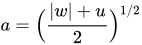
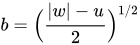
Suppose z = a + bi, w = u + iv and , . Prove that z2 = w if v ≥ 0 and that = w if v ≤ 0. Conclude that every complex number (with one exception!) has two complex roots.