Question 1
edit
a
x
=
a
{\displaystyle ax=a\,}
a
⋅
(
x
⋅
a
−
1
)
=
a
⋅
a
−
1
=
1
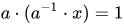
{\displaystyle a\cdot (x\cdot a^{-1})=a\cdot a^{-1}=1}
a
⋅
(
a
−
1
⋅
x
)
=
1
{\displaystyle a\cdot (a^{-1}\cdot x)=1}
(
a
⋅
a
−
1
)
⋅
x
)
=
1
{\displaystyle (a\cdot a^{-1})\cdot x)=1}
1
⋅
x
=
1
{\displaystyle 1\cdot x=1}
x
=
1
{\displaystyle x=1\,}
(
x
−
y
)
(
x
+
y
)
=
(
x
⋅
(
x
−
y
)
+
y
⋅
(
x
−
y
)
)
{\displaystyle (x-y)(x+y)=(x\cdot (x-y)+y\cdot (x-y))}
=
(
x
2
−
x
y
)
+
(
x
y
−
y
2
)
{\displaystyle =(x^{2}-xy)+(xy-y^{2})\,}
=
x
2
−
x
y
+
x
y
−
y
2
{\displaystyle =x^{2}-xy+xy-y^{2}\,}
=
x
2
−
y
2
{\displaystyle =x^{2}-y^{2}\,}
x
2
=
y
2
{\displaystyle x^{2}=y^{2}\,}
x
2
−
y
2
=
(
x
+
y
)
(
x
−
y
)
=
0
{\displaystyle x^{2}-y^{2}=(x+y)(x-y)=0\,}
Either
(
x
+
y
)
=
0
{\displaystyle (x+y)=0\,}
x
=
−
y
{\displaystyle x=-y\,}
(
x
−
y
)
=
0
{\displaystyle (x-y)=0\,}
x
=
y
{\displaystyle x=y\,}
x
3
−
y
3
=
(
x
−
y
)
(
x
2
+
x
y
+
y
2
)
{\displaystyle x^{3}-y^{3}=(x-y)(x^{2}+xy+y^{2})\,}
=
(
x
−
y
)
x
2
+
(
x
−
y
)
x
y
+
(
x
−
y
)
y
2
{\displaystyle =(x-y)x^{2}+(x-y)xy+(x-y)y^{2}\,}
=
(
x
3
−
x
2
y
+
x
2
y
−
x
y
2
+
x
y
2
−
y
3
{\displaystyle =(x^{3}-x^{2}y+x^{2}y-xy^{2}+xy^{2}-y^{3}\,}
=
x
3
−
y
3
{\displaystyle =x^{3}-y^{3}\,}
x
n
−
y
n
=
(
x
−
y
)
(
x
n
−
1
+
x
n
−
2
y
+
.
.
.
+
x
y
n
−
2
+
y
n
−
1
)
{\displaystyle x^{n}-y^{n}=(x-y)(x^{n-1}+x^{n-2}y+...+xy^{n-2}+y^{n-1})\,}
=
x
(
x
n
−
1
+
x
n
−
2
y
+
.
.
.
+
x
y
n
−
2
+
y
n
−
1
)
−
y
(
x
n
−
1
+
x
n
−
2
y
+
.
.
.
+
x
y
n
−
2
+
y
n
−
1
)
{\displaystyle =x(x^{n-1}+x^{n-2}y+...+xy^{n-2}+y^{n-1})-y(x^{n-1}+x^{n-2}y+...+xy^{n-2}+y^{n-1})\,}
=
(
x
n
+
x
n
−
1
y
+
.
.
.
+
x
2
y
n
−
2
+
x
y
n
−
1
)
−
(
x
n
−
1
y
+
x
n
−
2
y
2
+
.
.
.
+
x
y
n
−
1
+
y
n
)
{\displaystyle =(x^{n}+x^{n-1}y+...+x^{2}y^{n-2}+xy^{n-1})-(x^{n-1}y+x^{n-2}y^{2}+...+xy^{n-1}+y^{n})\,}
=
x
n
−
y
n
{\displaystyle =x^{n}-y^{n}\,}
Note that the two middle terms do no appear to match, but if you follow the logical development in each term, you will see that there is a matching additive inverse for each term on both sides.
Use the same method as iv , expand the expression and cancel.
Question 2
edit
Question 4
edit
All values of x satisfy the inequality, since it can be rewritten as
−
3
<
x
2
{\displaystyle -3<x^{2}\,}
x
2
>=
0
{\displaystyle x^{2}>=0\,}
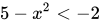
If
5
−
x
2
<
−
2
{\displaystyle 5-x^{2}<-2\,}
x
2
>
7
{\displaystyle x^{2}>7\,}
x
>
7
{\displaystyle x>{\sqrt {7}}\,}
x
<
−
7
{\displaystyle x<-{\sqrt {7}}\,}
x
2
−
2
x
+
2
{\displaystyle x^{2}-2x+2}
(
x
2
−
2
x
+
1
)
+
1
>
0
{\displaystyle (x^{2}-2x+1)+1>0\,}
x
2
−
2
x
+
1
=
(
x
−
1
)
2
{\displaystyle x^{2}-2x+1=(x-1)^{2}\,}
(
x
−
1
)
2
+
1
>
0
{\displaystyle (x-1)^{2}+1>0\,}
If
x
2
+
x
+
1
>
2
{\displaystyle x^{2}+x+1>2\,}
x
2
+
x
−
1
>
0
{\displaystyle x^{2}+x-1>0\,}
x
2
+
x
−
1
=
(
x
+
1
+
5
2
)
(
x
−
5
−
1
2
)
{\displaystyle x^{2}+x-1=\left(x+{\frac {1+{\sqrt {5}}}{2}}\right)\left(x-{\frac {{\sqrt {5}}-1}{2}}\right)}
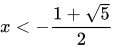
x
<
−
1
+
5
2
{\displaystyle x<-{\frac {1+{\sqrt {5}}}{2}}}
x
>
5
−
1
2
{\displaystyle x>{\frac {{\sqrt {5}}-1}{2}}}
Complete the square:
x
2
+
x
+
1
=
x
2
+
x
+
1
4
+
3
4
=
(
x
+
1
2
)
2
+
3
4
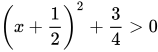
{\displaystyle x^{2}+x+1=x^{2}+x+{\frac {1}{4}}+{\frac {3}{4}}=\left(x+{\frac {1}{2}}\right)^{2}+{\frac {3}{4}}}
(
x
+
1
2
)
2
+
3
4
>
0
{\displaystyle \left(x+{\frac {1}{2}}\right)^{2}+{\frac {3}{4}}>0}
Solve for
(
x
−
π
)
(
x
+
5
)
>
0
{\displaystyle (x-\pi )(x+5)>0\,}
(
x
−
3
)
{\displaystyle (x-3)\,}
−
5
<
x
<
3
{\displaystyle -5<x<3\,}
x
>
π
{\displaystyle x>\pi \,}
x
>
2
{\displaystyle x>{\sqrt {2}}}
x
<
2
3
{\displaystyle x<{\sqrt[{3}]{2}}}
If
2
x
<
8
{\displaystyle 2^{x}<8\,}
l
o
g
2
2
x
<
l
o
g
2
8
=
x
<
3
{\displaystyle log_{2}2^{x}<log_{2}8=x<3\,}
x
<
1
{\displaystyle x<1\,}
NOTE: The answer in the 3rd Edition provides
0
<
x
<
1
{\displaystyle 0<x<1}
x
>
1
{\displaystyle x>1}
x
>
1
{\displaystyle x>1}
1
/
10
−
1
/
9
<
0
{\displaystyle 1/10-1/9<0}
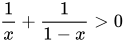
1
x
+
1
1
−
x
>
0
{\displaystyle {\frac {1}{x}}+{\frac {1}{1-x}}>0}
1
x
−
x
2
>
0
{\displaystyle {\frac {1}{x-x^{2}}}>0}
0
<
x
<
1
{\displaystyle 0<x<1}
x
2
>
x
{\displaystyle x^{2}>x}
Question 5
edit
a
+
c
<
b
+
d
{\displaystyle a+c<b+d\,}
=
(
b
+
d
)
−
(
a
+
c
)
>
0
{\displaystyle =(b+d)-(a+c)>0\,}
=
(
b
−
a
)
+
(
d
−
c
)
>
0
{\displaystyle =(b-a)+(d-c)>0\,}
(
b
−
a
)
,
(
d
−
c
)
>
0
{\displaystyle (b-a),(d-c)>0\,}
b
−
a
>
0
{\displaystyle b-a>0\,}
=
−
a
+
b
>
0
{\displaystyle =-a+b>0\,}
=
−
a
−
(
−
b
)
>
0
{\displaystyle =-a-(-b)>0\,}
=
−
b
<
−
a
{\displaystyle =-b<-a\,}
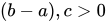
(
b
−
a
)
,
c
>
0
{\displaystyle (b-a),c>0\,}
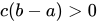
c
(
b
−
a
)
>
0
{\displaystyle c(b-a)>0\,}
c
(
b
−
a
)
=
b
c
−
a
c
{\displaystyle c(b-a)=bc-ac\,}
a
c
<
b
c
{\displaystyle ac<bc\,}
a
>
1
{\displaystyle a>1\,}
1
−
a
>
0
{\displaystyle 1-a>0\,}
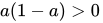
a
(
1
−
a
)
>
0
{\displaystyle a(1-a)>0\,}
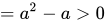
=
a
2
−
a
>
0
{\displaystyle =a^{2}-a>0\,}
=
a
2
>
a
{\displaystyle =a^{2}>a\,}
If
a
{\displaystyle a}
c
{\displaystyle c}
a
c
<
b
d
{\displaystyle ac<bd}
Otherwise, we have already proved that
a
c
<
b
c
{\displaystyle ac<bc}
a
,
c
>
0
{\displaystyle a,c>0}
c
<
d
{\displaystyle c<d}
a
c
<
b
d
{\displaystyle ac<bd}
If
a
=
0
{\displaystyle a=0}
a
2
<
b
2
{\displaystyle a^{2}<b^{2}}
b
2
>
0
{\displaystyle b^{2}>0}
If
0
<
a
<
b
{\displaystyle 0<a<b}
a
2
<
a
b
{\displaystyle a^{2}<ab}
a
b
<
b
2
{\displaystyle ab<b^{2}}
a
2
<
b
2
{\displaystyle a^{2}<b^{2}}
Question 6
edit




































![{\displaystyle x<{\sqrt[{3}]{2}}}](https://wikimedia.org/api/rest_v1/media/math/render/svg/61605d902da0e92dfbb747a2a8f8e9a04e2833e9)