
Quantum Mechanics/Operators and Commutators
Why Operators? edit
When we work with the Schrödinger Equation, or in any other formulation of Quantum Mechanics, exact values of properties can not be found. Instead we use operators.
The simplest way of expressing Schrödinger's Equation is
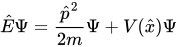
Now this could look deceptively simple if we didn't use operators for energy and momentum. We could simply divide by the wave function Ψ. But like most things, it's never simple. The energy operator acts on the wave function, as does the momentum operator. So we need to find the wave function in order to make any sense of this equation.
A Look at a Few Common Operators edit
Although we could theoretically come up with an infinite number of operators, in practice there are a few which are much more important than any others.
Momentum edit
The Momentum operator is

So the relative part of the Schrödinger Equation will become

Energy edit
The Energy operator is

So Schrödinger's Equation now looks like

As you can see this is now a differential equation, which may or may not be easily solved depending on the potential .

Note that this is the one dimensional form of Schrödinger's Equation, it does become more complex for higher dimensions.
Hamiltonian edit
We often call the Right Hand Side of this equation the Hamiltonian Operator.
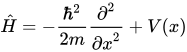
and it represents the total energy of the particle of mass m in the Potential Field V.
Expectation Values edit
In Quantum Mechanics, everything is probabilistic (e.g., the probability of finding a particle is the square of the amplitude of the wave function). So we often want to know the expected value of position, momentum, or anything else, and there is quite a nice method of doing this.
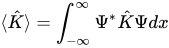
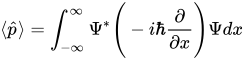
So, for instance, if you knew the wave function and wanted to find the expectation value of momentum you'd use the equation
Dirac Notation (Bra-Ket Notation) edit
To simplify notation Paul Dirac came up with a new way of writing states:

i.e a ket

i.e. a bra
So the expression for the expectation value of momentum can now be written as
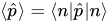
This notation is very widely used. It is extremely useful in finite dimensional problems, represented by matrices and state vectors. In 2D, qubits are used (most used in Quantum Information Theory), where:

and

are the state vectors.
For more on Dirac Notation see Wikipedia:Bra-ket_notation
Commutators edit
"And you know why four minus one plus ten is fourteen minus one? 'Cause addition is commutative, right." --Tom Lehrer
Commutators are very important in Quantum Mechanics. As well as being how Heisenberg discovered the Uncertainty Principle, they are often used in particle physics. It is known that you cannot know the value of two physical values at the same time if they do not commute.
Mathematical Definition of Commutator edit
![{\displaystyle [{\hat {A}},{\hat {B}}]={\hat {A}}{\hat {B}}-{\hat {B}}{\hat {A}}}](https://wikimedia.org/api/rest_v1/media/math/render/svg/57394bd8df1218ed4fe4be88716d657ed3aee846)
This is equal to 0 if they commute and something else if they don't.
As you can probably see all natural numbers will commute. For instance
![{\displaystyle [6,7]=6*7-7*6=42-42=0}](https://wikimedia.org/api/rest_v1/media/math/render/svg/157a9110072cac1e123554e03b6659a28df17c37)
But, if we look at Momentum and Position, things start to get interesting
![{\displaystyle {\begin{matrix}[{\hat {p}},{\hat {x}}]\Psi &=&({\hat {p}}{\hat {x}}-{\hat {x}}{\hat {p}})\Psi \\&=&-i\hbar {\frac {\partial }{\partial x}}(x\Psi )+ix\hbar {\frac {\partial }{\partial x}}(\Psi )\\&=&-i\hbar \Psi -ix\hbar {\frac {\partial \Psi }{\partial x}}+ix\hbar {\frac {\partial \Psi }{\partial x}}\\&=&-(i\hbar )\Psi \end{matrix}}}](https://wikimedia.org/api/rest_v1/media/math/render/svg/5d36d9514292f27e07701c79c848aa736e7476fa)
![{\displaystyle [{\hat {p}},{\hat {x}}]=-i\hbar }](https://wikimedia.org/api/rest_v1/media/math/render/svg/36b760e28a76f90a593f3ca2d88da979317e622c)
Essentially, this implies that you cannot simultaneously know position and momentum precisely for a given moment in time. There are no wavefunctions that are eigenfunctions of both the position and momentum operators, therefore there is no possible state of the system that simultaneously has a definite value of momentum and a definite value of position.
However, if we look at the commutator between momentum and energy,
![{\displaystyle {\begin{matrix}[{\hat {p}},{\hat {\epsilon }}]\Psi &=&{\hat {p}}{\hat {\epsilon }}\Psi -{\hat {\epsilon }}{\hat {p}}\Psi \\&=&-i\hbar {\frac {\partial }{\partial x}}(i\hbar {\frac {\partial }{\partial t}}\Psi )-i\hbar {\frac {\partial }{\partial t}}(-i\hbar {\frac {\partial }{\partial x}}\Psi )\\&=&\hbar ^{2}{\frac {\partial }{\partial x}}({\frac {\partial }{\partial t}}\Psi )-\hbar ^{2}{\frac {\partial }{\partial t}}({\frac {\partial }{\partial x}}\Psi )\\&=&0\end{matrix}}}](https://wikimedia.org/api/rest_v1/media/math/render/svg/95f9f136eefee0028bcb1c473b089a9388194931)
From this, we know that momentum and energy commute. Thus, we can find simultaneous eigenfunctions of energy and momentum with definite values of the two observables.