
Problems in Mathematics
The problems are listed in increasing order of difficulty. When a problem is simply a mathematical statement, the reader is supposed to supply a proof. Answers are given (or will be given) to all of the problems. This is mostly for quality control; the answers allow contributors other than the initial writer of the problem to check the validity of the problems. In other words, the reader is strongly discouraged from seeing the answers before they successfully solve the problems themselves.
Commutative algebra edit
Problem: A finite integral domain is a field.
Let be an element in the finite integral domain A. Then the map


is injective (since A is an integral domain) and is surjective by finiteness.

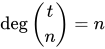
Problem: A polynomial has integer values for sufficiently large integer arguments if and only if it is a linear combination (over ) of binomial coefficients .


Since , for dimensional reason, if , then we can write:
![{\displaystyle f\in R[t]}](https://wikimedia.org/api/rest_v1/media/math/render/svg/74c12d95ac2c36275d6471d438d14a4daff2a030)

Applying finite differential operator to both sides d times, one finds that is an integer. By induction, are all integers then.



Problem: An integral domain is a PID if its prime ideals are principal. (Hint: apply Zorn's lemma to the set S of all non-principal prime ideals.)
Suppose, on the contrary, that S is nonempty. Then there is a a maximal element . We will reach a contradiction once we show . For that end, let . If , then, by maximality, . That is, it is principal; say,


- .

Let be an ideal consisting of such that . It turns out that


- .

Indeed, . Conversely, if , then and . Thus, . We now conclude that , for, otherwise, is principal.



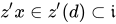


Problem: A ring is noetherian if and only if its prime ideals are finitely generated. (Hint: Zorn's lemma.)
The direction ( ) is obvious. For the converse, let be the set of all proper ideals of that are not finitely generated. We want to show is empty then. Suppose not. Then, by Zorn's lemma, contains a maximal element . It follows that is prime. To see that, let . If , then, by maximality, . That is, it is finitely generated; say,


- .

Let be an ideal consisting of such that . It turns out that
- .

In fact, if , then

Here, . We conclude that , for, otherwise, and thus are finitely generated.

Problem: Every nonempty set of prime ideals has a minimal element with respect to inclusion.
Problem: If an integral domain A is algebraic over a field F, then A is a field.
Since A is an integral domain, it is a subring of some field. Let . Then u is invertible in .


Problem: Every two elements in a UFD have a gcd.
Problem: If is a unit, then is nilpotent, where is the constant term of f.
![{\displaystyle f\in A[X]}](https://wikimedia.org/api/rest_v1/media/math/render/svg/c03fa6066f11e40bbef9e562dcec44275ecfcff8)


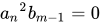
Let be the inverse of f. Then . Since , it follows . By obvious induction, for some r, we see kills every coefficient of ; hence, g. Thus, , meaning is nilpotent. Recall that the sum of a unit and a nilpotent element is a unit. Since is a unit, by applying the above argument, we see that is nilpotent. In the end, we conclude that is a sum of nilpotent elements; thus, nilpotent.








Problem: The nilradical and the Jacobson radical of coincide.
![{\displaystyle A[X]}](https://wikimedia.org/api/rest_v1/media/math/render/svg/40abd94a808a2369931fac9811cbd1cbdd44497d)
We only have to prove: if is in the Jacobson radical, then is nilpotent, since the converse is true for any ring. Recall that is a unit for every . In particular, is unit. Now use the previous problem to conclude is nilpotent.


Problem: Let A be a ring such that every ideal not contained in its nilradical contains an element e such that . Then the nilradical and the Jacobson radical of coincide.

In general, the nilradical is contained in the Jacobson radical. Suppose this inclusion is strict. Then by hypothesis there is a nonzero e such that . Since is a unit, , a contradiction.


Problem: is a unit if and only if the constant term of f is a unit.
![{\displaystyle f\in A[[X]]}](https://wikimedia.org/api/rest_v1/media/math/render/svg/e7cb27641d37a179a86bae106c0c97f0d44c5a95)
Real analysis edit
Problem: is irrational.

Let . Then . The equation can then be solved for
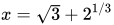
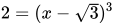

Problem: Is irrational?

Problem: Compute

Problem: If exists, then exists and
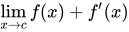

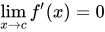
Apply L'Hospital's rule to

Problem: Let nonvanishing and such that , then

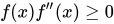
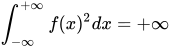
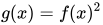
Derive twice , look at the asymptotic behaviour of .

Problem Let be a complete metric space, and be a function such that is a contraction. Then admits a fixed point.


By Banach's fixed point theorem, has a unique fixed point ; i.e., . But then



In other words, is also a fixed point of . By uniqueness, .


Problem Let be a compact metric space, and be such that

for all . Then admits a unique fixed point. (Do not use Banach's fixed point theorem.)

Let . By compactness, there is such that . If , then, by hypothesis, we have:



- ,

which is absurd. Thus, . For uniqueness, suppose . If , then



- ,

which is absurd. Hence, is the unique fixed point.
Problem Let be such that


then admits a unique fixed point.
Problem Let be a compact metric space, and be a contraction. Then

consists of exactly one point.
Since f is a contraction, it admits a fixed point . Thus, . Let . Then



for some sequence . Let c be the Lipschitz constant of f. Now,


which goes to 0 as since is bounded and and since for any by Banach's fixed point theorem.




Problem: Every closed subset of is separable.

Let be a countable dense subset of , and let


Then . In fact, since is a subset of for any , and so . Conversely, if , then for some ,


- .

Problem: Any connected nonempty subset of either consists of a single point or contains an irrational number.

Let be a connected nonempty subset of . Then is an interval with end-points a, b. If has more than one point, then contains a nonempty interval (a, b), which contains an irrational.

Problem: Let be a bounded function. is continuous if and only if has closed graph.

Problem: Let be a homeomorphism, then is monotone.
Problem Let be a continuous function. Then
![{\displaystyle f:[0,1]^{2}\to \mathbf {R} }](https://wikimedia.org/api/rest_v1/media/math/render/svg/96a4774b078f5c672a8a8c4ffb2470176ac5d7c5)
![{\displaystyle g(x)=\sup\{f(x,y)|y\in [0,1]\}\quad (x\in [0,1])}](https://wikimedia.org/api/rest_v1/media/math/render/svg/881962a2e1a42c4c02e0a1478810657c2fd85e48)
is continuous.
Let . Since is uniformly continuous, there is so that


- whenever


It follows that as well as when . Hence,



- .

Problem Let be continuous functions such that: for every . The equation has a solution if and only if has one.





( ) is trivial. For ( ), suppose we have so that . Define for . Then



- .

Thus, . If , then we are done. If , then, since , by the intermediate value theorem, for some . The same argument works for the case when .


Problem Suppose is uniformly continuous. Then there are constants such that:


for all .

There exists such that
- whenever .


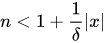
Let . Then for some integer . It follows:

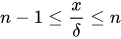


Here, . The estimate for is analogous.

Problem Let X be a compact metric space, and be an isometry: i.e., . Then f is a bijection.

f is clearly injective. To show f surjective, let . Since X is compact, contains a convergent subsequence, say, . Then



In other words, is in the closure of . Since the image of a closed set under an isometry is closed, we conclude: .


Problem Let be a sequence of polynomials with degree ≤ some fixed D. If converges pointwise to 0 on [0, 1], then converges uniformly on [0, 1].

We first prove a weaker statement:
- If converges pointwise on all but finitely many points in [0,1], then converges uniformly on all but finitely many points in [0,1].
We proceed by inducting on D. If D = 1, then the claim is obvious. Suppose it is true for D - 1. We write:

where is a point such that . Since the degree of is strictly less than that of , by inductive hypothesis, converges uniformly on the complement of some finite subset F of [0, 1]. Thus, converges on the complement of . This completes the proof of the claim. By the claim, converges uniformly except at some finitely many points. But since converges pointwise everywhere, it converges uniformly everywhere.


Problem On a closed interval a monotone function has at most countably many discontinuous points.
Problem Prove that in Rn the relation implies r > s and find a metric space when the implication doesn't hold.

Linear algebra edit
Throughout the section denotes a finite-dimensional vector space over the field of complex numbers.

Problem Given an , find a matrix with integer entries such that but


A permutation matrix.
Problem Let A be a real symmetric positive-definite matrix and b some fixed vector. Let . Then if and only if



Note that A is invertible. Fix and let . Then



Since , is the minimum of f.


Problem If for all square matrices , then


Take .

Problem Let x be a square matrix over a field of characteristic zero. If for all , then is nilpotent.


We may assume the field is algebraically closed. Suppose has nonzero distinct eigenvalues . The hypothesis then means that we have the system of linear equations:


Computing the determinant, we see the system has no nonzero solution, a contradiction.
Problem Let be square matrices of the same size. Then and have the same eigenvalues.


Let be an eigenvalue of . If , then . Thus, is an eigenvalue of . If , then for some nonzero . Thus, . Since implies , a contradiction, is an eigenvector. Hence, is an eigenvalue of . We thus proved that every eigenvalue of is an eigenvalue of . By the same argument, every eigenvalue of is an eigenvalue of .








Problem Let be square matrices of the same size. Then and have the same eigenvalues with same multiplicity.
If S is invertible, then

and thus
- .

If S is not invertible, then is invertible when is sufficiently small. Thus,



and letting gives the same identity. In any case, TS and ST share the same eigenvalues with same multiplicity.

Problem Let be a square matrix over complex numbers. A is a real symmetric matrix if and only if

is real for every x.
( ) is obvious. ( ) By hypothesis

Now recall that the numerical radius
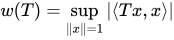
is a norm.
Problem Suppose the square matrix satisfies:

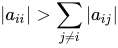
for all . Then is invertible.

Suppose . Then, in particular, each component of is zero; i.e.,



The inequality thus gives:


for all . Pick such that . Then, by hypothesis,

- ,

which is absurd, unless . Hence, .


Problem Let . If is finite-dimensional, then prove is invertible if and only if is invertible. Is this also true when is infinite-dimensional?

For the first part, use determinant. For the second, consider a shift operator.
Problem: Let be linear operators on . Then


The map

is well-defined. Hence,

Problem Every matrix (over an arbitrary field) is similar to its transpose.
The shortest proof would be to use a Smith normal form: a matrix A is similar to another matrix "B if and only if and have the same Smith normal form. Evidently, this is the case if B is the transpose of A.


Problem Every nonzero eigenvalue of a skew-symmetric matrix is pure imaginary.
Problem If the transpose of a matrix is zero, then is similar to a matrix with the main diagonal consisting of only zeros.
Problem for any square matrix .

Problem: Every square matrix is similar to an upper-triangular matrix.
Jordan form or Schur form.
Problem: Let A be a normal matrix. Then is a polynomial in A.

Problem: Let A be a normal matrix. Then:

Problem: Let A be a square matrix. Then (in operator norm) if and only if the spectral radius of


The Spectral radius formula.
Problem: Let A be a square matrix. Then
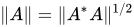
Problem: is a norm for bounded operators T on a "complex" Hilbert space.
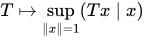
It is clear that the map is a seminorm. To see it is a norm, suppose for all x. In particular,



Combing the two we get:

for all x and y. Take and we get for all x.
