The electromagnetic field is defined in terms of the electric and magnetic fields as
F
=
E
+
i
c
B
.
{\displaystyle F=\mathbf {E} +ic\mathbf {B} .}
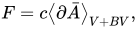
Alternatively, the fields can be derived from a paravector potential
A
{\displaystyle A}
F
=
c
⟨
∂
A
¯
⟩
V
+
B
V
,
{\displaystyle F=c\left\langle \partial {\bar {A}}\right\rangle _{V+BV},}
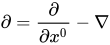
where:
∂
=
∂
∂
x
0
−
∇
{\displaystyle \partial ={\frac {\partial }{\partial x^{0}}}-\nabla }
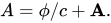
and
A
=
ϕ
/
c
+
A
.
{\displaystyle A=\phi /c+\mathbf {A} .}
Lorenz gauge
edit
The Lorenz gauge (without t) is expressed as
⟨
∂
A
¯
⟩
S
=
0
{\displaystyle \langle \partial {\bar {A}}\rangle _{S}=0}
The electromagnetic field
F
{\displaystyle F}
A
→
A
′
=
A
+
∂
χ
,
{\displaystyle A\rightarrow A^{\prime }=A+\partial \chi ,}
where
χ
{\displaystyle \chi }
∂
¯
∂
χ
=
0
{\displaystyle {\bar {\partial }}\partial \chi =0}
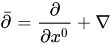
where
∂
¯
=
∂
∂
x
0
+
∇
{\displaystyle {\bar {\partial }}={\frac {\partial }{\partial x^{0}}}+\nabla }
Maxwell Equations
edit
The Maxwell equations can be expressed in a single equation
∂
¯
F
=
1
c
ϵ
j
¯
,
{\displaystyle {\bar {\partial }}F={\frac {1}{c\epsilon }}{\bar {j}},}
where the current
j
{\displaystyle j}
j
=
ρ
c
+
j
{\displaystyle j=\rho c+\mathbf {j} }
Decomposing in parts we have
Real scalar: Gauss's Law
Real vector: Ampere's Law
Imaginary scalar: No magnetic monopoles
Imaginary vector: Faraday's law of induction Electromagnetic Lagrangian
edit
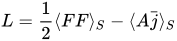
The electromagnetic Lagrangian that gives the Maxwell equations is
L
=
1
2
⟨
F
F
⟩
S
−
⟨
A
j
¯
⟩
S
{\displaystyle L={\frac {1}{2}}\langle FF\rangle _{S}-\langle A{\bar {j}}\rangle _{S}}
Energy density and Poynting vector
edit
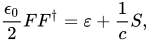
The energy density and Poynting vector can be extracted from
ϵ
0
2
F
F
†
=
ε
+
1
c
S
,
{\displaystyle {\frac {\epsilon _{0}}{2}}FF^{\dagger }=\varepsilon +{\frac {1}{c}}S,}
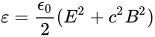
where energy density is
ε
=
ϵ
0
2
(
E
2
+
c
2
B
2
)
{\displaystyle \varepsilon ={\frac {\epsilon _{0}}{2}}(E^{2}+c^{2}B^{2})}
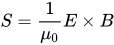
and the Poynting vector is
S
=
1
μ
0
E
×
B
{\displaystyle S={\frac {1}{\mu _{0}}}E\times B}
Lorentz Force
edit
The electromagnetic field plays the role of a spacetime rotation with
Ω
=
e
m
c
F
{\displaystyle \Omega ={\frac {e}{mc}}F}
The Lorentz force equation becomes
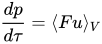
d
p
d
τ
=
⟨
F
u
⟩
V
{\displaystyle {\frac {dp}{d\tau }}=\langle Fu\rangle _{V}}
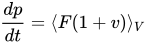
or equivalently
d
p
d
t
=
⟨
F
(
1
+
v
)
⟩
V
{\displaystyle {\frac {dp}{dt}}=\langle F(1+v)\rangle _{V}}
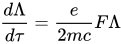
and the Lorentz force in spinor form is
d
Λ
d
τ
=
e
2
m
c
F
Λ
{\displaystyle {\frac {d\Lambda }{d\tau }}={\frac {e}{2mc}}F\Lambda }
Lorentz Force Lagrangian
edit
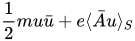
The Lagrangian that gives the Lorentz Force is
1
2
m
u
u
¯
+
e
⟨
A
¯
u
⟩
S
{\displaystyle {\frac {1}{2}}mu{\bar {u}}+e\langle {\bar {A}}u\rangle _{S}}
Plane electromagnetic waves
edit
The propagation paravector is defined as
k
=
ω
c
+
k
,
{\displaystyle k={\frac {\omega }{c}}+\mathbf {k} ,}
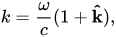
which is a null paravector that can be written in terms of the unit vector
k
{\displaystyle \mathbf {k} }
k
=
ω
c
(
1
+
k
^
)
,
{\displaystyle k={\frac {\omega }{c}}(1+\mathbf {\hat {k}} ),}
A vector potential that gives origin to a polarization|circularly polarized plane wave of left helicity is
A
=
e
i
s
k
^
a
,
{\displaystyle A=e^{is\mathbf {\hat {k}} }\mathbf {a} ,}
where the phase is
s
=
⟨
k
x
¯
⟩
S
=
ω
t
−
k
⋅
x
{\displaystyle s=\left\langle k{\bar {x}}\right\rangle _{S}=\omega t-\mathbf {k} \cdot \mathbf {x} }
and
a
{\displaystyle \mathbf {a} }
k
{\displaystyle \mathbf {k} }
The electromagnetic field of this paravector potential is calculated as
F
=
i
c
k
A
,
{\displaystyle F=ickA_{{}_{}},}
which is nilpotent
F
F
=
0
{\displaystyle FF_{{}_{}}=0}