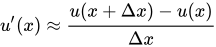
The finite difference method is a basic numeric method which is based on the approximation of a derivative as a difference quotient. We all know that, by definition:
The basic idea is that if is "small", then
Similarly,
It's a step backwards from calculus. Instead of taking the limit and getting the exact rate of change, we approximate the derivative as a difference quotient. Generally, the "difference" showing up in the difference quotient (ie, the quantity in the numeriator) is called a finite difference which is a discrete analog of the derivative and approximates the derivative when divided by .
Replacing all of the derivatives in a differential equation ditches differentiation and results in algebraic equations, which may be coupled depending on how the discretization is applied.
For example, the equation
may be discretized into:
This discretization is nice because the "next" value (temporally) may be expressed in terms of "older" values at different positions.