
Ordinary Differential Equations/Without x or y
Equations without y edit
Consider a differential equation of the form
.

If we can solve for y', then we can simply integrate the equation to get the a solution in the form y=f(x). However, sometimes it may be easier to solve for x. In that case, we get

Then differentiating by y,
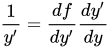
Which makes it become
.
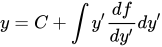
The two equations
and
is a parametric solution in terms of y'. To obtain an explicit solution, we eliminate y' between the two equations.
If it is possible to express
parametrically as ,

then one can differentiate the first equation:
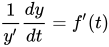
So that
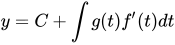
to obtain a parametric solution in terms of . If it is possible to eliminate , then one can obtain an integral solution.

Equations without x edit
Similarly, if the equation
.

can be solved for y, write y=f(y'). Then the following solution, which can be obtained by the same process as above is the parametric solution:

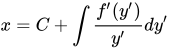
In addition, if one can express y and y' parametrically

then the parametric solution is

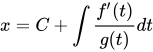
so that if the parameter can be eliminated, then one can obtain an integral solution.