On 2D Inverse Problems/Special matrices
An important object containing information about a weighted graph G(V,E,w) is its Laplacian matrix. Given a numbering of the vertices of the graph, it's an n by n square matrix LG, where n is the number of vertices in the graph, with the entries:
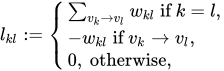
where vk → vl means that there is a directed edge from vertex vk to the vertex vl, and where w is the weight function.
- Exercise (*). Given a directed graph G without cycles, prove that one can number its vertices so that the corresponding Laplacian matrix LG is triangular.
Given a weighted graph with boundary it is often convenient to number its boundary vertices first and to write its Laplacian matrix in the block form.
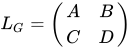
The Schur complement of the matrix w/respect of the invertible block D is the matrix


- Exercise (*). Prove the following determinant identity:

The following matrix W(G) consisting of random walk exiting probabilities (sums over weighted paths in a graph) plays an important role as boundary measurement for inverse problems. Suppose a weighted graph G has N boundary nodes, then the kl 'th entry of the N by N matrix equals to the probability that the first boundary vertex, that a particle starting its random walk at the boundary vertex vk occupies, is the boundary vertex vl. For a finite connected graph the columns of the matrix W(G) add up to 1.
- Exercise (**). Derive an explicit formula for the matrix in terms of the blocks of Laplace matrix of the graph G:


- Exercise (***). Prove the following expansion formulas for entries and blocks of the matrix W(G),
- for two boundary vertices pk and pl of a graph G
![{\displaystyle w_{kl}=\sum _{v_{k}{\xrightarrow[{}]{path}}v_{l}}\prod _{e=(p,q)\in path}w(e)/l_{pp},}](https://wikimedia.org/api/rest_v1/media/math/render/svg/393e0e98b79daae573e107a536682304af354c00)
Hint: use the Leibniz definition of the determinant
- for two distinct boundary vertices vk and vl of a graph G

where

- for two disjoint subsets of boundary vertices P and Q of size n of a graph G, see [6],[7] and [14]

where

The exercises above provide a bridge b/w connectivity property of graph G and ranks of submatrices of its Laplacian matrix L(G) and the matrix of hitting probabilities W(G).
- Exercise (*). Let G be a planar graph w/natural boundary, numbered circulary. Let P and Q be two non-interlacing subsets of boundary nodes of size n. Prove that

w/the strict inequality iff there is a disjoint set of paths from P to Q.
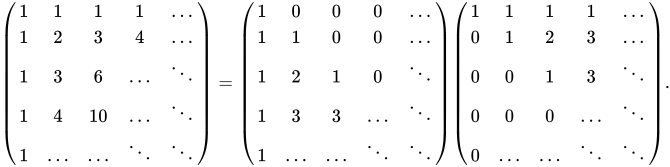
- Exercise (*). Show that the numbers of paths in the following graph are equal to the binomial coefficients.
.jpg)
Gluing the graphs w/out loops corresponds to multiplication of the weighted paths matrices.
- Exercise (**). Use the result of the previous exercise to it to prove the following Pascal triangle identity, see[13],