
On 2D Inverse Problems/Riemann mapping theorem
For every proper simply connected open subset U of the complex plane C there exists a one-to-one conformal Riemann map from U onto the open unit disk D. Since the composition of harmonic and analytic function is harmonic, the Riemann map provides a one-to-one correspondence b/w harmonic functions defined on the set U and on the disc D. Therefore, one can transfer a solution of Dirichlet boundary problem on the set D to the domain U.
Let be a Riemann map for the region U, the kernel of the Dirichlet-to-Neumann map for the region U can be expressed in terms of the kernel for the disc.

- Exercise (*). Proof that off the diagonal.

The Cayley transform maps the complex right half-plane onto the unit disc.
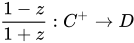
- Exercise (**). Derive the formula for the kernel of the DN map for the unit disc D: w/the kernel formula for the half-plane and the radial derivative of the Poisson kernel,solving Dirichlet boundary problem on the disc:

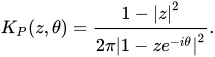
In order to solve a continuous inverse problem by data discretisation, one may obtain Dirichlet-to-Neumann (DN) matrix by uniform sampling of the kernel off the diagonal, and by defining the diagonal entries so, that rows and columns of the DN matrix sum up to zero. This leads to the following definition of the matrix in the case of the unit disc:
where n is a natural number and k,l = 1,2, ... 2n+1.

- Exercise (**). Prove that the eigenvalues of the matrix are natural numbers(!) w/multiplicity two and 0 w/multiplicity one.
