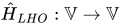
Definition: Linear Harmonic Oscillator Hamiltonian
edit
Definition: Anihilation Operator
edit
Anihilation Operator  is defined as

Definition: Creation Operator
edit
Creation Operator  is defined as

Theorem: a, a+ compound expressions
edit
Lets assume Linear Harmonic Oscillator Hamiltonian. Then
![{\displaystyle {\hat {a}}[{\hat {a}}^{+}(|n>)]={\frac {{\hat {H}}(|n>)}{\hbar \omega }}+{\frac {{\hat {1}}(|n>)}{2}},\qquad {\hat {a}}^{+}[{\hat {a}}(|n>)]={\frac {{\hat {H}}(|n>)}{\hbar \omega }}-{\frac {{\hat {1}}(|n>)}{2}},}](https://wikimedia.org/api/rest_v1/media/math/render/svg/05fdd5398fc96b43cb68c23b474fc0ac8cdc331f)
Proof:
Directly form a, a+ definitions with respect to LHO Hamiltonian definition and [x,p] commutator
![{\displaystyle a[a^{+}(|n>)]{\overset {def\,a,a^{+}}{=}}\left({\sqrt {\frac {m\omega }{2\hbar }}}{\hat {x}}+i{\sqrt {\frac {1}{2\hbar m\omega }}}{\hat {p}}\right)\left({\sqrt {\frac {m\omega }{2\hbar }}}{\hat {x}}-i{\sqrt {\frac {1}{2\hbar m\omega }}}{\hat {p}}\right)=}](https://wikimedia.org/api/rest_v1/media/math/render/svg/7c67121e73d11c6514f7d94749d69db068b2028e)
![{\displaystyle ={\frac {m\omega }{2\hbar }}{\hat {x}}^{2}(|n>)-i^{2}{\frac {1}{2\hbar m\omega }}{\hat {p}}^{2}(|n>)-i{\sqrt {\frac {m\omega }{2\hbar }}}{\sqrt {\frac {1}{2\hbar m\omega }}}{\hat {x}}[{\hat {p}}(|n>)]+i{\sqrt {\frac {m\omega }{2\hbar }}}{\sqrt {\frac {1}{2\hbar m\omega }}}{\hat {p}}[{\hat {x}}(|n>)]=}](https://wikimedia.org/api/rest_v1/media/math/render/svg/5238c0a70c8af35f0b61e8d69974271f498c8e20)

![{\displaystyle ={\frac {\hat {H}}{2\hbar \omega }}-{\frac {i}{2\hbar }}[{\hat {x}},{\hat {p}}]|n>={\frac {\hat {H}}{2\hbar \omega }}-{\frac {i}{2\hbar }}(i\hbar {\hat {1}})|n>={\frac {{\hat {H}}|n>}{2\hbar \omega }}+{\frac {{\hat {1}}|n>}{2}}}](https://wikimedia.org/api/rest_v1/media/math/render/svg/94144cabd6dd71d4a783e9e81b78747d5c145261)
Theorem: H,a,a+ commutators
edit
Lets assume Linear Harmonic Oscillator Hamiltonian. Then
={\hat {1}}(|n>),\qquad [{\hat {H}},{\hat {a}}^{+}](|n>)=\hbar \omega {\hat {a}}^{+}(|n>)\qquad [{\hat {H}},{\hat {a}}](|n>)=-\hbar \omega {\hat {a}}(|n>)}](https://wikimedia.org/api/rest_v1/media/math/render/svg/056e894d4b8086054fe6626349dfc0a5bfda133d)
Proof:
The first expression may be evaluated from commutator definition directly from a, a+ compound expression theorem
![{\displaystyle [{\hat {a}},{\hat {a}}^{+}]={\hat {a}}{\hat {a}}^{+}-{\hat {a}}^{+}{\hat {a}}{\overset {theorem}{=}}{\frac {{\hat {H}}|n>}{2\hbar \omega }}+{\frac {{\hat {1}}|n>}{2}}-{\frac {{\hat {H}}|n>}{2\hbar \omega }}-{\frac {{\hat {1}}|n>}{2}}={\hat {1}}|n>}](https://wikimedia.org/api/rest_v1/media/math/render/svg/06626ff8f25b23542e22891977b011f0435e0857)
The second and the third expressions needs 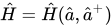 first, which can be obtained from a,a+ compound expression theorem again: