
Mathematical Proof/Appendix/Symbols Used in this Book
This is a list of all the mathematical symbols used in this book.
![{\displaystyle [a,b]}](https://wikimedia.org/api/rest_v1/media/math/render/svg/9c4b788fc5c637e26ee98b45f89a5c08c85f7935)
- Closed interval notation. Signifies the set of all numbers between a and b (a and b included)

- A logical "or" connector. A truth statement whose truth value is true if either of the two given statements is true and false if they are both false.


- A logical "and" connector. A truth statement whose truth value is true only if both of the two given statements is true and false otherwise.


- A logical "not" unary operator. A truth statement whose value is opposite of the given statement.

{ }
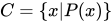
- Set delimiters. A set may be defined explicitly (e.g. ), or pseudo-explicitly by giving a pattern (e.g. . It may also be defined with a given rule (e.g. , the set of all x such that P(x) is true).



- The "element of" binary operator. This shows element inclusion in a set. If x is an element of A we write


- The "set inclusion" or "subset" binary operator. If all the elements of A are in B, then we say that A is a subset of B and write Note that in this book, when


- The union of two sets. A set containing all elements of two given sets.


- The intersection of two sets. A set containing all the elements that are in both of two given sets.
