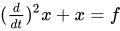
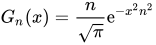
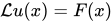
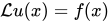
A Green's function for a linear operator over is a real function such that is solved by ; where symbolizes convolution. Hence, so that is a right inverse of and is a particular solution to the inhomogeneous equation.
For example: is solved by
Such a function might not exist and when it does might not be unique. The conditions under which this method is valid require careful examination. However, the theory of Green's functions obtains a more complete and regular form over the theory of distributions, or generalized functions.
As will be seen, the theory of Green's functions provides an extremely elegant procedure of solving differential equations. We wish to present here this method on a rigorous foundation.
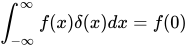
The Dirac delta-function is not a function as it is ordinarily defined. However, we write it as if it were a function, keeping in mind the scope of the definition.
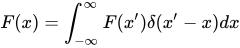
For any function ,we define
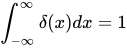
but for every ,
It follows that
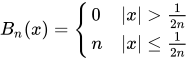
These conditions seem to be satisfied by a "function" which has value zero whenever , but has "infinite" value at
Consider an equation of the type ...(1), where is a differential operator. The functions may in general be functions of several independents, but for sake of clarity, we will write them here as if they were real valued. In most cases of interest, this equation can be written in the form
to be solved for in some closed set , with being non-zero over
Now, it so happens, that in problems of physics, it is much more convenient to solve the equation , when is the delta function .
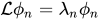
In this case, the solution of the operator is called the Green's function. That is,
Now, by the definition of the delta-function, we have that , where act as "weights" to the delta function.
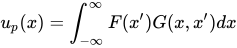
Hence, we have,
Note here that is an operator that depends on but not . Thus,
. We can view this as analogous to the inversion of and hence, we write
The subscript denotes that we have found a particular solution among the many possible. For example, consider any harmonic solution .
If we add , we see that is still a solution of (1). Thus, we have a class of functions satisfying (1).
Problems of physics are often presented as the operator equation to be solved for on a closed set , together with the boundary condition that for all ( is the boundary of ).
is a given function satisfying that describes the behaviour of the solution at the boundary of the region of concern.