
Linear Algebra/Factoring and Complex Numbers: A Review
This subsection is a review only and we take the main results as known. For proofs, see (Birkhoff & MacLane 1965) or (Ebbinghaus 1990).
Just as integers have a division operation— e.g., " goes times into with remainder "— so do polynomials.


- Theorem 1.1 (Division Theorem for Polynomials)
Let be a polynomial. If is a non-zero polynomial then there are quotient and remainder polynomials and such that



where the degree of is strictly less than the degree of .
In this book constant polynomials, including the zero polynomial, are said to have degree . (This is not the standard definition, but it is convienent here.)

The point of the integer division statement " goes times into with remainder " is that the remainder is less than — while goes times, it does not go times. In the same way, the point of the polynomial division statement is its final clause.

- Example 1.2
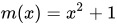
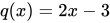
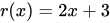
If and then and . Note that has a lower degree than .

- Corollary 1.3
The remainder when is divided by is the constant polynomial .


- Proof
The remainder must be a constant polynomial because it is of degree less than the divisor , To determine the constant, take from the theorem to be and substitute for to get .



If a divisor goes into a dividend evenly, meaning that is the zero polynomial, then is a factor of . Any root of the factor (any such that ) is a root of since . The prior corollary immediately yields the following converse.



- Corollary 1.4
If is a root of the polynomial then divides evenly, that is, is a factor of .
Finding the roots and factors of a high-degree polynomial can be hard. But for second-degree polynomials we have the quadratic formula: the roots of are


(if the discriminant is negative then the polynomial has no real number roots). A polynomial that cannot be factored into two lower-degree polynomials with real number coefficients is irreducible over the reals.

- Theorem 1.5
Any constant or linear polynomial is irreducible over the reals. A quadratic polynomial is irreducible over the reals if and only if its discriminant is negative. No cubic or higher-degree polynomial is irreducible over the reals.
- Corollary 1.6
Any polynomial with real coefficients can be factored into linear and irreducible quadratic polynomials. That factorization is unique; any two factorizations have the same powers of the same factors.
Note the analogy with the prime factorization of integers. In both cases, the uniqueness clause is very useful.
- Example 1.7
Because of uniqueness we know, without multiplying them out, that does not equal .


- Example 1.8
By uniqueness, if then where and , we know that .




While has no real roots and so doesn't factor over the real numbers, if we imagine a root— traditionally denoted so that — then factors into a product of linears .


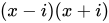
So we adjoin this root to the reals and close the new system with respect to addition, multiplication, etc. (i.e., we also add , and , and , etc., putting in all linear combinations of and ). We then get a new structure, the complex numbers, denoted .


In we can factor (obviously, at least some) quadratics that would be irreducible if we were to stick to the real numbers. Surprisingly, in we can not only factor and its close relatives, we can factor any quadratic.

- Example 1.9
The second degree polynomial factors over the complex numbers into the product of two first degree polynomials.


- Corollary 1.10 (Fundamental Theorem of Algebra)
Polynomials with complex coefficients factor into linear polynomials with complex coefficients. The factorization is unique.
References edit
- Ebbinghaus, H. D. (1990), Numbers, Springer-Verlag.
- Birkhoff, Garrett; MacLane, Saunders (1965), Survey of Modern Algebra (Third ed.), Macmillian.