
Linear Algebra/Changing Representations of Vectors
In converting to the underlying vector doesn't change. Thus, this translation is accomplished by the identity map on the space, described so that the domain space vectors are represented with respect to and the codomain space vectors are represented with respect to .


(The diagram is vertical to fit with the ones in the next subsection.)
- Definition 1.1
The change of basis matrixfor bases is the representation of the identity map with respect to those bases.


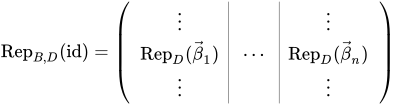
- Lemma 1.2
Left-multiplication by the change of basis matrix for converts a representation with respect to to one with respect to . Conversly, if left-multiplication by a matrix changes bases then is a change of basis matrix.



- Proof
For the first sentence, for each , as matrix-vector multiplication represents a map application, . For the second sentence, with respect to the matrix represents some linear map, whose action is , and is therefore the identity map.


- Example 1.3
With these bases for ,


because

the change of basis matrix is this.

We can see this matrix at work by finding the two representations of


and checking that the conversion goes as expected.

We finish this subsection by recognizing that the change of basis matrices are familiar.
- Lemma 1.4
A matrix changes bases if and only if it is nonsingular.
- Proof
For one direction, if left-multiplication by a matrix changes bases then the matrix represents an invertible function, simply because the function is inverted by changing the bases back. Such a matrix is itself invertible, and so nonsingular.
To finish, we will show that any nonsingular matrix performs a change of basis operation from any given starting basis to some ending basis. Because the matrix is nonsingular, it will Gauss-Jordan reduce to the identity, so there are elementatry reduction matrices such that . Elementary matrices are invertible and their inverses are also elementary, so multiplying from the left first by , then by , etc., gives as a product of elementary matrices . Thus, we will be done if we show that elementary matrices change a given basis to another basis, for then changes to some other basis , and changes to some , ..., and the net effect is that changes to . We will prove this about elementary matrices by covering the three types as separate cases.






Applying a row-multiplication matrix
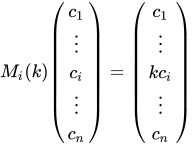
changes a representation with respect to to one with respect to in this way.




Similarly, left-multiplication by a row-swap matrix changes a representation with respect to the basis into one with respect to the basis in this way.





And, a representation with respect to changes via left-multiplication by a row-combination matrix into a representation with respect to




(the definition of reduction matrices specifies that and and so this last one is a basis).


- Corollary 1.5
A matrix is nonsingular if and only if it represents the identity map with respect to some pair of bases.
In the next subsection we will see how to translate among representations of maps, that is, how to change to . The above corollary is a special case of this, where the domain and range are the same space, and where the map is the identity map.


Exercises edit
- This exercise is recommended for all readers.
- Problem 1
In , where
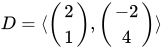
find the change of basis matrices from to and from to . Multiply the two.

- This exercise is recommended for all readers.
- Problem 2
Find the change of basis matrix for .

- ,
- ,
- ,
- ,


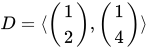
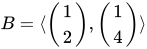

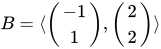
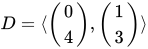
- Problem 3
For the bases in Problem 2, find the change of basis matrix in the other direction, from to .
- This exercise is recommended for all readers.
- Problem 4
Find the change of basis matrix for each .




- This exercise is recommended for all readers.
- Problem 5
Decide if each changes bases on . To what basis is changed?


- Problem 6
Find bases such that this matrix represents the identity map with respect to those bases.
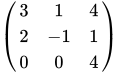
- Problem 7
Conside the vector space of real-valued functions with basis . Show that is also a basis for this space. Find the change of basis matrix in each direction.


- Problem 8
Where does this matrix
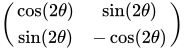
send the standard basis for ? Any other bases? Hint. Consider the inverse.
- This exercise is recommended for all readers.
- Problem 9
What is the change of basis matrix with respect to ?

- Problem 10
Prove that a matrix changes bases if and only if it is invertible.
- Problem 11
Finish the proof of Lemma 1.4.
- This exercise is recommended for all readers.
- Problem 12
Let be a nonsingular matrix. What basis of does change to the standard basis?


- This exercise is recommended for all readers.
- Problem 13
- In with basis
we have this
represenatation.
- State and prove that any nonzero vector representation can be changed to any other.


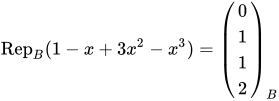
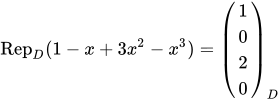
Hint. The proof of Lemma 1.4 is constructive— it not only says the bases change, it shows how they change.
- Problem 14
Let be vector spaces, and let be bases for and be bases for . Where is linear, find a formula relating to .


- This exercise is recommended for all readers.
- Problem 15
Show that the columns of an change of basis matrix form a basis for . Do all bases appear in that way: can the vectors from any basis make the columns of a change of basis matrix?
- This exercise is recommended for all readers.
- Problem 16
Find a matrix having this effect.
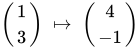
That is, find a that left-multiplies the starting vector to yield the ending vector. Is there a matrix having these two effects?


Give a necessary and sufficient condition for there to be a matrix such that and .

