Introduction to Mathematical Physics/N body problem in quantum mechanics/Crystals
Bloch's theorem edit
sectheobloch
Consider following spectral problem:
Problem:
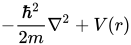
Find and such that


![{\displaystyle [-{\frac {\hbar ^{2}}{2m}}\nabla ^{2}+V(r)]\psi (r)=\epsilon \psi (r)}](https://wikimedia.org/api/rest_v1/media/math/render/svg/a6dd584a4a447af7cb66e4711f6421b0fa35e974)
where is a periodical function.

Bloch's theorem [ma:equad:Dautray5], [ph:solid:Kittel67], [ph:physt:Diu89] allows\index{Bloch theorem} to look for eigenfunctions under a form that takes into account symmetries of considered problem.
Theorem:
theobloch


with (function has the lattice's periodicity).


Proof:
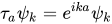
Operator commutes with translations defined by . Eigenfunctions of are such that: {IMP/label




Properties of Fourier transform\index{Fourier transform} allow to evaluate the eigenvalues of . Indeed, equation tra can be written:

where is the space convolution. Applying a Fourier transform to previous equation yields to:


That is the eigenvalue is with [1]. On another hand, eigenfunction can always be written:



Since is periodical[2] theorem is proved. }}
Free electron model edit
Hamiltonian can be written ([ph:solid:Kittel67],[ph:solid:Callaway64]) here:
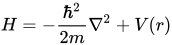
where is the potential of a periodical box of period (see figure figpotperioboit) figeneeleclib.


Eigenfunctions of are eigenfunctions of (translation invariance) that verify boundary conditions. Bloch's theorem implies that can be written:


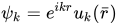
where is a function that has crystal's symmetry\index{crystal}, that means it is translation invariant:


Here (see [ph:solid:Callaway64]), any function that can be written

is valid. Injecting this last equation into Schr\"odinger equation yields to following energy expression:
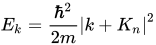
where can take values , where is lattice's period and is an integer. Plot of as a function of is represented in figure figeneeleclib.


Quasi-free electron model edit
Let us show that if the potential is no more the potential of a periodic box, degeneracy at is erased. Consider for instance a potential defined by the sum of the box periodic potential plus a periodic perturbation:



In the free electron model functions
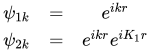
are degenerated. Diagonalization of Hamiltonian in this basis (perturbation method for solving spectral problems, see section chapresospec) shows that degeneracy is erased by the perturbation.
Thigh binding model edit
Tight binding approximation [ph:solid:Ashcroft76] consists in approximating the state space by the space spanned by atomic orbitals centred at each node of the lattice. That is, each eigenfunction is assumed to be of the form:
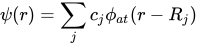
Application of Bloch's theorem yields to look for such that it can be written:


Identifying and , it can be shown that . Once more, symmetry considerations fully determine the eigenvectors. Energies are evaluated from the expression of the Hamiltonian. Please refer to [ph:solid:Ashcroft76] for more details.