This case corresponds to the study of hydrogen atom.\index{atom} It is a
particular case of particle in a central potential problem, so that we apply
methods presented at section #secpotcent to treat this
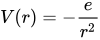
problem. Potential is here:
eqpotcenhy
It can be shown that eigenvalues of hamiltonian
with central potential depend in general on two quantum numbers
and
,
but that for particular potential given by
equation eqpotcenhy, eigenvalues depend only on sum
.
We treat in this section the particle in a central potential problem ([#References|references]). The spectral
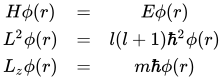
problem to be solved is given by the following equation:
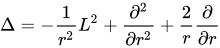
Laplacian operator can be expressed as a function of operator.
Theorem:
Laplacian operator can be written as:
Proof:
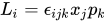
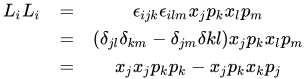
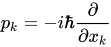
Here, tensorial notations are used (Einstein convention). By definition:
So:
The writing order of the operators is very important because operator do not
commute. They obey following commutation relations:
we look for a function that diagonalizes simultaneously
that is such that:
Spherical harmonics can be introduced now:
Definition:
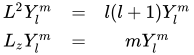
Spherical harmonics are eigenfunctions common to
operators and . It can be shown that:
Looking for a solution that can\footnote{Group theory
argument should be used to prove that solution actually are of this
form.} be written (variable separation):
problem becomes one dimensional:
eqaonedimrr
where is indexed by only.
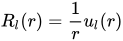
Using the following change of variable:
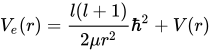
, one gets the following spectral equation:
where
The problem is then reduced to the study of
the movement of a particle in an effective potential . To go
forward in the solving of this problem, the expression of
potential is
needed. Particular case of hydrogen introduced at section sechydrog corresponds to a potential proportional to
and leads to an accidental degeneracy.
This approximation consists in considering each electron as moving in a mean
central potential and in neglecting spin--orbit interaction. It is a ``mean
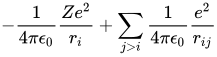
field approximation. The electrostatic interaction term
is modelized by the sum , where is the mean potential
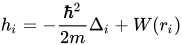
acting on particle . The hamiltonian can thus be written:
where .
Remark:
More precisely, is the linear operator acting in the tensorial
product space and defined by its action on function that are
tensorial products:
It is then sufficient to solve the spectral problem in a space
for operator . Physical kets are then constructed by
anti symmetrisation (see example exmppauli of chapter chapmq) in
order to satisfy Pauli principle.\index{Pauli}
The problem is a central potential problem (see section #secpotcent). However, potential is not like as in the
hydrogen atom case and thus the accidental degeneracy is not
observed here. The energy depends on two quantum numbers (relative
to kinetic
moment) and (rising from the radial equation eqaonedimrr).
Eigenstates in this approximation are called electronic configurations.
Example:
For the helium atom, the fundamental level corresponds to an electronic
configuration noted . A physical ket is obtained by anti symetrisation of
vector:
where
represents a correction to
due to the interactions between electrons. Solving of spectral problem associated to
using perturbative method is now presented.
Remark:
It is here assumed that
.
This assumption is called
--
coupling approximation.
To diagonalize
in the space spanned by the eigenvectors of
,
it is worth to consider problem's symmetries in order to simplify the spectral problem. It can be shown that operators
,
,
and
form a complete set of observables that commute.
Example:
Consider again the helium atom ([ph:mecaq:Cohen73]).
From the symmetries of the problem, the basis chosen is:
where
is the quantum number associated to the total kinetic
moment\index{kinetic moment}:
and is the quantum number associated to total spin of the
system\index{spin}:
Moreover, one has:
and
Table Tab. tabpauli represents in each box the value of for all possible values of
and
.
\begin{table}[hbt]
tabpauli
Theorem:
theopair
For an atom with two electrons, states such that is odd are excluded.
Proof:
We will proof this result using symmetries. We have:
Coefficients are called
Glebsh-Gordan\index{Glesh-Gordan coefficients} coefficients. If , it
can be shown (see ([ph:mecaq:Cohen73]) that:
can be solved considering
as a perturbation of
.
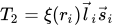
It can be shown ([ph:atomi:Cagnac71]) that operator can be written
. It can also be shown that operator
commutes with
.
Operator
will have thus to be diagonilized using eigenvectors
common to operators
and
. each state is labelled by:
where
are azimuthal quantum numbers associated with operators
.



![{\displaystyle -[{\frac {\hbar ^{2}}{2\mu }}\Delta +V(r)]\phi (r)=E\phi (r).}](https://wikimedia.org/api/rest_v1/media/math/render/svg/7b0013fa9db2dede0de9c7896e393397947aa54f)


![{\displaystyle [x_{i},p_{j}]=i\hbar \delta _{ij}}](https://wikimedia.org/api/rest_v1/media/math/render/svg/753921a44bc7d6b8a27297b359760a472e6b7596)
![{\displaystyle [x_{j},x_{k}]=0}](https://wikimedia.org/api/rest_v1/media/math/render/svg/74d31a8d054100bfbbbb5322621a53ed53eca4ec)
![{\displaystyle [p_{j},p_{k}]=0}](https://wikimedia.org/api/rest_v1/media/math/render/svg/bfd4617fa4bf3f818247af862f5b5f9b05aaed20)

![{\displaystyle {\begin{matrix}x_{j}p_{k}x_{k}p_{j}&=&[i\hbar \delta _{ik}+p_{k}x_{j}]x_{k}p_{j}\\&=&i\hbar x_{k}p_{k}+p_{k}x_{j}x_{k}p_{j}\\&=&i\hbar x_{k}p_{k}+p_{k}x_{k}x_{j}p_{j}\end{matrix}}}](https://wikimedia.org/api/rest_v1/media/math/render/svg/ea4f75a297a6491b3b8d6065f20ae6bf9075d390)









![{\displaystyle -[{\frac {\hbar ^{2}}{2\mu }}({\frac {d^{2}}{dr^{2}}}+{\frac {2}{r}}{\frac {\partial }{\partial r}})+{\frac {l(l+1)}{2\mu r^{2}}}\hbar ^{2}+V(r)]R_{l}(r)=E_{kl}R_{l}(r)}](https://wikimedia.org/api/rest_v1/media/math/render/svg/8ecc517022529bfb5edfcca7fbde45c134a8749b)

![{\displaystyle -[{\frac {\hbar ^{2}}{2\mu }}{\frac {d^{2}}{dr^{2}}}+V_{e}(r)]u_{kl}(r)=E_{kl}u_{kl}(r)}](https://wikimedia.org/api/rest_v1/media/math/render/svg/710d21aac88088d991d590cfe6021b7b1b42f7b5)








=h_{i}(\phi _{1})\otimes \dots \phi _{N}}](https://wikimedia.org/api/rest_v1/media/math/render/svg/5dcb3e32a72b96cba903b6eb61bf01db478c4a0c)