
Fundamentals of Physics/Motion in One Dimension
The goal of one dimensional motion is to understand how acceleration (), drives changes in speed () and position () along a single direction of motion (one-dimension). An "object" means anything that can move, like a ball, car, truck, or person. One-dimensional means the object will only move along a straight line, typically along the -axis if it's moving left or right or -axis if it's moving up or down. There are two equations you need for this,


,
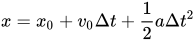
and the second is
.

If the object is at with speed , then and will be the object's new position and speed at some time interval later. These two equations allow you to compute the new position and speed of an object ( and ), based on its old position and speed ( and ), given some acceleration that is acting on the object, over a time interval . is sometimes called the "time step" and is a small interval of time that separates when the object has and , and when it will have and .


We said that drives changes in and . Notice in these equations if , then , meaning that doesn't change between time steps; is constant if . In order for to change, must be nonzero. In other words, an object's speed can change only if it has an acceleration. For the -axis (left-right motion), we have that



and
.

For the -axis (up-down motion), we have that

and
.

These equations are the same, just the notation is different, being very specific as to which axis it pertains.
A numerical example edit
As an example, Suppose you have a sphere at m with speed m/s and an acceleration of m/s . When the next frame comes up, say s later, where will the sphere be and what will its speed be? Use the equations to get that or m and or m/s. Be sure you see how the equations allowed you to compute the new position and speed of the object over the time step . You can iteratively use this new and as a new and (i.e. and ) for computing still another and another in the future. Can you find and after another has gone by? In the Figure 3.22 find the acceleration of the masses and the tension in the string.







Signs edit
Be very aware of signs. Think of a cartesian coordinate system with to the right, to the left, up and down (assume is always positive). Positive values of position mean the object is to the right ( ), or up ( ) relative to the origin. Negative means the object is left ( ) (or down, ) relative to the origin. Positive values of speed mean the object is moving toward the right ( ) or up ( ), negative means to the left ( ) or down ( ). The sign of alone doesn't immediately help to characterize the object's motion. If, however, and have the same sign, will predict an increase in (that is if and have the same sign, an object will speed up). Likewise, an object will slow down if and have opposite signs.


A case where opposite signs of and persist means will get smaller and smaller, until eventually at which case the object will stop. If still persists, then will begin to increase in the same direction as ; now the object is speeding up, but in the opposite direction to its original motion. All told the object slowed down, stopped, then started speeding up in the opposite direction. All combinations of signs between and are possible. and is a slow-down and potential turn-around case, as is and . and or and are speed up cases, but in opposite directions. Lastly, you should be able to draw arrows on an object, representing its and and that instant. The arrow should point in the direction of a given parameter and its length should be proportional to its strength. For example, if on an object the arrow for and the arrow for were opposite, you'd know the object was slowing down.


