
Fractals/Iterations in the complex plane/q-iterations
Iteration in mathematics refer to the process of iterating a function i.e. applying a function repeatedly, using the output from one iteration as the input to the next.[1] Iteration of apparently simple functions can produce complex behaviours and difficult problems.[2]

Applications edit
One can make inverse ( backward iteration) :
- of repeller for drawing Julia set ( IIM/J)[3]
- of circle outside Jlia set (radius=ER) for drawing level curves of escape time ( which tend to Julia set)[4]
- of circle inside Julia set (radius=AR) for drawing level curves of attract time ( which tend to Julia set)[5]
- of critical orbit ( in Siegel disc case) for drawing Julia set ( probably only in case of Goldem Mean )
- for drawing external ray
Repellor for forward iteration is attractor for backward iteration
Notes edit
- Iteration is always on the dynamic plane.
- There is no dynamic on the parameter plane.
- Mandelbrot set carries no dynamics. It is a set of parameter values.
- There are no orbits on parameter plane, one should not draw orbits on parameter plane.
- Orbit of critical point is on the dynamical plane
Iteration theory edit
It is a section from Tetration forum by Andrew Robbins 2006-02-15 by Andrew Robbins
"Iteration is fundamental to dynamics, chaos, analysis, recursive functions, and number theory. In most cases the kind of iteration required in these subjects is integer iteration, i.e. where the iteration parameter is an integer. However, in the study of dynamical systems continuous iteration is paramount to the solution of some systems.
Different kinds of iteration can be classified as follows:
- Discrete Iteration
- Integer Iteration
- Fractional Iteration or Rational Iteration
- Non-analytic Fractional Iteration
- analytic Fractional Iteration
- Continuous Iteration
Discrete iteration edit
Iterated function
Integer iteration edit
The usual definition of iteration, where the functional equation:

is used to generate the sequence:

known as the natural iterates of f(x), which forms a monoid under composition.
For invertible functions f(x), the inverses are also considered iterates, and form the sequence:

known as the integer iterates of f(x), which forms a group under composition.
Fractional Iteration or Rational Iteration edit
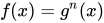
Solving the functional equation: . Once this functional equation is solved, then the rational iterates are the integer iterates of .


Non-analytic Fractional Iteration edit
By choosing a non-analytic fractional iterate, there is no uniqueness of the solutions obtained. (Iga's method)
Analytic Fractional Iteration edit
By solving for an analytic fractional iterate, there is a unique solution obtained in this way. (Dahl's method)
Continuous Iteration edit
A generalization of the usual notion of iteration, where the functional equation (FE): f n(x) = f(f n-1(x)) must be satisfied for all n in the domain (real or complex). If this is not the case, then to discuss these kinds of "iteration" (even though they are not technically "iteration" since they do not obey the FE of iteration), we will talk about them as though they were expressions for f n(x) where 0 ≤ Re(n) ≤ 1 and defined elsewhere by the FE of iteration. So even though a method is analytic, if it doesn't satisfy this fundamental FE, then by this re-definition, it is non-analytic.
Non-analytic Continuous Iteration edit
By choosing a non-analytic continuous iterate, there is no uniqueness of the solutions obtained. (Galidakis' and Woon's methods)
Analytic Continuous Iteration or just Analytic Iteration edit
By solving for an analytic continuous iterate, there is a unique solution obtained in this way.
Real-analytic Iteration edit
Complex-analytic Iteration or Holomorphic Iteration edit
Step edit
- Integer
- Fractional
- Continuous Iteration of Dynamical Maps.[8][9] This continuous iteration can be discretized by the finite element method and then solved—in parallel—on a computer.
visualisation edit
- folding [10][11][12][13]
- complex geometric sequence by Loo Kang Lawrence WEE
decomposition edit
Move during iteration in case of complex quadratic polynomial is complex. It consists of 2 moves :
- angular move = rotation ( see doubling map)
- radial move ( see external and internal rays, invariant curves )
- fallin into target set and attractor ( in hyperbolic and parabolic case )
- radial move
-
 Radius abs(z) = r < 1.0 after some iterations using f0(z) = z*z
 -
 Distance between repetive iteration of point smaller then one


- angular move
-
 angle 1/7 after doubling map
 -
 angle 1/15 after doubling map
 -
 angle 11/36 after doubling map


angular move (rotation) edit
Compute argument in turns[14] of the complex number :
/*
gives argument of complex number in turns


*/

double GiveTurn( double complex z){
double t;

  t =  carg(z);
  t /= 2*pi; // now in turns
  if (t<0.0) t += 1.0; // map from (-1/2,1/2] to [0, 1)
  return (t);
}
direction edit
forward edit
backward edit

Backward iteration or inverse iteration[15]
- Peitgen
- W Jung
- John Bonobo[16]
Peitgen edit
 /* Zn*Zn=Z(n+1)-c */
                Zx=Zx-Cx;
                Zy=Zy-Cy;
                /* sqrt of complex number algorithm from Peitgen, Jurgens, Saupe: Fractals for the classroom */
                if (Zx>0)
                {
                 NewZx=sqrt((Zx+sqrt(Zx*Zx+Zy*Zy))/2);
                 NewZy=Zy/(2*NewZx);
                 }
                 else /* ZX <= 0 */
                 {
                  if (Zx<0)
                     {
                      NewZy=sign(Zy)*sqrt((-Zx+sqrt(Zx*Zx+Zy*Zy))/2);
                      NewZx=Zy/(2*NewZy);
                      }
                      else /* Zx=0 */
                      {
                       NewZx=sqrt(fabs(Zy)/2);
                       if (NewZx>0) NewZy=Zy/(2*NewZx);
                          else NewZy=0;
                      }
                 };
              if (rand()<(RAND_MAX/2))
              {
                  Zx=NewZx;
                  Zy=NewZy;
                  }
              else {Zx=-NewZx;
                  Zy=-NewZy; }
Mandel edit
Here is example of c code of inverse iteration using code from program Mandel by Wolf Jung
/*
/*

 gcc i.c -lm -Wall
 ./a.out


z = 0.000000000000000  +0.000000000000000 i
z = -0.229955135116281  -0.141357981605006 i
z = -0.378328716195789  -0.041691618297441 i
z = -0.414752103217922  +0.051390827017207 i


*/

#include <stdio.h>
#include <math.h> // M_PI; needs -lm also
#include <complex.h>

/* find c in component of Mandelbrot set

   uses code by Wolf Jung from program Mandel
   see function mndlbrot::bifurcate from mandelbrot.cpp
   http://www.mndynamics.com/indexp.html

*/
double complex GiveC(double InternalAngleInTurns, double InternalRadius, unsigned int Period)
{
  //0 <= InternalRay<= 1
  //0 <= InternalAngleInTurns <=1
  double t = InternalAngleInTurns *2*M_PI; // from turns to radians
  double R2 = InternalRadius * InternalRadius;
  double Cx, Cy; /* C = Cx+Cy*i */

  switch ( Period ) // of component
    {
    case 1: // main cardioid
      Cx = (cos(t)*InternalRadius)/2-(cos(2*t)*R2)/4;
      Cy = (sin(t)*InternalRadius)/2-(sin(2*t)*R2)/4;
      break;
    case 2: // only one component
      Cx = InternalRadius * 0.25*cos(t) - 1.0;
      Cy = InternalRadius * 0.25*sin(t);
      break;
      // for each iPeriodChild  there are 2^(iPeriodChild-1) roots.
    default: // higher periods : to do, use newton method
      Cx = 0.0;
      Cy = 0.0;
      break; }

  return Cx + Cy*I;
}

/* mndyncxmics::root from mndyncxmo.cpp  by Wolf Jung (C) 2007-2014. */

// input = x,y
// output = u+v*I = sqrt(x+y*i)
complex double GiveRoot(complex double z)
{
  double x = creal(z);
  double y = cimag(z);
  double u, v;

   v  = sqrt(x*x + y*y);

   if (x > 0.0)
        { u = sqrt(0.5*(v + x)); v = 0.5*y/u; return  u+v*I; }
   if (x < 0.0)
         { v = sqrt(0.5*(v - x)); if (y < 0.0) v = -v; u = 0.5*y/v; return  u+v*I; }
   if (y >= 0.0)
       { u = sqrt(0.5*y); v = u; return  u+v*I; }

   u = sqrt(-0.5*y);
   v = -u;
   return  u+v*I;
}

// from mndlbrot.cpp  by Wolf Jung (C) 2007-2014. part of Madel 5.12
// input : c, z , mode
// c = cx+cy*i where cx and cy are global variables defined in mndynamo.h
// z = x+y*i
//
// output : z = x+y*i
complex double InverseIteration(complex double z, complex double c, char key)
{
    double x = creal(z);
    double y = cimag(z);
    double cx = creal(c);
    double cy = cimag(c);

   // f^{-1}(z) = inverse with principal value
   if (cx*cx + cy*cy < 1e-20)
   {
      z = GiveRoot(x - cx + (y - cy)*I); // 2-nd inverse function = key b
      if (key == 'B') { x = -x; y = -y; } // 1-st inverse function = key a
      return -z;
   }

   //f^{-1}(z) =  inverse with argument adjusted
   double u, v;
   complex double uv ;
   double w = cx*cx + cy*cy;

   uv = GiveRoot(-cx/w -(cy/w)*I);
   u = creal(uv);
   v = cimag(uv);
   //
   z =  GiveRoot(w - cx*x - cy*y + (cy*x - cx*y)*I);
   x = creal(z);
   y = cimag(z);
   //
   w = u*x - v*y;
   y = u*y + v*x;
   x = w;

   if (key =='A'){
    x = -x;
    y = -y;  // 1-st inverse function = key a
  }
  return x+y*I; // key b =  2-nd inverse function

}


 /*f^{-1}(z) =  inverse with argument adjusted
    "When you write the real and imaginary parts in the formulas as complex numbers again,
       you see that it is sqrt( -c / |c|^2 )  *  sqrt( |c|^2 - conj(c)*z ) ,
     so this is just sqrt( z - c )  except for the overall sign:
    the standard square-root takes values in the right halfplane,  but this is rotated by the squareroot of -c .
    The new line between the two planes has half the argument of -c .
    (It is not orthogonal to c ...  )"
    ...
    "the argument adjusting in the inverse branch has nothing to do with computing external arguments.  It is related to itineraries and kneading sequences,  ...
    Kneading sequences are explained in demo 4 or 5, in my slides on the stripping algorithm, and in several papers by Bruin and Schleicher.

    W Jung " */


double complex GiveInverseAdjusted (complex double z, complex double c, char key){


  double t = cabs(c);
  t = t*t;


  z =  csqrt(-c/t)*csqrt(t-z*conj(c));
  if (key =='A') z = -z; // 1-st inverse function = key a
  // else key == 'B'
  return z;


}


// make iMax inverse iteration with negative sign ( a in Wolf Jung notation )
complex double GivePrecriticalA(complex double z, complex double c, int iMax)
{
  complex double za = z;
  int i;


  for(i=0;i<iMax ;++i){
    printf("i = %d ,  z = (%f, %f) \n ", i,  creal(za), cimag(za) );
    za = InverseIteration(za,c, 'A');


   }

 printf("i = %d ,  z = (%f, %f) \n ", i,  creal(za), cimag(za) );
 return za;
}


// make iMax inverse iteration with negative sign ( a in Wolf Jung notation )
complex double GivePrecriticalA2(complex double z, complex double c, int iMax)
{
  complex double za = z;
  int i;


  for(i=0;i<iMax ;++i){
    printf("i = %d ,  z = (%f, %f) \n ", i,  creal(za), cimag(za) );
    za = GiveInverseAdjusted(za,c, 'A');


   }

 printf("i = %d ,  z = (%f, %f) \n ", i,  creal(za), cimag(za) );
 return za;
}


int main(){

 complex double c;
 complex double z;
 complex double zcr = 0.0; // critical point

 int iMax = 10;
 int iPeriodChild = 3; // period of
 int iPeriodParent = 1;


     c = GiveC(1.0/((double) iPeriodChild), 1.0, iPeriodParent); // root point = The unique point on the boundary of a mu-atom of period P where two external angles of denominator = (2^P-1) meet.
     z = GivePrecriticalA( zcr, c, iMax);
     printf("iAngle = %d/%d  c = (%f, %f); z = (%.16f, %.16f) \n ", iPeriodParent,  iPeriodChild, creal(c), cimag(c), creal(z), cimag(z) );

      z = GivePrecriticalA2( zcr, c, iMax);
     printf("iAngle = %d/%d  c = (%f, %f); z = (%.16f, %.16f) \n ", iPeriodParent,  iPeriodChild, creal(c), cimag(c), creal(z), cimag(z) );

return 0;
}
Test edit
One can iterate ad infinitum. Test tells when one can stop
- bailout test for forward iteration
Target set or trap edit
Target set is used in test. When zn is inside target set then one can stop the iterations.
Planes edit
Parameter plane edit
"Mandelbrot set carries no dynamics. It is a set of parameter values. There are no orbits on parameter plane, one should not draw orbits on parameter plane. Orbit of critical point is on the dynamical plane"
Dynamic plane edit
  "The polynomial Pc maps each dynamical ray to another ray doubling the angle (which we measure in full turns, i.e. 0 = 1 = 2π rad = 360◦), and the dynamical rays of any polynomial “look like straight rays” near infinity. This allows us to study the
   Mandelbrot and Julia sets combinatorially, replacing the dynamical plane by the unit circle, rays by angles, and the quadratic polynomial by the doubling modulo one map." Virpi K a u k o[17]
Dynamic plane f0 for c=0 edit

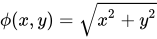
Lets take c=0, then one can call dynamical plane plane.

Here dynamical plane can be divided into :
- Julia set =
- Fatou set which consists of 2 subsets :
- interior of Julia set = basin of attraction of finite attractor =
- exterior of Julia set = basin of attraction of infinity =


Forward iteration edit


where :
- r is the absolute value or modulus or magnitude of a complex number z = x + i
- is the argument of complex number z (in many applications referred to as the "phase") is the angle of the radius with the positive real axis. Usually principal value is used

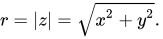
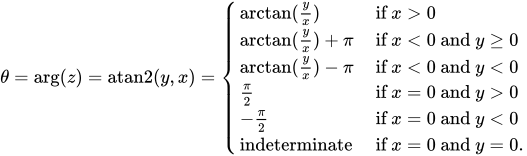
so

and forward iteration :[18]
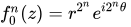
Forward iteration:
- squares radius and doubles angle ( phase, argument)[19][20]
- gives forward orbit = list of points {z0, z1, z2, z3... , zn} which lays on exponential spirals.[21][22]
One can check it interactively :
- Geogebra plet by Jorj Kowszun-Lecturer - try move along radial lines from the center to see changing behaviour
- Visualization of complex_square_iteration by M McClure
- program Mandel by W Jung
- squaring complex numbers by Jeffrey Ventrella
- MIT mathlets : complex-exponential
Chaos and the complex squaring map edit
The informal reason why the iteration is chaotic is that the angle doubles on every iteration and doubling grows very quickly as the angle becomes ever larger, but angles which differ by multiples of 2π radians are identical. Thus, when the angle exceeds 2π, it must wrap to the remainder on division by 2π. Therefore, the angle is transformed according to the dyadic transformation (also known as the 2x mod 1 map). As the initial value z0 has been chosen so that its argument is not a rational multiple of π, the forward orbit of zn cannot repeat itself and become periodic.
More formally, the iteration can be written as:

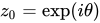
where is the resulting sequence of complex numbers obtained by iterating the steps above, and represents the initial starting number. We can solve this iteration exactly:


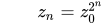
Starting with angle θ, we can write the initial term as so that . This makes the successive doubling of the angle clear. (This is equivalent to the relation .)


Escape test edit
If distance between:
- point z of exterior of Julia set
- Julia set

is :

then point z escapes (= it's magnitude is greate then escape radius = ER):

after :
- steps in non-parabolic case
- steps in parabolic case [23]


See also:
Backward iteration edit

Every angle (real number) α ∈ R/Z measured in turns has :
- one image = 2α mod 1 under doubling map
- "two preimages under the doubling map: ".[24] Inverse of doubling map is multivalued function.

Note that difference between these 2 preimages
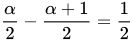
is half a turn = 180 degrees = Pi radians.


On complex dynamical plane backward iteration using quadratic polynomial

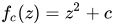
gives backward orbit = binary tree of preimages :



One can't choose good path in such tree without extra informations.
Not that preimages show rotational symmetry ( 180 degrees)
For other functions see Fractalforum[25]
See also:
Dynamic plane for fc edit
One can check it with :
- M McClure : visualization : interactive_basins
- GeoGebra - Complex Iteration - The Mandelbrot Set by Mark Dabbs
- critical orbits by Jeremy Rifkin
Level curves of escape or attracting time edit
-
 Preimages of circle from the exterior gives level sets of the escaping time
 -
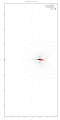 Preimages of circle from the interior gives level sets of the attracting time

_%3D_z*z%2B0.25.svg)
Julia set by IIM/J edit
Theory
- the periodic points are dense in the Julia set
- Julia set is the closure of the set of repelling periodic points
So drawing repelling periodic point and it's orbit ( forward and backward= inverse) gives visually good aproximation of Julia set = set of points dense enough that nonuniform distribution of these points over Julia set is not important.
-
 Preimages of repelling fixed point tend to Julia set for C = i. Image and source code
 -
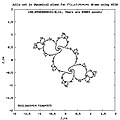 Julia set made with MIIM. Image and maxima source code
 -
 Preimages of critical orbit tend to whole Julia set in Siegel disc case
 -
 distribution of points in simple IIM/J
 -
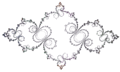 c = -0.750357820200574 +0.047756163825227 i
 -
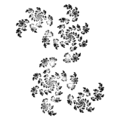 C = ( 0.4 0.3 )


.gif)
.gif)
In escape time one computes forward iteration of point z.
In IIM/J one computes:
- repelling fixed point[26] of complex quadratic polynomial
- preimages of by inverse iterations



"We know the periodic points are dense in the Julia set, but in the case of weird ones (like the ones with Cremer points, or even some with Siegel disks where the disk itself is very 'deep' within the Julia set, as measured by the external rays), the periodic points tend to avoid certain parts of the Julia set as long as possible. This is what causes the 'inverse method' of rendering images of Julia sets to be so bad for those cases." Jacques Carette[27]
Because square root is multivalued function then each has two preimages . Thus inverse iteration creates binary tree of preimages.


-
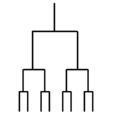 binary tree
 -
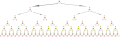 expanded growth of binary tree


Because of expanded growth of binary tree, the number of preimages grows exponentialy: the number of nodes in a full binary tree is
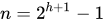
where
- is the height of the tree


If one wants to draw full binary tree then the methods of storing binary trees can waste a fair bit of memory, so alternative is
- threaded binary tree
- draw only some path from binary tree,
- random path : the longest path = path from root-to-leaf
See also :
Root of tree edit
- repelling fixed point[30] of complex quadratic polynomial
- - beta
- other repelling periodic points ( cut points of filled Julia set ). It will be important especially in case of the parabolic Julia set.
"... preimages of the repelling fixed point beta. These form a tree like
                                               beta
                    beta                                            -beta
   beta                         -beta                    x                     y
So every point is computed at last twice when you start the tree with beta. If you start with -beta, you will get the same points with half the number of computations.
Something similar applies to the preimages of the critical orbit. If z is in the critical orbit, one of its two preimages will be there as well, so you should draw -z and the tree of its preimages to avoid getting the same points twice." (Wolf Jung )
Variants of IIM edit
- random choose one of two roots IIM ( up to chosen level max). Random walk through the tree. Simplest to code and fast, but inefficient. Start from it.
- both roots with the same probability
- more often one then other root
- draw all roots ( up to chosen level max)[31]
- using recurrence
- using stack ( faster ?)
- draw some rare paths in binary tree = MIIM. This is modification of drawing all roots. Stop using some rare paths.
- using hits table ( while hit(pixel(iX,iY)) < HitMax )[32]
- using derivative ( while derivative(z) < DerivativeMax)[33][34]:
- " speed up the calculation by pruning dense branches of the tree. One such method is to prune branches when the map becomes contractive (the cumulative derivative becomes large). " Paul Nylander[35]
- " We cut off the sub tree from a given if the derivative is greater then limit. This eliminates dominant highly contractive regions of the inverse iteration, which have already been registered. We can calculate successive derivatives iteratively. Colour by the log of the absolute derivative" [36]
Examples of code :
Compare it with:

See also
- color: parts of Julia set have different color
See also edit
- Dynamical systems
- Fixed points
- Lyapunov number
- Functional equations
- Abel function
- Schroeder function
- Boettcher function
- Julia function
- Special matrices
- Carleman matrix
- Bell matrix
- Abel-Robbins matrix
References edit
- ↑ wikipedia : Iteration
- ↑ From local to global theories of iteration by Vaclav Kucera
- ↑ Inverse Iteration Algorithms for Julia Sets by Mark McClure
- ↑ Complex iteration by Microcomputadoras
- ↑ On rational maps with two critical points by John Milnor, fig. 5
- ↑ Iterated Functions by Tom Davis
- ↑ The Existence and Uniqueness of the Taylor Series of Iterated Functions by Daniel Geisler
- ↑ Continuous Iteration of Dynamical Maps R. Aldrovandi, L. P. Freitas (Sao Paulo, IFT)
- ↑ Continuous_iteration_of_fractals by Gerard Westendorp
- ↑ how-to-fold-a-julia-fractal by Steven Wittens
- ↑ Folding a Circle into a Julia Set by Karl Sims
- ↑ Visual Explanation of the Complexity in Julia Sets by Okke Schrijvers, Jarke J. van Wijk ( see video in the supporting info)
- ↑ How to Build a Julia Set
- ↑ turn
- ↑ Understanding Julia and Mandelbrot Sets by Karl Sims
- ↑ Une méthode rapide pour tracer les ensembles de Julia : l'itération inverse by John Bonobo
- ↑ Trees of visible components in the Mandelbrot set by Virpi K a u k o , FUNDAMENTA MATHEMATICAE 164 (2000)
- ↑ Real and imaginary parts of polynomial iterates by Julia A. Barnes, Clinton P. Curry and Lisbeth E. Schaubroeck. New York J. Math. 16 (2010) 749–761.
- ↑ mandelbrot-hue by Richard A Thomson
- ↑ phase by Linas Vepstas
- ↑ Complex numbers by David E Joyce
- ↑ Powers of complex numbers from Suitcase of Dreams
- ↑ Parabolic Julia Sets are Polynomial Time Computable by Mark Braverman
- ↑ SYMBOLIC DYNAMICS AND SELF-SIMILAR GROUPS by VOLODYMYR NEKRASHEVYCH
- ↑ Query about general Julia set IFS for higher powers.
- ↑ wikipedia : repelling fixed point
- ↑ mathbbc/185430 mathoverflow question: clustering-of-periodic-points-for-a-polynomial-iteration-of-mathbbc
- ↑ Wolfram Alpha
- ↑ example
- ↑ wikipedia : repelling fixed point
- ↑ Fractint documentation - Inverse Julias
- ↑ Image and c source code : IIMM using hit limit
- ↑ Exploding the Dark Heart of Chaos by Chris King
- ↑ Drakopoulos V., Comparing rendering methods for Julia sets, Journal of WSCG 10 (2002), 155-161
- ↑ bugman123: Fractals
- ↑ dhushara : DarkHeart
