
Engineering Analysis/Matrices
Norms edit
Induced Norms edit
n-Norm edit
Frobenius Norm edit
Spectral Norm edit
Derivatives edit
Consider the following set of linear equations:


We can define the matrix A to represent the coefficients, the vector B as the results, and the vector x as the variables:
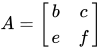


And rewriting the equation in terms of the matrices, we get:

Now, let's say we want the derivative of this equation with respect to the vector x:
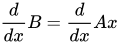
We know that the first term is constant, so the derivative of the left-hand side of the equation is zero. Analyzing the right side shows us:
Pseudo-Inverses edit
There are special matrices known as pseudo-inverses, that satisfies some of the properties of an inverse, but not others. To recap, If we have two square matrices A and B, that are both n × n, then if the following equation is true, we say that A is the inverse of B, and B is the inverse of A:

Right Pseudo-Inverse edit
Consider the following matrix:
![{\displaystyle R=A^{T}[AA^{T}]^{-1}}](https://wikimedia.org/api/rest_v1/media/math/render/svg/c544878c64753b232fbf25f755fa10ec884562d4)
We call this matrix R the right pseudo-inverse of A, because:

but

We will denote the right pseudo-inverse of A as

Left Pseudo-Inverse edit
Consider the following matrix:
![{\displaystyle L=[A^{T}A]^{-1}A^{T}}](https://wikimedia.org/api/rest_v1/media/math/render/svg/b2c91d6a13a926a4145a110b9df975a1fd7364f5)
We call L the left pseudo-inverse of A because

but

We will denote the left pseudo-inverse of A as
