Engineering Analysis/Cayley Hamilton Theorem
If the characteristic equation of matrix A is given by:

Then the Cayley-Hamilton theorem states that the matrix A itself is also a valid solution to that equation:

Another theorem worth mentioning here (and by "worth mentioning", we really mean "fundamental for some later topics") is stated as:
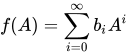
If λ are the eigenvalues of matrix A, and if there is a function f that is defined as a linear combination of powers of λ:
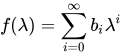
If this function has a radius of convergence S, and if all the eigenvectors of A have magnitudes less than S, then the matrix A itself is also a solution to that function: