Explicitly correlated Gaussian functions have been extensively used in quantum-mechanical variational calculations in atomic, molecular, and nuclear physics. This book is an attempt to collect the relevant information about this established tool in computational quantum mechanics.
Introduction
edit
Often we describe bound-state and scattering problems in nuclear and atomic physics through the Shrödinger equation.
Unfortunately modern quantum physics offers problems that we can not solve analytically. Luckily the availability of powerful computers is shifting the emphasis from the analytical computation of the solution toward numerical analysis. During the last century numerous methods were developed in order to approximate solutions numerically, e.g. Monte-Carlo simulation, Hypershperical expansion, variational methods with different trial wave functions etc.
In this section we discuss variational method with trial function in the form of correlated Gaussians which is widely used in the modern physics.
Mathematically it is based on the Ritz theorem, that states that for an arbitrary function Ψ from the state space
the expectation value of the Hamiltonian (<Ψ|H|Ψ>/<Ψ|Ψ>) is larger then the ground state energy. So choosing different trial wave functions and calculating mean values of the Hamiltonian for this functions allows us to get an upper bound for the ground state energy.
To show the idea of the method we consider two particles in 1 dimension interacting through the oscillator potential
[
−
1
2
∂
2
∂
x
1
−
1
2
∂
2
∂
x
2
+
1
2
(
x
1
−
x
2
)
2
]
ϕ
=
E
ϕ
.
{\displaystyle {\bigg [}-{\frac {1}{2}}{\frac {\partial ^{2}}{\partial {x}_{1}}}-{\frac {1}{2}}{\frac {\partial ^{2}}{\partial {x}_{2}}}+{\frac {1}{2}}(x_{1}-x_{2})^{2}{\bigg ]}\phi =E\phi \;.}
It is really simple textbook problem with the ground state solution
ϕ
0
=
(
2
π
)
1
/
4
exp
(
−
1
2
2
(
x
1
−
x
2
)
2
)
,
E
0
=
1
2
,
{\displaystyle \phi _{0}=({\frac {\sqrt {2}}{\pi }})^{1/4}\exp(-{\frac {1}{2{\sqrt {2}}}}(x_{1}-x_{2})^{2})\;,E_{0}={\frac {1}{\sqrt {2}}}\;,}
where we assumed for simplicity, that the total momentum is equal to zero.
To show how the method works we choose the trial wave function in the form of just one gaussian
f
t
r
=
(
4
α
π
)
1
/
4
exp
(
−
α
(
x
1
−
x
2
)
2
)
,
{\displaystyle f_{tr}=({\frac {4\alpha }{\pi }})^{1/4}\exp(-\alpha (x_{1}-x_{2})^{2})\;,}
where we have only one real positive parameter which has to minimize the energy. The idea of the method is to pick this parameter stochastically using just generator of the real numbers. We find out that independently of the seed after 50 attempts we found value of α that gives the ground state energy with 5 significant digits.
Convergence of the expectation value of the Hamiltonian (different curves corresponds to different starting seeds for the generator of the random numbers). Of course it's really simple example and we can establish energy with high precision just because we are working in the space that contains ground state wave function of the Hamiltonian.
In order to establish excited states it's not enough to use just one Gaussian so we pick trial wave function in more general form
f
t
r
=
∑
i
=
1
N
c
i
exp
(
−
α
i
(
x
1
−
x
2
−
s
i
)
2
)
.
{\displaystyle f_{tr}=\sum _{i=1}^{N}c_{i}\exp(-\alpha _{i}(x_{1}-x_{2}-s_{i})^{2})\;.}
As above we pick parameters
α
i
,
s
i
{\displaystyle \alpha _{i},s_{i}}
i demanding minimal expectation value of the Hamiltonian. Using N=25 and one random set of the parameters
α
i
,
s
i
{\displaystyle \alpha _{i},s_{i}}
0
<
α
i
<
5
,
−
1
<
s
i
<
1
{\displaystyle 0<\alpha _{i}<5,-1<s_{i}<1}
From this simple example we learn that we are able to approximate solution of the Schrödinger equation without any preliminary knowledge about the system using only random search. The main problem is to estimate how good this approximation is.
The method
edit
Hamiltonian under consideration
edit
We shall consider a non-relativistic quantum mechanical
N
{\displaystyle N}
H
^
=
∑
i
=
1
N
(
−
ℏ
2
2
m
i
)
∂
2
∂
r
→
i
+
∑
i
=
1
N
V
i
(
r
→
i
)
+
∑
i
<
j
N
V
i
j
(
r
→
i
−
r
→
j
)
,
{\displaystyle {\hat {H}}=\sum _{i=1}^{N}\left(-{\frac {\hbar ^{2}}{2m_{i}}}\right){\frac {\partial ^{2}}{\partial {\vec {r}}_{i}}}+\sum _{i=1}^{N}V_{i}({\vec {r}}_{i})+\sum _{i<j}^{N}V_{ij}({\vec {r}}_{i}-{\vec {r}}_{j})\;,}
where
m
i
{\displaystyle m_{i}}
r
→
i
{\displaystyle {\vec {r}}_{i}}
i
{\displaystyle i}
V
i
(
r
→
i
)
=
m
i
ω
2
2
r
→
i
2
{\displaystyle V_{i}({\vec {r}}_{i})={\frac {m_{i}\omega ^{2}}{2}}{\vec {r}}_{i}^{2}}
Magneto-optical trap ; and the third term is the two-body forces, the inter-particle interactions.
This Hamiltonian can describe a system of atoms in a trap or a nucleus.
In general one can also consider spin-dependent, three-body, non-local and other types of interactions which we shall introduce when needed.
Basis expansion of the Schrödinger equation
edit
We are going to solve the Schrödinger equation
H
^
|
ψ
⟩
=
ϵ
|
ψ
⟩
,
{\displaystyle {\hat {H}}|\psi \rangle =\epsilon |\psi \rangle \;,}
where
H
^
{\displaystyle {\hat {H}}}
|
ψ
⟩
{\displaystyle |\psi \rangle }
ϵ
{\displaystyle \epsilon }
We shall expand the wave-function
|
ψ
⟩
{\displaystyle |\psi \rangle }
|
i
⟩
i
=
1
…
n
{\displaystyle |i\rangle _{i=1\dots n}}
|
ψ
⟩
=
∑
i
=
1
n
c
i
|
i
⟩
.
{\displaystyle |\psi \rangle =\sum _{i=1}^{n}c_{i}|i\rangle \;.}
Inserting the expansion into the Schrödinger equation and multiplying from the left with
⟨
k
|
1
≤
k
≤
n
{\displaystyle \langle k|_{1\leq k\leq n}}
∑
i
=
1
n
⟨
k
|
H
^
|
i
⟩
c
i
=
ϵ
∑
i
=
1
n
⟨
k
|
i
⟩
c
i
.
{\displaystyle \sum _{i=1}^{n}\langle k|{\hat {H}}|i\rangle c_{i}=\epsilon \sum _{i=1}^{n}\langle k|i\rangle c_{i}\;.}
Or, in the matrix notation
H
c
=
ϵ
N
c
,
{\displaystyle {\cal {H}}c=\epsilon {\cal {N}}c\;,}
where
H
{\displaystyle {\cal {H}}}
N
{\displaystyle {\cal {N}}}
H
k
i
=
⟨
k
|
H
^
|
i
⟩
,
N
k
i
=
⟨
k
|
i
⟩
.
{\displaystyle {\cal {H}}_{ki}=\langle k|{\hat {H}}|i\rangle \,,\;{\cal {N}}_{ki}=\langle k|i\rangle \;.}
The matrix equation
H
c
=
ϵ
N
c
{\displaystyle {\cal {H}}c=\epsilon {\cal {N}}c}
If the basis function are orthogonal and normalized the overlap matrix equals the unity matrix,
N
i
j
=
δ
i
j
{\displaystyle {\cal {N}}_{ij}=\delta _{ij}}
H
c
=
ϵ
c
{\displaystyle {\cal {H}}c=\epsilon c}
We shall use Gaussians --- which are not orthogonal --- as basis functions, therefore we shall deal with the generalized eigenvalue problem.
Gaussians as basis functions
edit
We shall use the so-called Correlated Gaussians (or Explicitly Correlated Gaussians) as the basis functions. For a system of
N
{\displaystyle N}
r
→
i
,
i
=
1
…
N
{\displaystyle {\vec {r}}_{i}\,,\;i=1\dots N}
g
(
r
→
1
,
…
,
r
→
N
)
≐
exp
(
−
∑
i
,
j
=
1
N
A
i
j
r
→
i
⋅
r
→
j
+
∑
i
=
1
N
s
→
i
⋅
r
→
i
)
{\displaystyle g({\vec {r}}_{1},\dots ,{\vec {r}}_{N})\doteq \exp \left(-\sum _{i,j=1}^{N}A_{ij}{\vec {r}}_{i}\cdot {\vec {r}}_{j}+\sum _{i=1}^{N}{\vec {s}}_{i}\cdot {\vec {r}}_{i}\right)}
where
r
→
i
⋅
r
→
j
{\displaystyle {\vec {r}}_{i}\cdot {\vec {r}}_{j}}
A
{\displaystyle A}
s
→
i
|
i
=
1
,
…
,
N
{\displaystyle {\vec {s}}_{i}|_{i=1,\dots ,N}}
In matrix notation,
g
(
r
)
≐
exp
(
−
r
T
A
r
+
s
T
r
)
{\displaystyle g({\bf {r}})\doteq \exp \left(-{\bf {r}}^{\mathsf {T}}A{\bf {r}}+\mathbf {s} ^{\mathsf {T}}\mathbf {r} \right)}
where
r
{\displaystyle {\bf {r}}}
r
→
i
{\displaystyle {\vec {r}}_{i}}
s
{\displaystyle \mathbf {s} }
s
→
i
{\displaystyle {\vec {s}}_{i}}
r
≐
(
r
→
1
⋮
r
→
N
)
,
s
≐
(
s
→
1
⋮
s
→
N
)
{\displaystyle {\bf {r}}\doteq \left({\begin{matrix}{\vec {r}}_{1}\\\vdots \\{\vec {r}}_{N}\end{matrix}}\right),\;{\bf {s}}\doteq \left({\begin{matrix}{\vec {s}}_{1}\\\vdots \\{\vec {s}}_{N}\end{matrix}}\right)}
and
r
T
A
r
+
s
T
r
≐
∑
i
j
r
→
i
⋅
A
i
j
r
→
j
+
∑
i
s
→
i
⋅
r
→
i
{\displaystyle {\bf {r}}^{\mathsf {T}}A{\bf {r}}+\mathbf {s} ^{\mathsf {T}}\mathbf {r} \doteq \sum _{ij}{\vec {r}}_{i}\cdot A_{ij}{\vec {r}}_{j}+\sum _{i}{\vec {s}}_{i}\cdot {\vec {r}}_{i}}
Matrix elements with Gaussians
edit
We represent the few-body wave-function
Ψ
(
r
→
1
,
…
,
r
→
N
)
{\displaystyle \Psi ({\vec {r}}_{1},\dots ,{\vec {r}}_{N})}
n
{\displaystyle n}
Ψ
(
r
→
1
,
…
,
r
→
N
)
=
∑
i
=
1
n
c
i
g
i
(
r
→
1
,
…
,
r
→
N
)
.
{\displaystyle \Psi ({\vec {r}}_{1},\dots ,{\vec {r}}_{N})=\sum _{i=1}^{n}c_{i}g_{i}({\vec {r}}_{1},\dots ,{\vec {r}}_{N})\;.}
We shall discuss the choice of matrices
A
{\displaystyle A}
The overlap,
⟨
g
′
|
g
⟩
≐
∫
d
3
r
→
1
…
d
3
r
→
N
exp
(
−
r
T
(
A
′
+
A
)
r
+
(
s
′
+
s
)
T
r
)
≡
∫
d
r
exp
(
−
r
T
B
r
+
v
T
r
)
,
{\displaystyle \langle g'|g\rangle \doteq \int d^{3}{\vec {r}}_{1}\dots d^{3}{\vec {r}}_{N}\exp \left(-{\bf {r}}^{\mathsf {T}}(A'+A){\bf {r}}+(\mathbf {s} '+\mathbf {s} )^{\mathsf {T}}\mathbf {r} \right)\equiv \int d\mathbf {r} \exp \left(-\mathbf {r} ^{\mathsf {T}}B\mathbf {r} +\mathbf {v} ^{\mathsf {T}}\mathbf {r} \right)\;,}
(where
d
r
≐
d
3
r
→
1
…
d
3
r
→
N
{\displaystyle d\mathbf {r} \doteq d^{3}{\vec {r}}_{1}\dots d^{3}{\vec {r}}_{N}}
B
≐
A
′
+
A
{\displaystyle B\doteq A'+A}
v
≐
s
′
+
s
{\displaystyle \mathbf {v} \doteq \mathbf {s} '+\mathbf {s} }
r
→
x
=
Q
T
r
{\displaystyle {\bf {r}}\rightarrow {\bf {x}}=Q^{\mathsf {T}}{\bf {r}}}
Q
T
Q
=
1
{\displaystyle Q^{\mathsf {T}}Q=1}
B
{\displaystyle B}
⟨
g
′
|
g
⟩
=
∫
d
x
exp
(
−
x
T
B
x
+
v
T
x
)
=
∫
d
x
exp
(
−
∑
i
=
1
N
x
→
i
⋅
B
i
i
x
→
i
+
∑
i
=
1
N
v
→
i
⋅
x
→
i
)
=
∏
i
=
1
N
∫
d
3
x
→
i
exp
(
−
x
→
i
⋅
B
i
i
x
→
i
+
v
→
i
⋅
x
→
i
)
=
∏
i
=
1
N
exp
(
1
4
B
i
i
v
→
i
2
)
(
π
B
i
i
)
3
/
2
=
e
1
4
v
T
B
−
1
v
(
π
N
det
(
B
)
)
3
/
2
.
{\displaystyle {\begin{aligned}\langle g'|g\rangle &=\int d\mathbf {x} \exp \left(-{\bf {x}}^{\mathsf {T}}B{\bf {x}}+\mathbf {v} ^{\mathsf {T}}\mathbf {x} \right)=\int d\mathbf {x} \exp \left(-\sum _{i=1}^{N}{\vec {x}}_{i}\cdot B_{ii}{\vec {x}}_{i}+\sum _{i=1}^{N}{\vec {v}}_{i}\cdot {\vec {x}}_{i}\right)&\\&=\prod _{i=1}^{N}\int d^{3}{\vec {x}}_{i}\exp \left(-{\vec {x}}_{i}\cdot B_{ii}{\vec {x}}_{i}+{\vec {v}}_{i}\cdot {\vec {x}}_{i}\right)=\prod _{i=1}^{N}\exp \left({\frac {1}{4B_{ii}}}{\vec {v}}_{i}^{2}\right)\left({\frac {\pi }{B_{ii}}}\right)^{3/2}\\&=e^{{\frac {1}{4}}\mathbf {v} ^{\mathsf {T}}B^{-1}\mathbf {v} }\left({\frac {\pi ^{N}}{\det(B)}}\right)^{3/2}\;.&\end{aligned}}}
Finally,
⟨
g
′
|
g
⟩
=
e
1
4
v
T
B
−
1
v
(
π
N
det
(
B
)
)
3
/
2
,
w
h
e
r
e
B
≐
A
′
+
A
a
n
d
v
≐
s
′
+
s
.
{\displaystyle \langle g'|g\rangle =e^{{\frac {1}{4}}\mathbf {v} ^{\mathsf {T}}B^{-1}\mathbf {v} }\left({\frac {\pi ^{N}}{\det(B)}}\right)^{3/2}\,,\;\mathrm {where} \;B\doteq A'+A\;\mathrm {and} \;\mathbf {v} \doteq \mathbf {s} '+\mathbf {s} \;.}
Kinetic energy
edit
Let us consider a more general form of the kinetic energy operator,
K
^
=
−
∑
i
,
j
=
1
N
∂
∂
r
→
i
Λ
i
j
∂
∂
r
→
j
≡
−
∂
∂
r
Λ
∂
∂
r
T
,
{\displaystyle {\hat {K}}=-\sum _{i,j=1}^{N}{\frac {\partial }{\partial {\vec {r}}_{i}}}\Lambda _{ij}{\frac {\partial }{\partial {\vec {r}}_{j}}}\equiv -{\frac {\partial }{\partial {\bf {r}}}}\Lambda {\frac {\partial }{\partial \mathbf {r} ^{\mathsf {T}}}}\;,}
where
Λ
{\displaystyle \Lambda }
Λ
i
j
=
ℏ
2
2
m
i
δ
i
j
.
{\displaystyle \Lambda _{ij}={\frac {\hbar ^{2}}{2m_{i}}}\delta _{ij}\;.}
The matrix element is given as
⟨
g
′
|
K
^
|
g
⟩
=
∫
d
r
e
−
r
T
A
′
r
+
s
′
T
r
(
−
∑
i
,
j
=
1
N
∂
∂
r
→
i
Λ
i
j
∂
∂
r
→
j
)
e
−
r
T
A
r
+
s
T
r
.
{\displaystyle \langle g'|{\hat {K}}|g\rangle =\int d\mathbf {r} e^{-{\bf {r}}^{\mathsf {T}}A'{\bf {r}}+\mathbf {s} '^{\mathsf {T}}\mathbf {r} }\left(-\sum _{i,j=1}^{N}{\frac {\partial }{\partial {\vec {r}}_{i}}}\Lambda _{ij}{\frac {\partial }{\partial {\vec {r}}_{j}}}\right)e^{-{\bf {r}}^{\mathsf {T}}A{\bf {r}}+\mathbf {s} ^{\mathsf {T}}\mathbf {r} }\;.}
Integrating by parts with respect to the left derivative gives
⟨
g
′
|
K
^
|
g
⟩
=
∫
d
r
(
∂
∂
r
e
−
r
T
A
′
r
+
s
′
T
r
)
Λ
(
∂
∂
r
T
e
−
r
T
A
r
+
s
T
r
)
=
∫
d
r
e
−
r
T
B
r
+
v
T
r
(
−
2
r
T
A
′
+
s
′
T
)
Λ
(
−
2
A
r
+
s
)
=
∫
d
r
e
−
r
T
B
r
+
v
T
r
(
4
r
T
A
′
Λ
A
r
−
2
r
T
A
′
Λ
s
−
2
s
′
T
Λ
A
r
+
s
′
T
Λ
s
)
.
{\displaystyle {\begin{aligned}\langle g'|{\hat {K}}|g\rangle &=\int d\mathbf {r} \left({\frac {\partial }{\partial \mathbf {r} }}e^{-{\bf {r}}^{\mathsf {T}}A'{\bf {r}}+\mathbf {s} '^{\mathsf {T}}\mathbf {r} }\right)\Lambda \left({\frac {\partial }{\partial \mathbf {r} ^{\mathsf {T}}}}e^{-{\bf {r}}^{\mathsf {T}}A{\bf {r}}+\mathbf {s} ^{\mathsf {T}}\mathbf {r} }\right)\\&=\int d\mathbf {r} e^{-{\bf {r}}^{\mathsf {T}}B{\bf {r}}+\mathbf {v} ^{\mathsf {T}}\mathbf {r} }(-2\mathbf {r} ^{\mathsf {T}}A'+\mathbf {s} '^{\mathsf {T}})\Lambda (-2A\mathbf {r} +\mathbf {s} )\\&=\int d\mathbf {r} e^{-{\bf {r}}^{\mathsf {T}}B{\bf {r}}+\mathbf {v} ^{\mathsf {T}}\mathbf {r} }(4\mathbf {r} ^{\mathsf {T}}A'\Lambda A\mathbf {r} -2\mathbf {r} ^{\mathsf {T}}A'\Lambda \mathbf {s} -2\mathbf {s} '^{\mathsf {T}}\Lambda A\mathbf {r} +\mathbf {s} '^{\mathsf {T}}\Lambda \mathbf {s} )\;.\end{aligned}}}
Calculating term after term,
∫
d
r
e
−
r
T
B
r
+
v
T
r
r
T
F
r
=
∂
∂
v
F
∂
∂
v
T
∫
d
r
e
−
r
T
B
r
+
v
T
r
=
(
π
N
det
(
B
)
)
3
/
2
(
∂
∂
v
F
∂
∂
v
T
)
e
1
4
v
T
B
−
1
v
=
(
3
2
t
r
a
c
e
(
F
B
−
1
)
+
u
T
F
u
)
e
1
4
v
T
B
−
1
v
(
π
N
det
(
B
)
)
3
/
2
,
{\displaystyle {\begin{aligned}\int d\mathbf {r} e^{-\mathbf {r} ^{\mathsf {T}}B\mathbf {r} +\mathbf {v} ^{\mathsf {T}}\mathbf {r} }\mathbf {r} ^{\mathsf {T}}F\mathbf {r} &={\frac {\partial }{\partial \mathbf {v} }}F{\frac {\partial }{\partial \mathbf {v} ^{\mathsf {T}}}}\int d\mathbf {r} e^{-\mathbf {r} ^{\mathsf {T}}B\mathbf {r} +\mathbf {v} ^{\mathsf {T}}\mathbf {r} }=\left({\frac {\pi ^{N}}{\det(B)}}\right)^{3/2}\left({\frac {\partial }{\partial \mathbf {v} }}F{\frac {\partial }{\partial \mathbf {v} ^{\mathsf {T}}}}\right)e^{{\frac {1}{4}}\mathbf {v} ^{\mathsf {T}}B^{-1}\mathbf {v} }\\&=\left({\frac {3}{2}}\;\mathrm {trace} (FB^{-1})+\mathbf {u} ^{\mathsf {T}}F\mathbf {u} \right)e^{{\frac {1}{4}}\mathbf {v} ^{\mathsf {T}}B^{-1}\mathbf {v} }\left({\frac {\pi ^{N}}{\det(B)}}\right)^{3/2}\;,\end{aligned}}}
∫
d
r
e
−
r
T
B
r
+
v
T
r
a
T
r
=
a
T
∂
∂
v
T
∫
d
r
e
−
r
T
B
r
+
v
T
r
=
(
π
N
det
(
B
)
)
3
/
2
(
a
T
∂
∂
v
T
)
e
1
4
v
T
B
−
1
v
=
(
a
T
u
)
e
1
4
v
T
B
−
1
v
(
π
N
det
(
B
)
)
3
/
2
,
{\displaystyle {\begin{aligned}\int d\mathbf {r} e^{-\mathbf {r} ^{\mathsf {T}}B\mathbf {r} +\mathbf {v} ^{\mathsf {T}}\mathbf {r} }\mathbf {a} ^{\mathsf {T}}\mathbf {r} &=\mathbf {a} ^{\mathsf {T}}{\frac {\partial }{\partial \mathbf {v} ^{\mathsf {T}}}}\int d\mathbf {r} e^{-\mathbf {r} ^{\mathsf {T}}B\mathbf {r} +\mathbf {v} ^{\mathsf {T}}\mathbf {r} }=\left({\frac {\pi ^{N}}{\det(B)}}\right)^{3/2}\left(\mathbf {a} ^{\mathsf {T}}{\frac {\partial }{\partial \mathbf {v} ^{\mathsf {T}}}}\right)e^{{\frac {1}{4}}\mathbf {v} ^{\mathsf {T}}B^{-1}\mathbf {v} }\\&=\left(\mathbf {a} ^{\mathsf {T}}\mathbf {u} \right)e^{{\frac {1}{4}}\mathbf {v} ^{\mathsf {T}}B^{-1}\mathbf {v} }\left({\frac {\pi ^{N}}{\det(B)}}\right)^{3/2}\;,\end{aligned}}}
where
u
≐
1
2
B
−
1
v
{\displaystyle \mathbf {u} \doteq {\frac {1}{2}}B^{-1}\mathbf {v} }
Finally,
⟨
g
′
|
−
∂
∂
r
Λ
∂
∂
r
T
|
g
⟩
=
(
6
t
r
a
c
e
(
A
′
Λ
A
B
−
1
)
+
(
2
A
′
u
−
s
′
)
T
Λ
(
2
A
u
−
s
)
)
e
1
2
v
T
u
(
π
N
det
(
B
)
)
3
/
2
,
B
≐
A
′
+
A
,
u
≐
1
2
B
−
1
v
.
{\displaystyle \left\langle g'\left|-{\frac {\partial }{\partial {\bf {r}}}}\Lambda {\frac {\partial }{\partial \mathbf {r} ^{\mathsf {T}}}}\right|g\right\rangle =\left(6\,\mathrm {trace} (A'\Lambda AB^{-1})+(2A'\mathbf {u} -\mathbf {s} ')^{\mathsf {T}}\Lambda (2A\mathbf {u} -\mathbf {s} )\right)e^{{\frac {1}{2}}\mathbf {v} ^{\mathsf {T}}\mathbf {u} }\left({\frac {\pi ^{N}}{\det(B)}}\right)^{3/2}\,,\;B\doteq A'+A,\;\mathbf {u} \doteq {\frac {1}{2}}B^{-1}\mathbf {v} .}
Potential energy
edit
The matrix element of the interaction potential between, say, particles
i
{\displaystyle i}
j
{\displaystyle j}
⟨
g
′
|
V
(
r
→
i
−
r
→
j
)
|
g
⟩
{\displaystyle \langle g'|V({\vec {r}}_{i}-{\vec {r}}_{j})|g\rangle }
can be written in a more general form,
⟨
g
′
|
V
(
w
T
r
)
|
g
⟩
{\displaystyle \langle g'|V(w^{\mathsf {T}}\mathbf {r} )|g\rangle }
where
w
{\displaystyle w}
w
i
=
1
{\displaystyle w_{i}=1}
w
j
=
−
1
{\displaystyle w_{j}=-1}
A one-body interaction,
V
(
r
→
i
)
{\displaystyle V({\vec {r}}_{i})}
V
(
w
T
r
)
{\displaystyle V(w^{T}{\bf {r}})}
w
i
=
1
{\displaystyle w_{i}=1}
Central potential
edit
For a central potential in a Gaussian form,
V
(
r
→
i
)
≐
S
e
−
α
r
→
i
2
=
S
e
−
α
r
T
w
w
T
r
,
w
h
e
r
e
w
i
=
1
,
w
k
≠
i
=
0
,
{\displaystyle V({\vec {r}}_{i})\doteq Se^{-\alpha {\vec {r}}_{i}^{2}}=Se^{-\alpha \mathbf {r} ^{\mathsf {T}}ww^{\mathsf {T}}\mathbf {r} },\;\mathrm {where} \;w_{i}=1,\;w_{k\neq i}=0\;,}
the matrix element between shifted Gaussians can be calculated straightforwardly,
⟨
g
′
|
e
−
α
r
T
w
w
T
r
|
g
⟩
=
∫
d
r
e
−
r
T
(
B
+
α
w
w
T
)
r
+
v
T
r
=
e
1
4
v
T
B
′
−
1
v
(
π
N
det
(
B
′
)
)
3
/
2
{\displaystyle \langle g'|e^{-\alpha \mathbf {r} ^{\mathsf {T}}ww^{\mathsf {T}}\mathbf {r} }|g\rangle =\int d\mathbf {r} e^{-\mathbf {r} ^{\mathsf {T}}(B+\alpha ww^{\mathsf {T}})\mathbf {r} +\mathbf {v} ^{\mathsf {T}}\mathbf {r} }=e^{{\frac {1}{4}}\mathbf {v} ^{\mathsf {T}}B'^{-1}\mathbf {v} }\left({\frac {\pi ^{N}}{\det(B')}}\right)^{3/2}}
where
B
′
=
B
+
α
w
w
T
{\displaystyle B'=B+\alpha ww^{\mathsf {T}}}
The rank-1 updates of the determinant,
det
(
B
+
α
w
w
T
)
{\displaystyle \det(B+\alpha ww^{\mathsf {T}})}
(
B
+
α
w
w
T
)
−
1
{\displaystyle (B+\alpha ww^{\mathsf {T}})^{-1}}
det
(
B
+
u
v
T
)
=
(
1
+
v
T
B
−
1
u
)
det
(
B
)
,
{\displaystyle \det(B+uv^{\mathsf {T}})=(1+v^{\mathsf {T}}B^{-1}u)\,\det(B)\,,}
and (Sherman-Morrison)
(
B
+
u
v
T
)
−
1
=
B
−
1
−
B
−
1
u
v
T
B
−
1
1
+
v
T
B
−
1
u
.
{\displaystyle (B+uv^{T})^{-1}=B^{-1}-{B^{-1}uv^{T}B^{-1} \over 1+v^{T}B^{-1}u}.}
For a general form-factor central potential one way to calculate the matrix element is through the Fourier transform of the potential,
V
(
r
→
)
=
∫
d
3
k
→
(
2
π
)
3
f
(
k
→
)
e
i
k
→
⋅
r
→
{\displaystyle V({\vec {r}})=\int {\frac {d^{3}{\vec {k}}}{(2\pi )^{3}}}{\mathfrak {f}}({\vec {k}})e^{i{\vec {k}}\cdot {\vec {r}}}}
⟨
g
′
|
V
(
w
T
r
)
|
g
⟩
=
∫
d
3
k
→
(
2
π
)
3
f
(
k
→
)
∫
d
r
e
−
r
T
B
r
+
(
v
+
i
k
→
w
)
T
r
=
∫
d
3
k
→
(
2
π
)
3
f
(
k
→
)
e
1
4
(
v
+
i
k
→
w
)
T
B
−
1
(
v
+
i
k
→
w
)
(
π
N
det
(
B
)
)
3
/
2
{\displaystyle \langle g'|V(w^{\mathsf {T}}\mathbf {r} )|g\rangle =\int {\frac {d^{3}{\vec {k}}}{(2\pi )^{3}}}{\mathfrak {f}}({\vec {k}})\int d{\bf {r}}e^{-{\bf {r}}^{\mathsf {T}}B{\bf {r}}+(\mathbf {v} +i{\vec {k}}w)^{\mathsf {T}}{\bf {r}}}=\int {\frac {d^{3}{\vec {k}}}{(2\pi )^{3}}}{\mathfrak {f}}({\vec {k}})\;e^{{\frac {1}{4}}(\mathbf {v} +i{\vec {k}}w)^{\mathsf {T}}B^{-1}(\mathbf {v} +i{\vec {k}}w)}\left({\frac {\pi ^{N}}{\det(B)}}\right)^{3/2}}
Thus
⟨
g
′
|
V
(
w
T
r
)
|
g
⟩
=
e
1
4
v
T
B
−
1
v
(
π
N
det
(
B
)
)
3
/
2
∫
d
3
k
→
(
2
π
)
3
f
(
k
→
)
e
−
α
k
→
2
+
i
k
→
q
→
,
{\displaystyle \langle g'|V(w^{\mathsf {T}}\mathbf {r} )|g\rangle =e^{{\frac {1}{4}}\mathbf {v} ^{\mathsf {T}}B^{-1}\mathbf {v} }\left({\frac {\pi ^{N}}{\det(B)}}\right)^{3/2}\int {\frac {d^{3}{\vec {k}}}{(2\pi )^{3}}}{\mathfrak {f}}({\vec {k}})e^{-\alpha {\vec {k}}^{2}+i{\vec {k}}{\vec {q}}}\,,}
where
f
(
k
→
)
{\displaystyle {\mathfrak {f}}({\vec {k}})}
V
(
r
→
)
{\displaystyle V({\vec {r}})}
α
≐
1
4
w
T
B
−
1
w
{\displaystyle \alpha \doteq {\frac {1}{4}}w^{T}B^{-1}w}
q
→
≐
1
2
w
T
B
−
1
v
{\displaystyle {\vec {q}}\doteq {\frac {1}{2}}w^{\mathsf {T}}B^{-1}\mathbf {v} }
The last integral can be also written via the potential itself,
∫
d
3
k
→
(
2
π
)
3
f
(
k
→
)
e
−
α
k
→
2
+
i
k
→
q
→
=
∫
d
3
k
→
(
2
π
)
3
∫
d
3
r
→
V
(
r
→
)
e
−
α
k
→
2
−
i
k
→
(
r
→
−
q
→
)
=
∫
d
3
r
→
V
(
r
→
)
e
−
(
r
→
−
q
→
)
2
4
α
∫
d
3
k
→
(
2
π
)
3
e
−
α
(
k
→
+
i
r
→
−
q
→
2
α
)
2
=
∫
d
3
r
→
V
(
r
→
)
e
−
(
r
→
−
q
→
)
2
4
α
π
3
/
2
(
2
π
)
3
α
3
/
2
=
(
1
4
α
π
)
3
/
2
∫
d
3
r
→
V
(
r
→
)
e
−
(
r
→
−
q
→
)
2
4
α
=
(
β
π
)
3
/
2
∫
d
3
r
→
V
(
r
→
)
e
−
β
(
r
→
−
q
→
)
2
,
{\displaystyle {\begin{aligned}\int {\frac {d^{3}{\vec {k}}}{(2\pi )^{3}}}{\mathfrak {f}}({\vec {k}})e^{-\alpha {\vec {k}}^{2}+i{\vec {k}}{\vec {q}}}&=\int {\frac {d^{3}{\vec {k}}}{(2\pi )^{3}}}\int d^{3}{\vec {r}}V({\vec {r}})e^{-\alpha {\vec {k}}^{2}-i{\vec {k}}({\vec {r}}-{\vec {q}})}=\int d^{3}{\vec {r}}V({\vec {r}})e^{-{\frac {({\vec {r}}-{\vec {q}})^{2}}{4\alpha }}}\int {\frac {d^{3}{\vec {k}}}{(2\pi )^{3}}}e^{-\alpha \left({\vec {k}}+i{\frac {{\vec {r}}-{\vec {q}}}{2\alpha }}\right)^{2}}=\int d^{3}{\vec {r}}V({\vec {r}})e^{-{\frac {({\vec {r}}-{\vec {q}})^{2}}{4\alpha }}}{\frac {\pi ^{3/2}}{(2\pi )^{3}\alpha ^{3/2}}}\\&=\left({\frac {1}{4\alpha \pi }}\right)^{3/2}\int d^{3}{\vec {r}}V({\vec {r}})e^{-{\frac {({\vec {r}}-{\vec {q}})^{2}}{4\alpha }}}=\left({\frac {\beta }{\pi }}\right)^{3/2}\int d^{3}{\vec {r}}V({\vec {r}})e^{-\beta ({\vec {r}}-{\vec {q}})^{2}}\;,\end{aligned}}}
where
β
≐
1
4
α
=
(
w
T
B
−
1
w
)
−
1
{\displaystyle \beta \doteq {\frac {1}{4\alpha }}=(w^{T}B^{-1}w)^{-1}}
Finally,
⟨
g
′
|
V
(
w
T
r
)
|
g
⟩
=
e
1
4
v
T
B
−
1
v
(
π
N
det
(
B
)
)
3
/
2
(
β
π
)
3
/
2
∫
d
3
r
→
V
(
r
→
)
e
−
β
(
r
→
−
q
→
)
2
,
{\displaystyle \langle g'|V(w^{\mathsf {T}}\mathbf {r} )|g\rangle =e^{{\frac {1}{4}}\mathbf {v} ^{\mathsf {T}}B^{-1}\mathbf {v} }\left({\frac {\pi ^{N}}{\det(B)}}\right)^{3/2}\left({\frac {\beta }{\pi }}\right)^{3/2}\int d^{3}{\vec {r}}V({\vec {r}})e^{-\beta ({\vec {r}}-{\vec {q}})^{2}}\,,}
where
β
=
(
w
T
B
−
1
w
)
−
1
{\displaystyle \beta =(w^{T}B^{-1}w)^{-1}}
q
→
≐
1
2
w
T
B
−
1
v
{\displaystyle {\vec {q}}\doteq {\frac {1}{2}}w^{\mathsf {T}}B^{-1}\mathbf {v} }
Here are integrals for some popular potentials,
Gaussian,
∫
d
3
r
→
e
−
γ
r
→
2
e
−
β
(
r
→
−
q
→
)
2
=
e
−
γ
β
γ
+
β
q
→
2
(
π
γ
+
β
)
3
/
2
{\displaystyle \int d^{3}{\vec {r}}\;e^{-\gamma {\vec {r}}^{2}}\;e^{-\beta ({\vec {r}}-{\vec {q}})^{2}}=e^{-{\frac {\gamma \beta }{\gamma +\beta }}{\vec {q}}^{2}}\left({\frac {\pi }{\gamma +\beta }}\right)^{3/2}}
Coulomb,
∫
d
3
r
→
1
r
e
−
β
(
r
→
−
q
→
)
2
=
2
π
∫
0
∞
r
d
r
∫
−
1
1
d
cos
θ
e
−
β
r
2
+
2
β
r
q
cos
θ
−
β
q
2
=
2
π
β
1
2
q
∫
0
∞
d
r
(
e
−
β
(
r
−
q
)
2
−
e
−
β
(
r
+
q
)
2
)
=
2
π
β
π
2
e
r
f
(
β
q
)
β
q
{\displaystyle \int d^{3}{\vec {r}}\;{\frac {1}{r}}\;e^{-\beta ({\vec {r}}-{\vec {q}})^{2}}=2\pi \int _{0}^{\infty }rdr\int _{-1}^{1}d\cos \theta \;e^{-\beta r^{2}+2\beta rq\cos \theta -\beta q^{2}}={\frac {2\pi }{\beta }}{\frac {1}{2q}}\int _{0}^{\infty }dr\left(e^{-\beta (r-q)^{2}}-e^{-\beta (r+q)^{2}}\right)={\frac {2\pi }{\beta }}{\frac {\sqrt {\pi }}{2}}{\frac {\mathrm {erf} ({\sqrt {\beta }}q)}{{\sqrt {\beta }}q}}}
Oscillator,
∫
d
3
r
→
r
→
2
e
−
β
(
r
→
−
q
→
)
2
=
β
−
5
/
2
∫
d
3
x
→
(
x
→
+
β
q
→
)
2
e
−
x
→
2
=
π
3
/
2
β
5
/
2
(
3
2
+
β
q
→
2
)
{\displaystyle \int d^{3}{\vec {r}}\;{\vec {r}}^{2}\;e^{-\beta ({\vec {r}}-{\vec {q}})^{2}}=\beta ^{-5/2}\int d^{3}{\vec {x}}\left({\vec {x}}+{\sqrt {\beta }}{\vec {q}}\right)^{2}e^{-{\vec {x}}^{2}}={\frac {\pi ^{3/2}}{\beta ^{5/2}}}\left({\frac {3}{2}}+\beta {\vec {q}}^{2}\right)}
Tensor potential
edit
In nuclear physics the tensor potential between two nucleons has the form
V
^
t
e
n
s
o
r
=
f
(
r
)
(
σ
→
1
⋅
r
→
)
(
σ
→
2
⋅
r
→
)
{\displaystyle {\hat {V}}_{\mathsf {tensor}}=f(r)({\vec {\sigma }}_{1}\cdot {\vec {r}})({\vec {\sigma }}_{2}\cdot {\vec {r}})}
where
f
(
r
)
{\displaystyle f(r)}
r
→
=
r
→
1
−
r
→
2
{\displaystyle {\vec {r}}={\vec {r}}_{1}-{\vec {r}}_{2}}
r
→
1
{\displaystyle {\vec {r}}_{1}}
r
→
2
{\displaystyle {\vec {r}}_{2}}
σ
1
{\displaystyle \sigma _{1}}
σ
2
{\displaystyle \sigma _{2}}
s
→
1
{\displaystyle {\vec {s}}_{1}}
s
→
1
{\displaystyle {\vec {s}}_{1}}
s
→
1
=
1
2
σ
→
1
{\displaystyle {\vec {s}}_{1}={\frac {1}{2}}{\vec {\sigma }}_{1}}
s
→
2
=
1
2
σ
→
2
{\displaystyle {\vec {s}}_{2}={\frac {1}{2}}{\vec {\sigma }}_{2}}
One often adds the term
−
f
(
r
)
1
3
σ
1
⋅
σ
2
{\displaystyle -f(r){\frac {1}{3}}\sigma _{1}\cdot \sigma _{2}}
1
3
f
(
r
)
(
σ
1
⋅
σ
2
{\displaystyle {\frac {1}{3}}f(r)(\sigma _{1}\cdot \sigma _{2}}
Again introducing the column
w
{\displaystyle w}
w
1
=
1
{\displaystyle w_{1}=1}
w
2
=
−
1
{\displaystyle w_{2}=-1}
w
i
≠
1
,
2
=
0
{\displaystyle w_{i\neq 1,2}=0}
a
=
σ
→
1
w
{\displaystyle \mathbf {a} ={\vec {\sigma }}_{1}w}
b
=
σ
→
2
w
{\displaystyle \mathbf {b} ={\vec {\sigma }}_{2}w}
V
^
t
e
n
s
o
r
=
f
(
w
T
r
)
(
a
T
r
)
(
b
T
r
)
{\displaystyle {\hat {V}}_{\mathsf {tensor}}=f(w^{\mathsf {T}}\mathbf {r} )(\mathbf {a} ^{\mathsf {T}}\mathbf {r} )(\mathbf {b} ^{\mathsf {T}}\mathbf {r} )}
The matrix element of this operator between shifted Gaussians is given as
⟨
g
′
|
V
^
t
e
n
s
o
r
|
g
⟩
=
∫
d
r
e
−
r
T
B
r
−
v
T
r
f
(
w
T
r
)
(
a
T
r
)
(
b
T
r
)
=
(
a
T
∂
∂
v
T
)
(
b
T
∂
∂
v
T
)
∫
d
r
e
−
r
T
B
r
−
v
T
r
f
(
w
T
r
)
.
{\displaystyle \langle g'|{\hat {V}}_{\mathsf {tensor}}|g\rangle =\int d\mathbf {r} e^{-\mathbf {r} ^{\mathsf {T}}B\mathbf {r} -\mathbf {v} ^{\mathsf {T}}\mathbf {r} }f(w^{\mathsf {T}}\mathbf {r} )(\mathbf {a} ^{\mathsf {T}}\mathbf {r} )(\mathbf {b} ^{\mathsf {T}}\mathbf {r} )=\left(\mathbf {a} ^{\mathsf {T}}{\frac {\partial }{\partial \mathbf {v} ^{\mathsf {T}}}}\right)\left(\mathbf {b} ^{\mathsf {T}}{\frac {\partial }{\partial \mathbf {v} ^{\mathsf {T}}}}\right)\int d\mathbf {r} e^{-\mathbf {r} ^{\mathsf {T}}B\mathbf {r} -\mathbf {v} ^{\mathsf {T}}\mathbf {r} }f(w^{\mathsf {T}}\mathbf {r} )\;.}
This can be calculated analytically for a Gaussian form-factor,
f
(
w
T
r
)
=
e
−
γ
r
T
w
w
T
r
{\displaystyle f(w^{\mathsf {T}}\mathbf {r} )=e^{-\gamma \mathbf {r} ^{\mathsf {T}}ww^{\mathsf {T}}\mathbf {r} }}
(
a
T
∂
∂
v
T
)
(
b
T
∂
∂
v
T
)
∫
d
r
e
−
r
T
B
r
−
v
T
r
e
−
γ
r
T
w
w
T
r
=
(
a
T
∂
∂
v
T
)
(
b
T
∂
∂
v
T
)
e
1
4
v
T
B
′
−
1
v
(
π
N
det
(
B
′
)
)
3
/
2
=
(
1
2
a
T
B
′
−
1
b
+
1
4
(
a
T
B
′
−
1
v
)
(
b
T
B
′
−
1
v
)
)
e
1
4
v
T
B
′
−
1
v
(
π
N
det
(
B
′
)
)
3
/
2
,
{\displaystyle {\begin{aligned}\left(\mathbf {a} ^{\mathsf {T}}{\frac {\partial }{\partial \mathbf {v} ^{\mathsf {T}}}}\right)\left(\mathbf {b} ^{\mathsf {T}}{\frac {\partial }{\partial \mathbf {v} ^{\mathsf {T}}}}\right)\int d\mathbf {r} e^{-\mathbf {r} ^{\mathsf {T}}B\mathbf {r} -\mathbf {v} ^{\mathsf {T}}\mathbf {r} }e^{-\gamma \mathbf {r} ^{\mathsf {T}}ww^{\mathsf {T}}\mathbf {r} }&=\left(\mathbf {a} ^{\mathsf {T}}{\frac {\partial }{\partial \mathbf {v} ^{\mathsf {T}}}}\right)\left(\mathbf {b} ^{\mathsf {T}}{\frac {\partial }{\partial \mathbf {v} ^{\mathsf {T}}}}\right)e^{{\frac {1}{4}}\mathbf {v} ^{\mathsf {T}}B'^{-1}\mathbf {v} }\left({\frac {\pi ^{N}}{\det(B')}}\right)^{3/2}\\&=\left({\frac {1}{2}}\mathbf {a} ^{\mathsf {T}}B'^{-1}\mathbf {b} +{\frac {1}{4}}(\mathbf {a} ^{\mathsf {T}}B'^{-1}\mathbf {v} )(\mathbf {b} ^{\mathsf {T}}B'^{-1}\mathbf {v} )\right)e^{{\frac {1}{4}}\mathbf {v} ^{\mathsf {T}}B'^{-1}\mathbf {v} }\left({\frac {\pi ^{N}}{\det(B')}}\right)^{3/2}\;,\end{aligned}}}
where
B
′
=
B
+
γ
w
w
T
{\displaystyle B'=B+\gamma ww^{\mathsf {T}}}
Finally, for a Gaussian tensor potential,
⟨
g
′
|
e
−
γ
r
T
w
w
T
r
(
a
T
r
)
(
b
T
r
)
|
g
⟩
=
(
1
2
a
T
B
′
−
1
b
+
1
4
(
a
T
B
′
−
1
v
)
(
b
T
B
′
−
1
v
)
)
e
1
4
v
T
B
′
−
1
v
(
π
N
det
(
B
′
)
)
3
/
2
,
{\displaystyle \left\langle g'\left|e^{-\gamma \mathbf {r} ^{\mathsf {T}}ww^{\mathsf {T}}\mathbf {r} }(\mathbf {a} ^{\mathsf {T}}\mathbf {r} )(\mathbf {b} ^{\mathsf {T}}\mathbf {r} )\right|g\right\rangle =\left({\frac {1}{2}}\mathbf {a} ^{\mathsf {T}}B'^{-1}\mathbf {b} +{\frac {1}{4}}(\mathbf {a} ^{\mathsf {T}}B'^{-1}\mathbf {v} )(\mathbf {b} ^{\mathsf {T}}B'^{-1}\mathbf {v} )\right)e^{{\frac {1}{4}}\mathbf {v} ^{\mathsf {T}}B'^{-1}\mathbf {v} }\left({\frac {\pi ^{N}}{\det(B')}}\right)^{3/2}\;,}
where
B
′
=
B
+
γ
w
w
T
{\displaystyle B'=B+\gamma ww^{\mathsf {T}}}
Spin-orbit potential
edit
The spin-orbit potential between two nucleons --- with coordinates
r
→
1
{\displaystyle {\vec {r}}_{1}}
r
→
2
{\displaystyle {\vec {r}}_{2}}
1
2
σ
→
1
{\displaystyle {\frac {1}{2}}{\vec {\sigma }}_{1}}
1
2
σ
→
2
{\displaystyle {\frac {1}{2}}{\vec {\sigma }}_{2}}
V
s
p
i
n
−
o
r
b
i
t
=
f
(
r
)
(
S
→
⋅
L
→
)
{\displaystyle V_{\mathsf {spin-orbit}}=f(r)\left({\vec {S}}\cdot {\vec {L}}\right)}
where
r
→
=
r
→
1
−
r
→
2
{\displaystyle {\vec {r}}={\vec {r}}_{1}-{\vec {r}}_{2}}
S
→
{\displaystyle {\vec {S}}}
S
→
=
1
2
(
σ
→
1
+
σ
→
2
)
,
{\displaystyle {\vec {S}}={\frac {1}{2}}({\vec {\sigma }}_{1}+{\vec {\sigma }}_{2})\,,}
and
L
→
{\displaystyle {\vec {L}}}
L
→
=
(
r
→
1
−
r
→
2
)
×
−
i
2
(
∂
∂
r
→
1
−
∂
∂
r
→
2
)
.
{\displaystyle {\vec {L}}=({\vec {r}}_{1}-{\vec {r}}_{2})\times {\frac {-i}{2}}\left({\frac {\partial }{\partial {\vec {r}}_{1}}}-{\frac {\partial }{\partial {\vec {r}}_{2}}}\right)\,.}
where
×
{\displaystyle \times }
The orbital momentum can be rewritten --- using the column
w
{\displaystyle w}
w
1
=
1
{\displaystyle w_{1}=1}
w
2
=
−
1
{\displaystyle w_{2}=-1}
w
i
≠
1
,
2
=
0
{\displaystyle w_{i\neq 1,2}=0}
L
→
=
−
i
2
(
w
T
r
×
w
T
∂
∂
r
T
)
.
{\displaystyle {\vec {L}}={\frac {-i}{2}}\left(w^{\mathsf {T}}\mathbf {r} \times w^{\mathsf {T}}{\frac {\partial }{\partial \mathbf {r} ^{\mathsf {T}}}}\right)\,.}
For a Gaussian form-factor,
f
(
w
T
r
)
=
exp
(
−
γ
r
T
w
w
T
r
)
{\displaystyle f(w^{\mathsf {T}}\mathbf {r} )=\exp(-\gamma \mathbf {r} ^{\mathsf {T}}ww^{\mathsf {T}}\mathbf {r} )}
⟨
g
′
|
e
−
γ
r
T
w
w
T
r
(
w
T
r
×
w
T
∂
∂
r
T
)
|
g
⟩
=
∫
d
r
e
−
γ
r
T
w
w
T
r
e
−
r
T
A
′
r
+
s
′
T
r
(
w
T
r
×
w
T
∂
∂
r
T
)
e
−
r
T
A
r
+
s
T
r
=
(
w
T
∂
∂
s
′
T
)
×
(
w
T
s
−
2
w
T
A
∂
∂
s
T
)
e
1
4
v
T
B
′
−
1
v
(
π
N
det
(
B
′
)
)
3
/
2
=
(
1
2
w
T
B
′
−
1
v
)
×
(
w
T
s
−
w
T
A
B
′
−
1
v
)
e
1
4
v
T
B
′
−
1
v
(
π
N
det
(
B
′
)
)
3
/
2
.
{\displaystyle {\begin{aligned}\left\langle g'\left|e^{-\gamma \mathbf {r} ^{\mathsf {T}}ww^{\mathsf {T}}\mathbf {r} }\left(w^{\mathsf {T}}\mathbf {r} \times w^{\mathsf {T}}{\frac {\partial }{\partial \mathbf {r} ^{\mathsf {T}}}}\right)\right|g\right\rangle &=\int d\mathbf {r} e^{-\gamma \mathbf {r} ^{\mathsf {T}}ww^{\mathsf {T}}\mathbf {r} }e^{-\mathbf {r} ^{\mathsf {T}}A'\mathbf {r} +\mathbf {s} '^{\mathsf {T}}\mathbf {r} }\left(w^{\mathsf {T}}\mathbf {r} \times w^{\mathsf {T}}{\frac {\partial }{\partial \mathbf {r} ^{\mathsf {T}}}}\right)e^{-\mathbf {r} ^{\mathsf {T}}A\mathbf {r} +\mathbf {s} ^{\mathsf {T}}\mathbf {r} }\\&=\left(w^{\mathsf {T}}{\frac {\partial }{\partial \mathbf {s} '^{\mathsf {T}}}}\right)\times \left(w^{\mathsf {T}}\mathbf {s} -2w^{\mathsf {T}}A{\frac {\partial }{\partial \mathbf {s} ^{\mathsf {T}}}}\right)e^{{\frac {1}{4}}\mathbf {v} ^{\mathsf {T}}B'^{-1}\mathbf {v} }\left({\frac {\pi ^{N}}{\det(B')}}\right)^{3/2}\\&=\left({\frac {1}{2}}w^{\mathsf {T}}B'^{-1}\mathbf {v} \right)\times \left(w^{\mathsf {T}}\mathbf {s} -w^{\mathsf {T}}AB'^{-1}\mathbf {v} \right)e^{{\frac {1}{4}}\mathbf {v} ^{\mathsf {T}}B'^{-1}\mathbf {v} }\left({\frac {\pi ^{N}}{\det(B')}}\right)^{3/2}\,.\end{aligned}}}
where
B
=
A
′
+
A
{\displaystyle B=A'+A}
v
=
s
′
+
s
{\displaystyle \mathbf {v} =\mathbf {s} '+\mathbf {s} }
B
′
=
B
+
γ
w
w
T
{\displaystyle B'=B+\gamma ww^{\mathsf {T}}}
Mathematical formulation for the ground state problem
edit
Let us consider a time-independent physical system whose Hamiltonian H is Hermitian and bounded from below. We want to approximate the discrete eigenvalues of H and its wave functions
H
Ψ
n
=
E
n
Ψ
n
,
{\displaystyle H\Psi _{n}=E_{n}\Psi _{n}\;,}
where we ordered eigenvalues s.t.
E
0
<
E
1
<
.
.
.
.
{\displaystyle E_{0}<E_{1}<...\;.}
It means that we would like to find such square integrable functions
f
i
{\displaystyle {f_{i}}}
⟨
(
H
−
E
i
)
f
i
|
(
H
−
E
i
)
f
i
⟩
≪
e
p
s
×
E
i
2
⟨
f
i
|
f
i
⟩
{\displaystyle \langle (H-E_{i})f_{i}|(H-E_{i})f_{i}\rangle \ll {\mathit {eps}}\times E_{i}^{2}\langle f_{i}|f_{i}\rangle }
e
p
s
∈
R
{\displaystyle {\mathit {eps}}\in \mathbf {R} }
E
i
{\displaystyle E_{i}}
Min-max theorem one can extend to the whole discrete spectrum of the Hamiltonian
Theorem
The expectation value of the Hamiltonian for any
ϕ
{\displaystyle \phi }
E
0
{\displaystyle E_{0}}
Proof
Apparently the function
ϕ
{\displaystyle \phi }
Ψ
n
{\displaystyle {\Psi _{n}}}
ϕ
=
∑
a
i
Ψ
i
{\displaystyle \phi =\sum a_{i}\Psi _{i}}
E
[
ϕ
]
=
<
ϕ
|
H
|
ϕ
>
<
ϕ
|
ϕ
>
=
∑
i
|
a
i
|
2
E
i
∑
i
|
a
i
|
2
{\displaystyle E[\phi ]={\frac {<\phi |H|\phi >}{<\phi |\phi >}}={\frac {\sum _{i}|a_{i}|^{2}E_{i}}{\sum _{i}|a_{i}|^{2}}}}
E
[
ϕ
]
=
E
0
+
∑
i
|
a
i
|
2
(
E
i
−
E
0
)
∑
i
|
a
i
|
2
≥
E
0
◻
{\displaystyle E[\phi ]=E_{0}+{\frac {\sum _{i}|a_{i}|^{2}(E_{i}-E_{0})}{\sum _{i}|a_{i}|^{2}}}\geq E_{0}\;\Box }
This statement is often called Ritz theorem and might be seen as a corollary of the Min-max theorem.
This result allows us compute an upper bound for the ground state energy.
The following theorem according to Weinstein allows us to rewrite our initial demand that
⟨
(
H
−
E
i
)
f
i
|
(
H
−
E
i
)
f
i
⟩
≪
e
p
s
×
E
i
2
⟨
f
i
|
f
i
⟩
{\displaystyle \langle (H-E_{i})f_{i}|(H-E_{i})f_{i}\rangle \ll {\mathit {eps}}\times E_{i}^{2}\langle f_{i}|f_{i}\rangle }
σ
2
[
ϕ
]
=
<
ϕ
|
(
H
−
E
)
2
|
ϕ
>
<
ϕ
|
ϕ
>
{\displaystyle \sigma ^{2}[\phi ]={\frac {<\phi |(H-E)^{2}|\phi >}{<\phi |\phi >}}}
Theorem
There exist at least one eigenvalue in the interval
[
E
[
ϕ
]
−
σ
[
ϕ
]
,
E
[
ϕ
]
+
σ
[
ϕ
]
]
{\displaystyle {\bigg [}E[\phi ]-\sigma [\phi ],E[\phi ]+\sigma [\phi ]{\bigg ]}}
Proof
We write
ϕ
{\displaystyle \phi }
Ψ
n
{\displaystyle {\Psi _{n}}}
σ
2
[
ϕ
]
=
∑
i
|
a
i
|
2
(
E
i
−
E
)
2
∑
i
|
a
i
|
2
{\displaystyle \sigma ^{2}[\phi ]={\frac {\sum _{i}|a_{i}|^{2}(E_{i}-E)^{2}}{\sum _{i}|a_{i}|^{2}}}}
k
{\displaystyle k}
(
E
k
−
E
)
2
<
(
E
i
−
E
)
2
,
∀
i
≠
k
{\displaystyle (E_{k}-E)^{2}<(E_{i}-E)^{2},\forall i\neq k}
σ
2
[
ϕ
]
=
(
E
k
−
E
)
2
+
∑
i
|
a
i
|
2
(
(
E
i
−
E
)
2
−
(
E
k
−
E
)
2
)
∑
i
|
a
i
|
2
≥
(
E
k
−
E
)
2
◻
.
{\displaystyle \sigma ^{2}[\phi ]=(E_{k}-E)^{2}+{\frac {\sum _{i}|a_{i}|^{2}{\bigg (}(E_{i}-E)^{2}-(E_{k}-E)^{2}{\bigg )}}{\sum _{i}|a_{i}|^{2}}}\geq (E_{k}-E)^{2}\;\Box .}
This result might be useful if and only if the lower bound can be calculated as close as possible to the ground state energy.
With these theorems we see the way to proceed:
1. Take convenient basis in the state space of the Hamiltonian.
2. Cut the basis size to some finite number.
3. Minimise expectation value of the Hamiltonian in this basis.
4. Enlarge basis and do step 3.
5. Do steps 3,4 as long as needed to insure convergence of the ground state energy.
6. Calculate variance.
7. If variance is larger than some precision value than enlarge basis size and do 3,4,5,6 again, otherwise we are done.
In practice steps 3,4,5 alone can give accurate value of energy. Steps 6,7 are needed for approximation of the wave function.
This is due to the following theorem
Theorem
The expectation value of the Hamiltonian is stationary in the neighbourhood of the discrete eigenvalues.
Proof
So in general it is easier to get accurate approximation to the energy than to other observables.
We want to start with the first step: take some convenient basis. We would like to define convenient for our problem
1. Simple transformation from one system of coordinates to another.
2. Possibility to eliminate the centre of mass.
3. Easy computations for the overlap and kinetic energy.
Coordinates
edit
It is of advantage to introduce rescaled coordinates,
q
i
=
m
i
m
r
i
,
{\displaystyle \mathbf {q} _{i}={\sqrt {\frac {m_{i}}{m}}}\mathbf {r} _{i}\;,}
where
m
{\displaystyle m}
T
{\displaystyle T}
V
h
{\displaystyle V_{h}}
T
=
−
ℏ
2
2
m
∑
i
∂
∂
q
i
2
,
V
h
=
m
ω
2
2
∑
i
=
1
N
q
i
2
.
{\displaystyle T=-{\frac {\hbar ^{2}}{2m}}\sum _{i}{\frac {\partial }{\partial \mathbf {q} _{i}^{2}}}\;,V_{h}={\frac {m\omega ^{2}}{2}}\sum _{i=1}^{N}\mathbf {q} _{i}^{2}\;.}
The Jacobian of the transformation from
r
{\displaystyle \mathbf {r} }
q
{\displaystyle \mathbf {q} }
∂
(
q
1
,
…
,
q
N
)
∂
(
r
1
,
…
,
r
N
)
=
∏
i
=
1
N
(
m
i
m
)
3
/
2
.
{\displaystyle {\frac {\partial (\mathbf {q} _{1},\dots ,\mathbf {q} _{N})}{\partial (\mathbf {r} _{1},\dots ,\mathbf {r} _{N})}}=\prod _{i=1}^{N}\left({\frac {m_{i}}{m}}\right)^{3/2}\;.}
A further suitable linear transformation to a new set of coordinates is possible,
x
i
=
∑
j
=
1
N
U
i
j
q
j
,
{\displaystyle \mathbf {x} _{i}=\sum _{j=1}^{N}U_{ij}\mathbf {q} _{j}\;,}
or, in matrix notation,
x
=
U
q
,
{\displaystyle \mathbf {x} =U\mathbf {q} \;,}
where
U
{\displaystyle U}
If the transformation matrix is unitary,
U
T
U
=
1
{\displaystyle U^{T}U=1}
T
=
−
ℏ
2
2
m
∑
i
∂
∂
x
i
2
,
V
h
=
m
ω
2
2
∑
i
=
1
N
x
i
2
.
{\displaystyle T=-{\frac {\hbar ^{2}}{2m}}\sum _{i}{\frac {\partial }{\partial \mathbf {x} _{i}^{2}}}\;,V_{h}={\frac {m\omega ^{2}}{2}}\sum _{i=1}^{N}\mathbf {x} _{i}^{2}\;.}
Last transformation is of particular use if new system has the coordinate
x
N
∼
∑
i
r
i
,
{\displaystyle \mathbf {x_{N}} \sim \sum _{i}\mathbf {r_{i}} \;,}
which can be seen as a center of mass coordinate. It allows us to work with a wave function in the form
Ψ
(
r
1
,
r
2
,
.
.
.
,
r
N
)
=
Φ
(
x
1
,
x
2
,
.
.
.
,
x
N
−
1
)
ϕ
(
x
N
)
,
{\displaystyle \Psi (\mathbf {r_{1}} ,\mathbf {r_{2}} ,...,\mathbf {r_{N}} )=\Phi (\mathbf {x_{1}} ,\mathbf {x_{2}} ,...,\mathbf {x_{N-1}} )\phi (\mathbf {x_{N}} )\;,}
where
ϕ
(
x
N
)
{\displaystyle \phi (\mathbf {x_{N}} )}
Correlated Gaussians General Case
edit
First we consider trial wave function in the basis of completely general shifted Gaussian, which can be used to describe a system in the external field with anisotropic inter-particle interaction
|
ϕ
⟩
=
∑
k
=
1
K
C
k
|
A
(
k
)
,
s
(
k
)
;
x
⟩
{\displaystyle \left|\phi \right\rangle =\sum _{k=1}^{K}C_{k}\left|A^{(k)},s^{(k)};x\right\rangle }
where
|
A
,
s
;
x
⟩
=
exp
(
−
∑
i
,
j
=
1
D
∗
n
A
i
j
(
x
i
−
s
i
)
(
x
j
−
s
j
)
)
≡
e
−
(
x
−
s
)
T
A
(
x
−
s
)
,
{\displaystyle \left|A,s;x\right\rangle =\exp \left(-\sum _{i,j=1}^{D*n}A_{ij}(x_{i}-s_{i})(x_{j}-s_{j})\right)\equiv e^{-(x-s)^{T}A(x-s)}\;,}
A
{\displaystyle A}
s
{\displaystyle s}
K
(
1
2
D
∗
n
(
D
∗
n
+
1
)
+
D
∗
n
)
{\displaystyle K({\frac {1}{2}}D*n(D*n+1)+D*n)}
Powell's method ) or methods based on a stochastic search. We use latter approach though we find
K
{\displaystyle K}
Matrix elements
edit
The matix elements can be determined analytically either by diagonalizing the matrix
B
{\displaystyle B}
B
=
L
L
T
{\displaystyle B=LL^{T}}
Correlated Gaussians are generally non-orthogonal and the overlap is therefore non-diagonal,
N
≡
⟨
A
′
,
s
′
;
x
|
A
,
s
;
x
⟩
=
∫
d
D
x
1
…
∫
d
D
x
n
e
−
(
x
−
s
)
T
A
(
x
−
s
)
−
(
x
−
s
′
)
T
A
′
(
x
−
s
′
)
=
π
D
∗
n
2
det
B
e
(
−
s
T
A
s
−
s
′
T
A
′
s
′
+
1
4
v
T
B
−
1
v
)
.
{\displaystyle N\equiv \langle A',s';x|A,s;x\rangle =\int d^{D}x_{1}\dots \int d^{D}x_{n}e^{-(x-s)^{T}A(x-s)-(x-s')^{T}A'(x-s')}={\frac {\pi ^{\frac {D*n}{2}}}{\sqrt {\det B}}}e^{(-s^{T}As-s'^{T}A's'+{\frac {1}{4}}v^{T}B^{-1}v)}\;.}
where we defined
B
=
A
+
A
′
,
v
=
2
A
s
+
2
A
′
s
′
{\displaystyle B=A+A'\;,v=2As+2A's'}
Kinetic energy
edit
Here we calculate kinetic energy
−
⟨
A
′
,
s
′
;
x
|
∂
∂
x
T
Λ
∂
∂
x
|
A
,
s
;
x
⟩
=
N
×
(
2
t
r
(
A
′
Λ
A
B
−
1
)
+
4
u
T
A
′
Λ
A
u
−
4
u
T
(
A
′
Λ
A
s
+
A
Λ
A
′
s
′
)
+
4
s
′
T
A
′
Λ
A
s
)
{\displaystyle -\langle A',s';x|{\frac {\partial }{\partial x}}^{T}\Lambda {\frac {\partial }{\partial x}}|A,s;x\rangle =N\times \left(2{\rm {tr}}(A'\Lambda AB^{-1})+4u^{T}A'\Lambda Au-4u^{T}(A'\Lambda As+A\Lambda A's')+4s'^{T}A'\Lambda As\right)}
where we defined
u
=
1
2
B
−
1
v
{\displaystyle u={\frac {1}{2}}B^{-1}v}
Λ
=
1
2
I
{\displaystyle \Lambda ={\frac {1}{2}}I}
I
{\displaystyle I}
−
1
2
∂
∂
x
T
∂
∂
x
|
A
,
s
;
x
⟩
=
(
t
r
A
−
2
(
x
−
s
)
T
A
A
(
x
−
s
)
)
|
A
,
s
;
x
⟩
{\displaystyle -{\frac {1}{2}}{\frac {\partial }{\partial x}}^{T}{\frac {\partial }{\partial x}}|A,s;x\rangle =({\rm {tr}}A-2(x-s)^{T}AA(x-s))|A,s;x\rangle }
To proceed one has to derive the following identities:
⟨
A
′
,
s
′
;
x
|
(
a
T
x
)
|
A
,
s
;
x
⟩
=
N
×
(
a
T
u
)
,
{\displaystyle \langle A',s';x|\left(a^{T}x\right)|A,s;x\rangle =N\times (a^{T}u)\;,}
⟨
A
′
,
s
′
;
x
|
(
x
T
F
x
)
|
A
,
s
;
x
⟩
=
N
×
(
u
T
F
u
+
1
2
t
r
(
F
B
−
1
)
)
.
{\displaystyle \langle A',s';x|\left(x^{T}Fx\right)|A,s;x\rangle =N\times \left(u^{T}Fu+{\frac {1}{2}}{\rm {tr}}(FB^{-1})\right)\;.}
To calculate
⟨
A
′
,
s
′
;
x
|
(
−
1
2
∂
∂
x
T
∂
∂
x
)
(
−
1
2
∂
∂
x
T
∂
∂
x
)
|
A
,
s
;
x
⟩
{\displaystyle \langle A',s';x|(-{\frac {1}{2}}{\frac {\partial }{\partial x}}^{T}{\frac {\partial }{\partial x}})(-{\frac {1}{2}}{\frac {\partial }{\partial x}}^{T}{\frac {\partial }{\partial x}})|A,s;x\rangle }
which we need to calculate variance we have to calculate the following matrix element
⟨
A
′
,
s
′
;
x
|
(
x
T
D
x
)
(
x
T
D
1
x
)
|
A
,
s
;
x
⟩
=
N
×
(
[
u
T
D
u
]
[
u
T
D
1
u
]
+
1
2
[
u
T
D
1
u
]
t
r
(
D
B
−
1
)
+
1
2
[
u
T
D
u
]
t
r
(
D
1
B
−
1
)
+
2
u
T
D
B
−
1
D
1
u
+
1
4
t
r
(
D
B
−
1
)
t
r
(
D
1
B
−
1
)
+
t
r
(
D
B
−
1
D
1
B
−
1
)
)
,
{\displaystyle {\begin{array}{lcl}\langle A',s';x|(x^{T}Dx)(x^{T}D_{1}x)|A,s;x\rangle =N\times &{\bigg (}[u^{T}Du][u^{T}D_{1}u]+{\frac {1}{2}}[u^{T}D_{1}u]{\rm {tr}}(DB^{-1})+{\frac {1}{2}}[u^{T}Du]{\rm {tr}}(D_{1}B^{-1})+\\&2u^{T}DB^{-1}D_{1}u+{\frac {1}{4}}{\rm {tr}}(DB^{-1}){\rm {tr}}(D_{1}B^{-1})+{\rm {tr}}(DB^{-1}D_{1}B^{-1}){\bigg )}\;,\end{array}}}
Potential energy
edit
Here we calculate matrix element
⟨
A
′
,
s
′
;
x
|
V
|
A
,
s
;
x
⟩
=
∑
i
<
j
N
∫
d
D
x
1
…
∫
d
D
x
n
V
i
j
e
−
(
x
−
s
)
T
A
(
x
−
s
)
−
(
x
−
s
′
)
T
A
′
(
x
−
s
′
)
.
{\displaystyle \langle A',s';x|V|A,s;x\rangle =\sum _{i<j}^{N}\int d^{D}x_{1}\dots \int d^{D}x_{n}V_{ij}e^{-(x-s)^{T}A(x-s)-(x-s')^{T}A'(x-s')}\;.}
In general we can not write analytical expression for this integral, but we can reduce it to D dimensional integrals. For example, consider
just one term from the sum
I
=
∫
d
D
x
1
…
∫
d
D
x
n
V
i
j
e
−
(
x
−
s
)
T
A
(
x
−
s
)
−
(
x
−
s
′
)
T
A
′
(
x
−
s
′
)
,
{\displaystyle I=\int d^{D}x_{1}\dots \int d^{D}x_{n}V_{ij}e^{-(x-s)^{T}A(x-s)-(x-s')^{T}A'(x-s')}\;,}
to simplify this integral we have to make transformation from Jacobi set
(
x
1
,
x
2
,
.
.
.
,
x
n
)
{\displaystyle (\mathbf {x_{1}} ,\mathbf {x_{2}} ,...,\mathbf {x_{n}} )}
(
y
1
,
y
2
,
.
.
.
,
y
n
)
{\displaystyle (\mathbf {y_{1}} ,\mathbf {y_{2}} ,...,\mathbf {y_{n}} )}
y
1
=
r
i
−
r
j
{\displaystyle \mathbf {y_{1}} =\mathbf {r_{i}} -\mathbf {r_{j}} }
I
=
∫
d
D
y
1
…
∫
d
D
y
n
V
i
j
(
y
1
)
e
−
(
y
−
U
T
s
)
T
U
T
A
U
(
y
−
U
T
s
)
−
(
y
−
U
T
s
′
)
T
U
T
A
′
U
(
y
−
U
T
s
′
)
=
∫
d
D
y
1
V
i
j
(
y
1
)
f
(
y
1
)
,
{\displaystyle I=\int d^{D}y_{1}\dots \int d^{D}y_{n}V_{ij}(\mathbf {y_{1}} )e^{-(y-U^{T}s)^{T}U^{T}AU(y-U^{T}s)-(y-U^{T}s')^{T}U^{T}A'U(y-U^{T}s')}=\int d^{D}y_{1}V_{ij}(\mathbf {y_{1}} )f(\mathbf {y_{1}} )\;,}
where
f
(
y
1
)
=
∫
d
D
y
2
…
∫
d
D
y
n
e
−
(
y
−
U
T
s
)
T
U
T
A
U
(
y
−
U
T
s
)
−
(
y
−
U
T
s
′
)
T
U
T
A
′
U
(
y
−
U
T
s
′
)
,
{\displaystyle f(\mathbf {y_{1}} )=\int d^{D}y_{2}\dots \int d^{D}y_{n}e^{-(y-U^{T}s)^{T}U^{T}AU(y-U^{T}s)-(y-U^{T}s')^{T}U^{T}A'U(y-U^{T}s')}\;,}
can be found analytically.
If we can write potential as a sum of Gaussians
V
i
j
(
y
1
)
=
∑
k
c
k
e
−
∑
a
,
b
=
1
a
,
b
=
D
(
y
a
−
u
a
k
)
T
F
a
b
k
(
y
b
−
u
b
k
)
{\displaystyle V_{ij}(\mathbf {y_{1}} )=\sum _{k}c_{k}e^{-\sum _{a,b=1}^{a,b=D}(y_{a}-u_{a}^{k})^{T}F_{ab}^{k}(y_{b}-u_{b}^{k})}}
I
{\displaystyle I}
Particles with spin
edit
To consider particles with spin we add spin part to the trial wave function
|
ϕ
⟩
=
∑
k
=
1
K
C
k
|
A
(
k
)
,
s
(
k
)
;
x
⟩
χ
k
{\displaystyle \left|\phi \right\rangle =\sum _{k=1}^{K}C_{k}\left|A^{(k)},s^{(k)};x\right\rangle \chi _{k}\;}
where for particles with spin = 1/2 function
χ
k
{\displaystyle \chi _{k}}
χ
k
=
|
1
2
,
1
2
,
.
.
.
,
1
2
>
{\displaystyle \chi _{k}=|{\frac {1}{2}},{\frac {1}{2}},...,{\frac {1}{2}}>}
s
(
i
)
{\displaystyle \mathbf {s^{(i)}} }
i
{\displaystyle i}
<
±
1
2
|
s
z
(
i
)
|
±
1
2
>=
±
1
2
{\displaystyle <\pm {\frac {1}{2}}|s_{z}^{(i)}|\pm {\frac {1}{2}}>=\pm {\frac {1}{2}}}
<
±
1
2
|
s
x
(
i
)
|
∓
1
2
>=
1
2
{\displaystyle <\pm {\frac {1}{2}}|s_{x}^{(i)}|\mp {\frac {1}{2}}>={\frac {1}{2}}}
<
±
1
2
|
s
y
(
i
)
|
∓
1
2
>=
∓
i
2
{\displaystyle <\pm {\frac {1}{2}}|s_{y}^{(i)}|\mp {\frac {1}{2}}>=\mp {\frac {\mathbf {i} }{2}}}
and zero otherwise.
Spin-orbit
edit
Here we discuss spin-orbit potential of the form
V
i
j
,
L
S
=
V
(
|
r
i
−
r
j
|
)
L
(
i
j
)
S
(
i
j
)
{\displaystyle V_{ij,LS}=V(|\mathbf {r_{i}} -\mathbf {r_{j}} |)\mathbf {L^{(ij)}} {\mathbf {S^{(ij)}} }}
S
(
i
j
)
=
s
(
i
)
+
s
(
j
)
{\displaystyle \mathbf {S^{(ij)}} =\mathbf {s^{(i)}} +\mathbf {s^{(j)}} }
L
k
(
i
j
)
=
−
i
∑
l
,
m
=
1
l
,
m
=
D
e
k
l
m
y
l
∂
∂
y
m
{\displaystyle L_{k}^{(ij)}=-\mathbf {i} \sum _{l,m=1}^{l,m=D}e_{klm}y_{l}{\frac {\partial }{\partial y_{m}}}}
e
k
l
m
{\displaystyle e_{klm}}
y
=
r
i
−
r
j
{\displaystyle \mathbf {y} =\mathbf {r_{i}} -\mathbf {r_{j}} }
I
k
=
⟨
A
′
,
s
′
;
x
|
V
(
y
)
e
k
l
m
y
l
∂
∂
y
m
|
A
,
s
;
x
⟩
{\displaystyle I_{k}=\left\langle A',s';x|V(y)e_{klm}y_{l}{\frac {\partial }{\partial y_{m}}}|A,s;x\right\rangle }
again we are making transformation from the Jacobi set
(
x
1
,
.
.
.
,
x
n
)
{\displaystyle (\mathbf {x_{1}} ,...,\mathbf {x_{n}} )}
(
y
1
=
y
,
.
.
.
,
y
n
)
{\displaystyle (\mathbf {y_{1}} =\mathbf {y} ,...,\mathbf {y_{n}} )}
I
k
=
∫
d
D
y
1
…
∫
d
D
y
n
V
(
y
1
)
e
k
l
m
y
l
(
−
2
(
U
T
A
U
)
j
m
(
y
−
U
T
s
)
j
)
e
−
(
y
−
U
T
s
)
T
U
T
A
U
(
y
−
U
T
s
)
−
(
y
−
U
T
s
′
)
T
U
T
A
′
U
(
y
−
U
T
s
′
)
,
0
<
j
≤
n
∗
D
,
0
<
k
,
l
,
m
≤
D
,
{\displaystyle {\begin{array}{lcl}I_{k}=&\int d^{D}y_{1}\dots \int d^{D}y_{n}V(\mathbf {y_{1}} )e_{klm}y_{l}{\bigg (}-2(U^{T}AU)_{jm}(y-U^{T}s)_{j}{\bigg )}\\&e^{-(y-U^{T}s)^{T}U^{T}AU(y-U^{T}s)-(y-U^{T}s')^{T}U^{T}A'U(y-U^{T}s')},0<j\leq n*D,0<k,l,m\leq D\;,\end{array}}}
Correlated Gaussians with Super Vectors
edit
In the previous section we considered completely general setup, which is suitable for any inter-particle potentials and external fields.
This approach is far from optimal if for example we are interested in ground state of N bosons with isotropic pairwise interaction, because
in this case we know that our ground state must have zero orbital momentum, with this in mind we write the trial wave function in the smaller variational basis:
|
ϕ
⟩
=
∑
k
=
1
K
C
k
|
A
(
k
)
,
s
(
k
)
;
x
⟩
{\displaystyle \left|\phi \right\rangle =\sum _{k=1}^{K}C_{k}\left|A^{(k)},\mathbf {s^{(k)}} ;x\right\rangle }
where
|
A
,
s
;
x
⟩
=
exp
(
−
∑
i
,
j
=
1
n
A
i
j
(
x
i
−
s
i
)
⋅
(
x
j
−
s
j
)
)
≡
e
−
(
x
−
s
)
T
A
(
x
−
s
)
.
{\displaystyle \left|A,\mathbf {s} ;x\right\rangle =\exp \left(-\sum _{i,j=1}^{n}A_{ij}(\mathbf {x_{i}} -\mathbf {s_{i}} )\cdot (\mathbf {x_{j}} -\mathbf {s_{j}} )\right)\equiv e^{-(\mathbf {x} -\mathbf {s} )^{T}A(\mathbf {x} -\mathbf {s} )}\;.}
If we put shift vectors to be zeros
s
i
=
0
,
s
j
=
0
{\displaystyle \mathbf {s_{i}} =0,\mathbf {s_{j}} =0}
x
{\displaystyle \mathbf {x} }
Matrix Elements
edit
N
≡
⟨
A
′
,
s
′
;
x
|
A
,
s
;
x
⟩
=
∫
d
D
x
1
…
∫
d
D
x
n
e
−
(
x
−
s
)
T
A
(
x
−
s
)
−
(
x
−
s
′
)
T
A
′
(
x
−
s
′
)
=
(
π
n
det
B
)
D
2
e
(
−
s
T
A
s
−
s
′
T
A
′
s
′
+
1
4
v
T
B
−
1
v
)
.
{\displaystyle N\equiv \langle A',\mathbf {s'} ;x|A,\mathbf {s} ;x\rangle =\int d^{D}x_{1}\dots \int d^{D}x_{n}e^{-(\mathbf {x} -\mathbf {s} )^{T}A(\mathbf {x} -\mathbf {s} )-(\mathbf {x} -\mathbf {s'} )^{T}A'(\mathbf {x} -\mathbf {s'} )}={\bigg (}{\frac {\pi ^{n}}{\det B}}{\bigg )}^{\frac {D}{2}}e^{(-\mathbf {s} ^{T}A\mathbf {s} -\mathbf {s'} ^{T}A'\mathbf {s'} +{\frac {1}{4}}\mathbf {v} ^{T}B^{-1}\mathbf {v} )}\;.}
where we defined
B
=
A
+
A
′
,
v
=
2
A
s
+
2
A
′
s
′
{\displaystyle B=A+A'\;,\mathbf {v} =2A\mathbf {s} +2A'\mathbf {s'} }
Kinetic energy
edit
−
⟨
A
′
,
s
′
;
x
|
∂
∂
x
T
Λ
∂
∂
x
|
A
,
s
;
x
⟩
=
N
×
(
2
D
t
r
(
A
′
Λ
A
B
−
1
)
+
4
u
T
A
′
Λ
A
u
−
4
u
T
(
A
′
Λ
A
s
+
A
Λ
A
′
s
′
)
+
4
s
′
T
A
′
Λ
A
s
)
=
N
×
(
2
D
t
r
(
A
′
Λ
A
B
−
1
)
+
4
(
u
−
s
′
)
T
A
′
Λ
A
(
u
−
s
)
)
{\displaystyle {\begin{array}{lcl}-\langle A',\mathbf {s'} ;x|{\frac {\partial }{\partial x}}^{T}\Lambda {\frac {\partial }{\partial x}}|A,\mathbf {s} ;x\rangle =&N\times \left(2D{\rm {tr}}(A'\Lambda AB^{-1})+4\mathbf {u} ^{T}A'\Lambda A\mathbf {u} -4\mathbf {u} ^{T}(A'\Lambda A\mathbf {s} +A\Lambda A'\mathbf {s'} )+4\mathbf {s'} ^{T}A'\Lambda A\mathbf {s} \right)=\\&N\times \left(2D{\rm {tr}}(A'\Lambda AB^{-1})+4(\mathbf {u} -\mathbf {s'} )^{T}A'\Lambda A(\mathbf {u} -\mathbf {s} )\right)\end{array}}}
where we defined
u
=
1
2
B
−
1
v
{\displaystyle \mathbf {u} ={\frac {1}{2}}B^{-1}\mathbf {v} }
Angular momentum
edit
We consider the matrix element of the operator
O
=
∑
i
,
j
=
1
i
,
j
=
n
a
i
b
j
[
x
i
×
∂
∂
x
j
]
≡
[
a
x
×
b
∂
∂
x
]
{\displaystyle O=\sum _{i,j=1}^{i,j=n}a_{i}b_{j}[\mathbf {x_{i}} \times \mathbf {\frac {\partial }{\partial \mathbf {x_{j}} }} ]\equiv [a\mathbf {x} \times b{\frac {\partial }{\partial \mathbf {x} }}]}
a
,
b
{\displaystyle a,b}
First we calculate matrix elements of the form
⟨
A
′
,
s
′
;
x
|
a
x
|
A
,
s
;
x
⟩
=
N
⋅
(
a
u
)
{\displaystyle \langle A',\mathbf {s'} ;x|a\mathbf {x} |A,\mathbf {s} ;x\rangle =N\cdot (a\mathbf {u} )}
⟨
A
′
,
s
′
;
x
|
[
a
x
×
b
x
]
|
A
,
s
;
x
⟩
=
N
⋅
(
a
u
×
b
u
)
{\displaystyle \langle A',\mathbf {s'} ;x|[a\mathbf {x} \times b\mathbf {x} ]|A,\mathbf {s} ;x\rangle =N\cdot (a\mathbf {u} \times b\mathbf {u} )}
and now we can calculate matrix element for operator
O
{\displaystyle O}
⟨
A
′
,
s
′
;
x
|
[
a
x
×
b
∂
∂
x
]
|
A
,
s
;
x
⟩
=
−
2
⟨
A
′
,
s
′
;
x
|
[
a
x
×
b
A
x
]
|
A
,
s
;
x
⟩
+
2
⟨
A
′
,
s
′
;
x
|
[
a
x
×
b
A
s
]
|
A
,
s
;
x
⟩
=
2
N
[
a
u
×
b
A
(
s
−
u
)
]
.
{\displaystyle \langle A',\mathbf {s'} ;x|[a\mathbf {x} \times b{\frac {\partial }{\partial \mathbf {x} }}]|A,\mathbf {s} ;x\rangle =-2\langle A',\mathbf {s'} ;x|[a\mathbf {x} \times bA\mathbf {x} ]|A,\mathbf {s} ;x\rangle +2\langle A',\mathbf {s'} ;x|[a\mathbf {x} \times bA\mathbf {s} ]|A,\mathbf {s} ;x\rangle =2N[a\mathbf {u} \times bA(\mathbf {s} -\mathbf {u} )]\;.}
We define total angular momentum to be
L
≡
∑
i
N
(
r
i
×
p
i
)
{\displaystyle \mathbf {L} \equiv \sum _{i}^{N}(\mathbf {r} _{i}\times \mathbf {p} _{i})}
L
=
∑
i
N
(
x
i
×
P
i
)
{\displaystyle \mathbf {L} =\sum _{i}^{N}(\mathbf {x} _{i}\times \mathbf {P} _{i})}
P
i
{\displaystyle \mathbf {P} _{i}}
i
{\displaystyle i}
P
N
=
0
{\displaystyle \mathbf {P} _{N}=0}
<
L
2
>=
−
ℏ
2
∑
i
=
1
n
∑
k
=
1
n
⟨
A
′
,
s
′
;
x
|
(
x
i
×
∂
∂
x
i
)
(
x
k
×
∂
∂
x
k
)
|
A
,
s
;
x
⟩
=
ℏ
2
∑
i
=
1
n
∑
k
=
1
n
⟨
A
′
,
s
′
;
x
|
←
(
x
i
×
∂
∂
x
i
)
(
x
k
×
∂
∂
x
k
)
|
A
,
s
;
x
⟩
{\displaystyle <L^{2}>=-\hbar ^{2}\sum _{i=1}^{n}\sum _{k=1}^{n}\langle A',\mathbf {s'} ;x|(\mathbf {x} _{i}\times {\frac {\partial }{\partial \mathbf {x} _{i}}})(\mathbf {x} _{k}\times {\frac {\partial }{\partial \mathbf {x} _{k}}})|A,\mathbf {s} ;x\rangle =\hbar ^{2}\sum _{i=1}^{n}\sum _{k=1}^{n}\langle A',\mathbf {s'} ;x|\leftarrow (\mathbf {x} _{i}\times {\frac {\partial }{\partial \mathbf {x} _{i}}})(\mathbf {x} _{k}\times {\frac {\partial }{\partial \mathbf {x} _{k}}})|A,\mathbf {s} ;x\rangle }
After simplification (first we rotate to the set of coordinate, where matrix
A
{\displaystyle A}
A
′
{\displaystyle A'}
<
L
2
>=
4
ℏ
2
∑
i
,
m
,
k
,
l
=
1
n
⟨
A
′
,
s
′
;
x
|
A
i
m
′
(
x
i
×
s
′
m
)
A
k
l
(
x
k
×
s
l
)
|
A
,
s
;
x
⟩
{\displaystyle <L^{2}>=4\hbar ^{2}\sum _{i,m,k,l=1}^{n}\langle A',\mathbf {s'} ;x|A_{im}'(\mathbf {x} _{i}\times \mathbf {s'} _{m})A_{kl}(\mathbf {x} _{k}\times \mathbf {s} _{l})|A,\mathbf {s} ;x\rangle }
We take the following integral
⟨
A
′
,
s
′
;
x
|
x
m
l
x
k
f
|
A
,
s
;
x
⟩
=
N
(
1
2
(
B
−
1
)
k
m
δ
f
l
+
1
4
(
B
−
1
)
k
c
v
c
f
(
B
−
1
)
m
n
v
n
l
)
;
l
,
f
=
1
,
2
,
3
;
m
,
k
=
1
,
2
,
.
.
.
,
n
{\displaystyle \langle A',\mathbf {s'} ;x|x_{m}^{l}x_{k}^{f}|A,\mathbf {s} ;x\rangle =N{\bigg (}{\frac {1}{2}}(B^{-1})_{km}\delta ^{fl}+{\frac {1}{4}}(B^{-1})_{kc}v_{c}^{f}(B^{-1})_{mn}v_{n}^{l}{\bigg )};l,f=1,2,3;m,k=1,2,...,n}
where
δ
f
l
{\displaystyle \delta ^{fl}}
Kronecker delta .
With this we write total angular momentum
<
L
2
>=
4
ℏ
2
N
(
s
′
T
A
′
B
−
1
A
s
+
1
4
∑
k
,
c
(
A
′
B
−
1
)
k
c
[
v
k
×
s
′
c
]
⋅
∑
a
,
b
(
A
B
−
1
)
a
b
[
v
a
×
s
b
]
)
{\displaystyle <L^{2}>=4\hbar ^{2}N{\bigg (}\mathbf {s'} ^{T}A'B^{-1}A\mathbf {s} +{\frac {1}{4}}\sum _{k,c}(A'B^{-1})_{kc}[\mathbf {v} _{k}\times \mathbf {s'} _{c}]\cdot \sum _{a,b}(AB^{-1})_{ab}[\mathbf {v} _{a}\times \mathbf {s} _{b}]{\bigg )}}
Appendix A: some integrals with 3D Gaussians
edit
Not-shifted
edit
∫
−
∞
+
∞
d
3
x
e
−
β
x
→
2
=
(
π
β
)
3
/
2
{\displaystyle \int _{-\infty }^{+\infty }d^{3}xe^{-\beta {\vec {x}}^{2}}=\left({\frac {\pi }{\beta }}\right)^{3/2}}
∫
−
∞
+
∞
d
3
x
e
−
β
x
→
2
x
→
2
=
3
2
1
β
(
π
β
)
3
/
2
{\displaystyle \int _{-\infty }^{+\infty }d^{3}xe^{-\beta {\vec {x}}^{2}}{\vec {x}}^{2}={\frac {3}{2}}{\frac {1}{\beta }}\left({\frac {\pi }{\beta }}\right)^{3/2}}
∫
−
∞
+
∞
d
3
x
e
−
β
x
→
2
(
a
→
x
→
)
(
b
→
x
→
)
=
(
a
→
b
→
)
1
3
∫
−
∞
+
∞
d
3
x
e
−
β
x
→
2
x
→
2
=
(
a
→
b
→
)
1
2
β
(
π
β
)
3
/
2
{\displaystyle \int _{-\infty }^{+\infty }d^{3}xe^{-\beta {\vec {x}}^{2}}({\vec {a}}{\vec {x}})({\vec {b}}{\vec {x}})=({\vec {a}}{\vec {b}}){\frac {1}{3}}\int _{-\infty }^{+\infty }d^{3}xe^{-\beta {\vec {x}}^{2}}{\vec {x}}^{2}=({\vec {a}}{\vec {b}}){\frac {1}{2\beta }}\left({\frac {\pi }{\beta }}\right)^{3/2}}
∫
−
∞
+
∞
d
3
x
e
−
β
x
→
2
(
a
→
x
→
)
(
b
→
x
→
)
x
→
2
=
(
a
→
b
→
)
1
3
∫
−
∞
+
∞
d
3
x
e
−
β
x
→
2
=
(
a
→
b
→
)
1
3
(
π
β
)
3
/
2
{\displaystyle \int _{-\infty }^{+\infty }d^{3}xe^{-\beta {\vec {x}}^{2}}{\frac {({\vec {a}}{\vec {x}})({\vec {b}}{\vec {x}})}{{\vec {x}}^{2}}}=({\vec {a}}{\vec {b}}){\frac {1}{3}}\int _{-\infty }^{+\infty }d^{3}xe^{-\beta {\vec {x}}^{2}}=({\vec {a}}{\vec {b}}){\frac {1}{3}}\left({\frac {\pi }{\beta }}\right)^{3/2}}
∫
−
∞
+
∞
d
3
x
e
−
β
x
2
(
3
(
a
→
x
→
)
(
b
→
x
→
)
x
→
2
−
(
a
→
b
→
)
)
=
0
{\displaystyle \int _{-\infty }^{+\infty }d^{3}xe^{-\beta x^{2}}\left(3{\frac {({\vec {a}}{\vec {x}})({\vec {b}}{\vec {x}})}{{\vec {x}}^{2}}}-({\vec {a}}{\vec {b}})\right)=0}
∫
−
∞
+
∞
d
3
x
e
−
β
x
→
2
(
x
→
2
)
2
=
15
4
π
3
/
2
β
7
/
2
{\displaystyle \int _{-\infty }^{+\infty }d^{3}xe^{-\beta {\vec {x}}^{2}}({\vec {x}}^{2})^{2}={\frac {15}{4}}{\frac {\pi ^{3/2}}{\beta ^{7/2}}}}
∫
−
∞
+
∞
d
3
x
e
−
β
x
→
2
(
x
→
2
)
3
=
105
8
π
3
/
2
β
9
/
2
{\displaystyle \int _{-\infty }^{+\infty }d^{3}xe^{-\beta {\vec {x}}^{2}}({\vec {x}}^{2})^{3}={\frac {105}{8}}{\frac {\pi ^{3/2}}{\beta ^{9/2}}}}
∫
−
∞
+
∞
d
3
x
e
−
α
′
x
→
2
e
−
α
x
→
2
=
(
π
α
+
α
′
)
3
/
2
{\displaystyle \int _{-\infty }^{+\infty }d^{3}xe^{-\alpha ^{\prime }{\vec {x}}^{2}}e^{-\alpha {\vec {x}}^{2}}=\left({\frac {\pi }{\alpha +\alpha ^{\prime }}}\right)^{3/2}}
∫
−
∞
+
∞
d
3
x
e
−
α
′
x
→
2
x
→
2
e
−
α
x
→
2
=
3
2
1
α
+
α
′
(
π
α
+
α
′
)
3
/
2
{\displaystyle \int _{-\infty }^{+\infty }d^{3}xe^{-\alpha ^{\prime }{\vec {x}}^{2}}{\vec {x}}^{2}e^{-\alpha {\vec {x}}^{2}}={\frac {3}{2}}{\frac {1}{\alpha +\alpha ^{\prime }}}\left({\frac {\pi }{\alpha +\alpha ^{\prime }}}\right)^{3/2}}
∫
−
∞
+
∞
d
3
x
e
−
α
′
x
→
2
(
−
∂
2
∂
x
→
2
)
e
−
α
x
→
2
=
6
α
α
′
α
+
α
′
(
π
α
+
α
′
)
3
/
2
{\displaystyle \int _{-\infty }^{+\infty }d^{3}xe^{-\alpha ^{\prime }{\vec {x}}^{2}}\left(-{\frac {\partial ^{2}}{\partial {\vec {x}}^{2}}}\right)e^{-\alpha {\vec {x}}^{2}}=6{\frac {\alpha \alpha ^{\prime }}{\alpha +\alpha ^{\prime }}}\left({\frac {\pi }{\alpha +\alpha ^{\prime }}}\right)^{3/2}}
∫
−
∞
+
∞
d
3
x
1
…
d
3
x
n
exp
(
−
∑
i
=
1
n
α
i
′
x
→
i
2
)
exp
(
−
∑
i
=
1
n
α
i
x
→
i
2
)
=
(
π
n
∏
i
=
1
n
(
α
i
+
α
i
′
)
)
3
/
2
{\displaystyle \int _{-\infty }^{+\infty }d^{3}x_{1}\dots d^{3}x_{n}\exp \left(-\sum _{i=1}^{n}\alpha _{i}^{\prime }{\vec {x}}_{i}^{2}\right)\exp \left(-\sum _{i=1}^{n}\alpha _{i}{\vec {x}}_{i}^{2}\right)=\left({\frac {\pi ^{n}}{\prod _{i=1}^{n}(\alpha _{i}+\alpha _{i}^{\prime })}}\right)^{3/2}}
∫
−
∞
+
∞
d
3
x
1
…
d
3
x
n
exp
(
−
∑
i
j
x
→
i
A
i
j
′
x
→
j
)
exp
(
−
∑
i
j
x
→
i
A
i
j
x
→
j
)
=
(
π
n
det
(
B
)
)
3
/
2
,
B
=
A
+
A
′
{\displaystyle \int _{-\infty }^{+\infty }d^{3}x_{1}\dots d^{3}x_{n}\exp \left(-\sum _{ij}{\vec {x}}_{i}A_{ij}^{\prime }{\vec {x}}_{j}\right)\exp \left(-\sum _{ij}{\vec {x}}_{i}A_{ij}{\vec {x}}_{j}\right)=\left({\frac {\pi ^{n}}{\det(B)}}\right)^{3/2},B=A+A^{\prime }}
∫
−
∞
+
∞
d
3
x
1
…
d
3
x
n
exp
(
−
∑
i
j
x
→
i
A
i
j
′
x
→
j
)
∑
i
j
x
→
i
F
i
j
x
→
j
exp
(
−
∑
i
j
x
→
i
A
i
j
x
→
j
)
=
(
π
n
det
(
B
)
)
3
/
2
3
2
t
r
a
c
e
(
F
B
−
1
)
,
B
=
A
+
A
′
{\displaystyle \int _{-\infty }^{+\infty }d^{3}x_{1}\dots d^{3}x_{n}\exp \left(-\sum _{ij}{\vec {x}}_{i}A_{ij}^{\prime }{\vec {x}}_{j}\right)\sum _{ij}{\vec {x}}_{i}F_{ij}{\vec {x}}_{j}\exp \left(-\sum _{ij}{\vec {x}}_{i}A_{ij}{\vec {x}}_{j}\right)=\left({\frac {\pi ^{n}}{\det(B)}}\right)^{3/2}{\frac {3}{2}}\;\mathrm {trace} (FB^{-1}),B=A+A^{\prime }}
∫
−
∞
+
∞
d
3
x
1
…
d
3
x
n
exp
(
−
∑
i
j
x
→
i
A
i
j
′
x
→
j
)
∑
i
j
(
−
∂
∂
x
→
i
Λ
i
j
∂
∂
x
→
j
)
exp
(
−
∑
i
j
x
→
i
A
i
j
x
→
j
)
=
(
π
n
det
(
B
)
)
3
/
2
6
t
r
a
c
e
(
A
′
Λ
A
B
−
1
)
,
B
=
A
+
A
′
{\displaystyle \int _{-\infty }^{+\infty }d^{3}x_{1}\dots d^{3}x_{n}\exp \left(-\sum _{ij}{\vec {x}}_{i}A_{ij}^{\prime }{\vec {x}}_{j}\right)\sum _{ij}\left(-{\frac {\partial }{\partial {\vec {x}}_{i}}}\Lambda _{ij}{\frac {\partial }{\partial {\vec {x}}_{j}}}\right)\exp \left(-\sum _{ij}{\vec {x}}_{i}A_{ij}{\vec {x}}_{j}\right)=\left({\frac {\pi ^{n}}{\det(B)}}\right)^{3/2}6\;\mathrm {trace} (A^{\prime }\Lambda AB^{-1}),B=A+A^{\prime }}
u
→
≐
1
2
β
−
1
v
→
,
{\displaystyle {\vec {u}}\doteq {\frac {1}{2}}\beta ^{-1}{\vec {v}}\;,}
∫
−
∞
+
∞
d
3
x
e
−
β
x
→
2
+
v
→
x
→
=
e
1
4
v
→
2
β
(
π
β
)
3
/
2
{\displaystyle \int _{-\infty }^{+\infty }d^{3}xe^{-\beta {\vec {x}}^{2}+{\vec {v}}{\vec {x}}}=e^{{\frac {1}{4}}{\frac {{\vec {v}}^{2}}{\beta }}}\left({\frac {\pi }{\beta }}\right)^{3/2}}
∫
−
∞
+
∞
d
3
x
e
−
β
x
→
2
+
v
→
x
→
a
→
x
→
=
(
a
→
∂
∂
v
→
)
e
1
4
v
→
2
β
(
π
β
)
3
/
2
=
1
2
β
(
a
→
v
→
)
e
1
4
v
→
2
β
(
π
β
)
3
/
2
=
(
a
→
u
→
)
e
1
4
v
→
2
β
(
π
β
)
3
/
2
,
{\displaystyle \int _{-\infty }^{+\infty }d^{3}xe^{-\beta {\vec {x}}^{2}+{\vec {v}}{\vec {x}}}{\vec {a}}{\vec {x}}=\left({\vec {a}}{\frac {\partial }{\partial {\vec {v}}}}\right)e^{{\frac {1}{4}}{\frac {{\vec {v}}^{2}}{\beta }}}\left({\frac {\pi }{\beta }}\right)^{3/2}={\frac {1}{2\beta }}\left({\vec {a}}{\vec {v}}\right)e^{{\frac {1}{4}}{\frac {{\vec {v}}^{2}}{\beta }}}\left({\frac {\pi }{\beta }}\right)^{3/2}=\left({\vec {a}}{\vec {u}}\right)e^{{\frac {1}{4}}{\frac {{\vec {v}}^{2}}{\beta }}}\left({\frac {\pi }{\beta }}\right)^{3/2}\;,}
∫
−
∞
+
∞
d
3
x
e
−
β
x
→
2
+
v
→
x
→
(
a
→
x
→
)
(
b
→
x
→
)
=
(
a
→
∂
∂
v
→
)
(
b
→
∂
∂
v
→
)
e
1
4
v
→
2
β
(
π
β
)
3
/
2
=
(
1
2
β
(
a
→
b
→
)
+
1
4
β
2
(
a
→
v
→
)
(
b
→
v
→
)
)
e
1
4
v
→
2
β
(
π
β
)
3
/
2
{\displaystyle \int _{-\infty }^{+\infty }d^{3}xe^{-\beta {\vec {x}}^{2}+{\vec {v}}{\vec {x}}}({\vec {a}}{\vec {x}})({\vec {b}}{\vec {x}})=\left({\vec {a}}{\frac {\partial }{\partial {\vec {v}}}}\right)\left({\vec {b}}{\frac {\partial }{\partial {\vec {v}}}}\right)e^{{\frac {1}{4}}{\frac {{\vec {v}}^{2}}{\beta }}}\left({\frac {\pi }{\beta }}\right)^{3/2}=\left({\frac {1}{2\beta }}({\vec {a}}{\vec {b}})+{\frac {1}{4\beta ^{2}}}({\vec {a}}{\vec {v}})({\vec {b}}{\vec {v}})\right)e^{{\frac {1}{4}}{\frac {{\vec {v}}^{2}}{\beta }}}\left({\frac {\pi }{\beta }}\right)^{3/2}}
∫
−
∞
+
∞
d
3
x
e
−
β
x
→
2
+
v
→
x
→
x
→
2
=
(
3
2
1
β
+
u
→
2
)
e
1
4
v
→
2
β
(
π
β
)
3
/
2
{\displaystyle \int _{-\infty }^{+\infty }d^{3}xe^{-\beta {\vec {x}}^{2}+{\vec {v}}{\vec {x}}}{\vec {x}}^{2}=\left({\frac {3}{2}}{\frac {1}{\beta }}+{\vec {u}}^{2}\right)e^{{\frac {1}{4}}{\frac {{\vec {v}}^{2}}{\beta }}}\left({\frac {\pi }{\beta }}\right)^{3/2}}
Here we need to indroduce a notation to simplify the expressions:
x
~
≐
(
x
→
1
⋮
x
→
n
)
,
(
x
~
)
i
=
x
→
i
,
(
B
x
~
)
i
≐
∑
j
B
i
j
x
→
j
,
(
x
~
T
B
)
i
≐
∑
j
x
→
j
B
j
i
,
v
~
T
x
~
≐
∑
i
=
1
n
v
→
i
⋅
x
→
i
.
{\displaystyle {\tilde {x}}\doteq \left({\begin{array}{c}{\vec {x}}_{1}\\\vdots \\{\vec {x}}_{n}\end{array}}\right)\;,\;({\tilde {x}})_{i}={\vec {x}}_{i}\;,\;\left(B{\tilde {x}}\right)_{i}\doteq \sum _{j}B_{ij}{\vec {x}}_{j}\;,\;\left({\tilde {x}}^{T}B\right)_{i}\doteq \sum _{j}{\vec {x}}_{j}B_{ji}\;,\;{\tilde {v}}^{T}{\tilde {x}}\doteq \sum _{i=1}^{n}{\vec {v}}_{i}\cdot {\vec {x}}_{i}\;.}
d
x
~
≐
d
3
x
1
…
d
3
x
n
.
{\displaystyle d{\tilde {x}}\doteq d^{3}x_{1}\dots d^{3}x_{n}\;.}
∫
−
∞
+
∞
d
x
~
e
−
x
~
T
B
x
~
+
v
~
T
x
~
=
e
1
4
v
~
T
B
−
1
v
~
(
π
n
det
(
B
)
)
3
/
2
{\displaystyle \int _{-\infty }^{+\infty }d{\tilde {x}}e^{-{\tilde {x}}^{T}B{\tilde {x}}+{\tilde {v}}^{T}{\tilde {x}}}=e^{{\frac {1}{4}}{\tilde {v}}^{T}B^{-1}{\tilde {v}}}\left({\frac {\pi ^{n}}{\det(B)}}\right)^{3/2}}
∫
−
∞
+
∞
d
x
~
e
−
x
~
T
B
x
~
+
v
~
T
x
~
(
a
~
T
x
~
)
=
(
a
~
T
∂
∂
v
~
T
)
e
1
4
v
~
T
B
−
1
v
~
(
π
n
det
(
B
)
)
3
/
2
=
(
a
~
T
u
~
)
e
1
4
v
~
T
B
−
1
v
~
(
π
n
det
(
B
)
)
3
/
2
,
u
~
=
1
2
B
−
1
v
~
{\displaystyle \int _{-\infty }^{+\infty }d{\tilde {x}}e^{-{\tilde {x}}^{T}B{\tilde {x}}+{\tilde {v}}^{T}{\tilde {x}}}\left({\tilde {a}}^{T}{\tilde {x}}\right)=\left({\tilde {a}}^{T}{\frac {\partial }{\partial {\tilde {v}}^{T}}}\right)e^{{\frac {1}{4}}{\tilde {v}}^{T}B^{-1}{\tilde {v}}}\left({\frac {\pi ^{n}}{\det(B)}}\right)^{3/2}=\left({\tilde {a}}^{T}{\tilde {u}}\right)e^{{\frac {1}{4}}{\tilde {v}}^{T}B^{-1}{\tilde {v}}}\left({\frac {\pi ^{n}}{\det(B)}}\right)^{3/2}\;,\;{\tilde {u}}={\frac {1}{2}}B^{-1}{\tilde {v}}}
∫
−
∞
+
∞
d
x
~
e
−
x
~
T
B
x
~
+
v
~
T
x
~
(
a
~
T
x
~
)
(
b
~
T
x
~
)
=
(
a
~
T
∂
∂
v
~
T
)
(
b
~
T
∂
∂
v
~
T
)
e
1
4
v
~
T
B
−
1
v
~
(
π
n
det
(
B
)
)
3
/
2
=
(
1
2
a
~
T
B
−
1
b
~
+
(
a
~
T
u
~
)
(
b
~
T
u
~
)
)
e
1
2
v
~
T
u
~
(
π
n
det
(
B
)
)
3
/
2
,
w
h
e
r
e
B
=
B
T
{\displaystyle \int _{-\infty }^{+\infty }d{\tilde {x}}e^{-{\tilde {x}}^{T}B{\tilde {x}}+{\tilde {v}}^{T}{\tilde {x}}}\left({\tilde {a}}^{T}{\tilde {x}}\right)\left({\tilde {b}}^{T}{\tilde {x}}\right)=\left({\tilde {a}}^{T}{\frac {\partial }{\partial {\tilde {v}}^{T}}}\right)\left({\tilde {b}}^{T}{\frac {\partial }{\partial {\tilde {v}}^{T}}}\right)e^{{\frac {1}{4}}{\tilde {v}}^{T}B^{-1}{\tilde {v}}}\left({\frac {\pi ^{n}}{\det(B)}}\right)^{3/2}=\left({\frac {1}{2}}{\tilde {a}}^{T}B^{-1}{\tilde {b}}+({\tilde {a}}^{T}{\tilde {u}})({\tilde {b}}^{T}{\tilde {u}})\right)e^{{\frac {1}{2}}{\tilde {v}}^{T}{\tilde {u}}}\left({\frac {\pi ^{n}}{\det(B)}}\right)^{3/2}\;,\mathrm {where} \;B=B^{T}}
∫
−
∞
+
∞
d
x
~
e
−
x
~
T
B
x
~
+
v
~
T
x
~
(
x
~
T
F
x
~
)
=
(
3
2
t
r
a
c
e
(
F
B
−
1
)
+
u
~
T
F
u
~
)
e
1
4
v
~
T
B
−
1
v
~
(
π
n
det
(
B
)
)
3
/
2
,
{\displaystyle \int _{-\infty }^{+\infty }d{\tilde {x}}e^{-{\tilde {x}}^{T}B{\tilde {x}}+{\tilde {v}}^{T}{\tilde {x}}}\left({\tilde {x}}^{T}F{\tilde {x}}\right)=\left({\frac {3}{2}}\mathrm {trace} (FB^{-1})+{\tilde {u}}^{T}F{\tilde {u}}\right)e^{{\frac {1}{4}}{\tilde {v}}^{T}B^{-1}{\tilde {v}}}\left({\frac {\pi ^{n}}{\det(B)}}\right)^{3/2}\;,\;}
∫
−
∞
+
∞
d
x
~
e
−
x
~
T
A
′
x
~
+
s
~
′
T
x
~
(
−
∂
∂
x
~
Λ
∂
∂
x
~
T
)
e
−
x
~
T
A
x
~
+
s
~
T
x
~
=
(
6
t
r
a
c
e
(
A
′
Λ
A
B
−
1
)
+
4
u
~
T
A
′
Λ
A
u
~
−
2
u
~
T
A
′
Λ
s
~
−
2
s
~
′
T
Λ
A
u
~
+
s
~
′
T
Λ
s
~
)
e
1
4
v
~
T
B
−
1
v
~
(
π
n
det
(
B
)
)
3
/
2
,
B
=
A
+
A
′
,
v
~
=
s
~
+
s
~
′
{\displaystyle {\begin{aligned}&\int _{-\infty }^{+\infty }d{\tilde {x}}\;e^{-{\tilde {x}}^{T}A'{\tilde {x}}+{\tilde {s}}'^{T}{\tilde {x}}}\left(-{\frac {\partial }{\partial {\tilde {x}}}}\Lambda {\frac {\partial }{\partial {\tilde {x}}^{T}}}\right)e^{-{\tilde {x}}^{T}A{\tilde {x}}+{\tilde {s}}^{T}{\tilde {x}}}\\&=\left(6\mathrm {trace} (A'\Lambda AB^{-1})+4{\tilde {u}}^{T}A'\Lambda A{\tilde {u}}-2{\tilde {u}}^{T}A'\Lambda {\tilde {s}}-2{\tilde {s}}'^{T}\Lambda A{\tilde {u}}+{\tilde {s}}'^{T}\Lambda {\tilde {s}}\right)e^{{\frac {1}{4}}{\tilde {v}}^{T}B^{-1}{\tilde {v}}}\left({\frac {\pi ^{n}}{\det(B)}}\right)^{3/2}\;,\;B=A+A'\;,\;{\tilde {v}}={\tilde {s}}+{\tilde {s}}'\end{aligned}}}
Appendix B: some integrals with 1D Gaussians
edit
First the overlap (denoted N and used in the following expressions)
∫
−
∞
∞
d
x
→
e
−
x
→
T
B
x
→
+
v
→
T
x
→
=
e
1
4
v
→
B
−
1
v
→
(
π
n
det
(
B
)
)
=
N
{\displaystyle {\begin{aligned}\int _{-\infty }^{\infty }\,d{\vec {x}}e^{-{\vec {x}}^{T}B{\vec {x}}+{\vec {v}}^{T}{\vec {x}}}=e^{{\frac {1}{4}}{\vec {v}}B^{-1}{\vec {v}}}\left({\frac {\pi ^{n}}{\det(B)}}\right)=N\end{aligned}}}
Polynomial like terms
edit
∫
−
∞
∞
d
x
→
e
−
x
→
T
B
x
→
+
v
→
T
x
→
×
(
a
→
T
x
→
)
=
N
×
1
2
(
a
→
T
B
−
1
v
→
)
{\displaystyle {\begin{aligned}\int _{-\infty }^{\infty }\,d{\vec {x}}e^{-{\vec {x}}^{T}B{\vec {x}}+{\vec {v}}^{T}{\vec {x}}}\times \left({\vec {a}}^{T}{\vec {x}}\right)=N\times {\frac {1}{2}}\left({\vec {a}}^{T}B^{-1}{\vec {v}}\right)\end{aligned}}}
∫
−
∞
∞
d
x
→
e
−
x
→
T
B
x
→
+
v
→
T
x
→
×
(
x
→
T
F
x
→
)
=
N
×
[
1
2
T
r
a
c
e
(
F
B
−
1
)
+
1
4
v
→
T
B
−
1
v
→
]
{\displaystyle {\begin{aligned}\int _{-\infty }^{\infty }\,d{\vec {x}}e^{-{\vec {x}}^{T}B{\vec {x}}+{\vec {v}}^{T}{\vec {x}}}\times \left({\vec {x}}^{T}F{\vec {x}}\right)=N\times \left[{\frac {1}{2}}Trace\left(FB^{-1}\right)+{\frac {1}{4}}{\vec {v}}^{T}B^{-1}{\vec {v}}\right]\end{aligned}}}
for any matrix F with the right dimensions including
F
=
a
→
b
→
T
{\displaystyle F={\vec {a}}{\vec {b}}^{T}}
∫
−
∞
∞
d
x
→
e
−
x
→
T
B
x
→
+
v
→
T
x
→
×
(
a
→
T
x
→
x
→
T
F
x
→
)
=
{\displaystyle {\begin{aligned}\int _{-\infty }^{\infty }\,d{\vec {x}}e^{-{\vec {x}}^{T}B{\vec {x}}+{\vec {v}}^{T}{\vec {x}}}\times \left({\vec {a}}^{T}{\vec {x}}{\vec {x}}^{T}F{\vec {x}}\right)=\end{aligned}}}
∫
−
∞
∞
d
x
→
e
−
x
→
T
B
x
→
+
v
→
T
x
→
×
(
x
→
T
F
x
→
)
(
x
→
T
P
x
→
)
=
{\displaystyle {\begin{aligned}\int _{-\infty }^{\infty }\,d{\vec {x}}e^{-{\vec {x}}^{T}B{\vec {x}}+{\vec {v}}^{T}{\vec {x}}}\times \left({\vec {x}}^{T}F{\vec {x}}\right)\left({\vec {x}}^{T}P{\vec {x}}\right)=\end{aligned}}}
Exponential and sinusoidal terms
edit
∫
−
∞
∞
d
x
→
e
−
x
→
T
B
x
→
+
v
→
T
x
→
×
a
e
c
→
T
x
→
=
N
×
a
e
1
4
c
→
T
B
−
1
c
→
+
1
2
c
→
B
−
1
v
→
{\displaystyle {\begin{aligned}\int _{-\infty }^{\infty }\,d{\vec {x}}e^{-{\vec {x}}^{T}B{\vec {x}}+{\vec {v}}^{T}{\vec {x}}}\times ae^{{\vec {c}}^{T}{\vec {x}}}=N\times ae^{{\frac {1}{4}}{\vec {c}}^{T}B^{-1}{\vec {c}}+{\frac {1}{2}}{\vec {c}}B^{-1}{\vec {v}}}\end{aligned}}}
(Co)Sine term:
Due to the Euler formulae for (Co)Sine and the linearity we can express these matrix elements
as the (Real) Imaginary part of the above matrix element with complex vector
c
→
=
i
l
→
{\displaystyle {\vec {c}}=i{\vec {l}}}
∫
−
∞
∞
d
x
→
e
−
x
→
T
B
x
→
+
v
→
T
x
→
×
a
cos
(
l
→
T
x
→
)
=
N
×
a
cos
(
1
2
l
→
T
B
−
1
v
→
)
e
−
1
4
l
→
B
−
1
l
→
{\displaystyle {\begin{aligned}\int _{-\infty }^{\infty }\,d{\vec {x}}e^{-{\vec {x}}^{T}B{\vec {x}}+{\vec {v}}^{T}{\vec {x}}}\times a\cos \left({\vec {l}}^{T}{\vec {x}}\right)=N\times a\cos \left({\frac {1}{2}}{\vec {l}}^{T}B^{-1}{\vec {v}}\right)e^{{\frac {-1}{4}}{\vec {l}}B^{-1}{\vec {l}}}\end{aligned}}}
∫
−
∞
∞
d
x
→
e
−
x
→
T
B
x
→
+
v
→
T
x
→
×
a
sin
(
l
→
T
x
→
)
=
N
×
a
sin
(
1
2
l
→
T
B
−
1
v
→
)
e
−
1
4
l
→
B
−
1
l
→
{\displaystyle {\begin{aligned}\int _{-\infty }^{\infty }\,d{\vec {x}}e^{-{\vec {x}}^{T}B{\vec {x}}+{\vec {v}}^{T}{\vec {x}}}\times a\sin \left({\vec {l}}^{T}{\vec {x}}\right)=N\times a\sin \left({\frac {1}{2}}{\vec {l}}^{T}B^{-1}{\vec {v}}\right)e^{{\frac {-1}{4}}{\vec {l}}B^{-1}{\vec {l}}}\end{aligned}}}
Gaussian term:
∫
−
∞
∞
d
x
→
e
−
x
→
T
B
x
→
+
v
→
T
x
→
×
G
0
g
π
e
−
g
(
a
→
T
x
→
−
R
)
2
=
N
×
g
π
(
1
+
g
a
→
T
B
−
1
a
→
)
e
−
g
1
+
g
a
→
T
B
−
1
a
→
(
1
2
a
→
T
B
−
1
v
→
−
R
)
2
{\displaystyle {\begin{aligned}\int _{-\infty }^{\infty }\,d{\vec {x}}e^{-{\vec {x}}^{T}B{\vec {x}}+{\vec {v}}^{T}{\vec {x}}}\times G_{0}{\sqrt {\frac {g}{\pi }}}e^{-g\left({\vec {a}}^{T}{\vec {x}}-R\right)^{2}}=N\times {\sqrt {\frac {g}{\pi \left(1+g{\vec {a}}^{T}B^{-1}{\vec {a}}\right)}}}e^{{\frac {-g}{1+g{\vec {a}}^{T}B^{-1}{\vec {a}}}}\left({\frac {1}{2}}{\vec {a}}^{T}B^{-1}{\vec {v}}-R\right)^{2}}\end{aligned}}}
Delta term:
This can be calculated as the limiting case
g
→
∞
{\displaystyle g\rightarrow \infty }
∫
−
∞
∞
d
x
→
e
−
x
→
T
B
x
→
+
v
→
T
x
→
×
δ
(
a
→
T
x
→
−
R
)
=
N
×
1
π
a
→
T
B
−
1
a
→
e
−
1
a
→
T
B
−
1
a
→
(
1
2
a
→
T
B
−
1
v
→
−
R
)
2
{\displaystyle {\begin{aligned}\int _{-\infty }^{\infty }\,d{\vec {x}}e^{-{\vec {x}}^{T}B{\vec {x}}+{\vec {v}}^{T}{\vec {x}}}\times \delta \left({\vec {a}}^{T}{\vec {x}}-R\right)=N\times {\sqrt {\frac {1}{\pi {\vec {a}}^{T}B^{-1}{\vec {a}}}}}e^{{\frac {-1}{{\vec {a}}^{T}B^{-1}{\vec {a}}}}\left({\frac {1}{2}}{\vec {a}}^{T}B^{-1}{\vec {v}}-R\right)^{2}}\end{aligned}}}

![{\displaystyle {\bigg [}-{\frac {1}{2}}{\frac {\partial ^{2}}{\partial {x}_{1}}}-{\frac {1}{2}}{\frac {\partial ^{2}}{\partial {x}_{2}}}+{\frac {1}{2}}(x_{1}-x_{2})^{2}{\bigg ]}\phi =E\phi \;.}](https://wikimedia.org/api/rest_v1/media/math/render/svg/7790c30ea70bd27f104a8d912c24e7618c27e4b3)










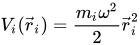
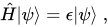


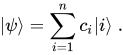

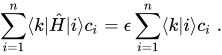












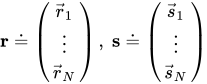

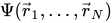






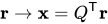


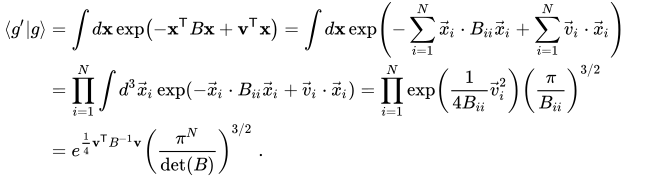



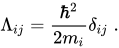

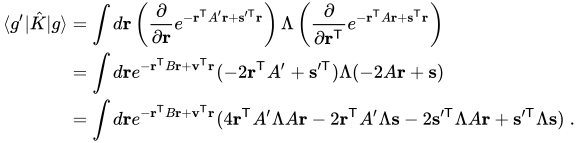






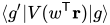






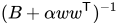


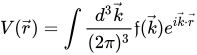




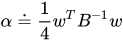
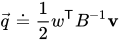

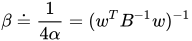








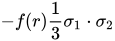
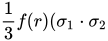










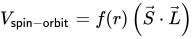

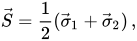



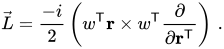

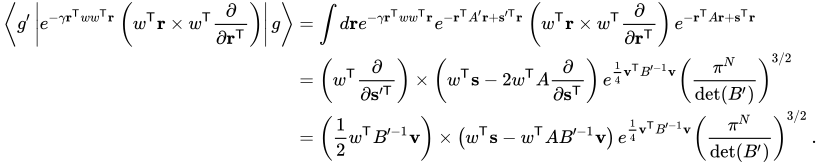








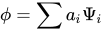
![{\displaystyle E[\phi ]={\frac {<\phi |H|\phi >}{<\phi |\phi >}}={\frac {\sum _{i}|a_{i}|^{2}E_{i}}{\sum _{i}|a_{i}|^{2}}}}](https://wikimedia.org/api/rest_v1/media/math/render/svg/7223f90bfd4e7ce55d20fa683f01e2c60335fd2c)
![{\displaystyle E[\phi ]=E_{0}+{\frac {\sum _{i}|a_{i}|^{2}(E_{i}-E_{0})}{\sum _{i}|a_{i}|^{2}}}\geq E_{0}\;\Box }](https://wikimedia.org/api/rest_v1/media/math/render/svg/547badf640c0f03c3d554875a312b5e60a0d6068)
![{\displaystyle \sigma ^{2}[\phi ]={\frac {<\phi |(H-E)^{2}|\phi >}{<\phi |\phi >}}}](https://wikimedia.org/api/rest_v1/media/math/render/svg/dbd507744b99d8906134b9df24a33bef305ad49e)
![{\displaystyle {\bigg [}E[\phi ]-\sigma [\phi ],E[\phi ]+\sigma [\phi ]{\bigg ]}}](https://wikimedia.org/api/rest_v1/media/math/render/svg/2df42aa47efca4e9756440e9600a4d8a52b3eb62)
![{\displaystyle \sigma ^{2}[\phi ]={\frac {\sum _{i}|a_{i}|^{2}(E_{i}-E)^{2}}{\sum _{i}|a_{i}|^{2}}}}](https://wikimedia.org/api/rest_v1/media/math/render/svg/09b20d8fd92c385b211c76075d1f6c4b28dfdb97)


![{\displaystyle \sigma ^{2}[\phi ]=(E_{k}-E)^{2}+{\frac {\sum _{i}|a_{i}|^{2}{\bigg (}(E_{i}-E)^{2}-(E_{k}-E)^{2}{\bigg )}}{\sum _{i}|a_{i}|^{2}}}\geq (E_{k}-E)^{2}\;\Box .}](https://wikimedia.org/api/rest_v1/media/math/render/svg/97ecd10ed4600771b9cfbf534184b5023b3805d3)
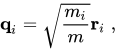





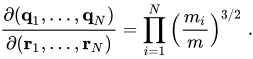
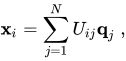



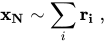


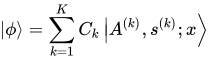














![{\displaystyle {\begin{array}{lcl}\langle A',s';x|(x^{T}Dx)(x^{T}D_{1}x)|A,s;x\rangle =N\times &{\bigg (}[u^{T}Du][u^{T}D_{1}u]+{\frac {1}{2}}[u^{T}D_{1}u]{\rm {tr}}(DB^{-1})+{\frac {1}{2}}[u^{T}Du]{\rm {tr}}(D_{1}B^{-1})+\\&2u^{T}DB^{-1}D_{1}u+{\frac {1}{4}}{\rm {tr}}(DB^{-1}){\rm {tr}}(D_{1}B^{-1})+{\rm {tr}}(DB^{-1}D_{1}B^{-1}){\bigg )}\;,\end{array}}}](https://wikimedia.org/api/rest_v1/media/math/render/svg/3db97febe092883e7096f17e2c02f909a061928f)








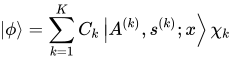

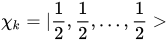

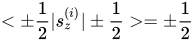
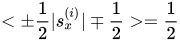
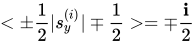


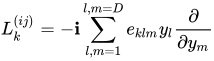






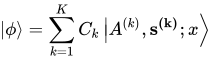

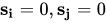





![{\displaystyle O=\sum _{i,j=1}^{i,j=n}a_{i}b_{j}[\mathbf {x_{i}} \times \mathbf {\frac {\partial }{\partial \mathbf {x_{j}} }} ]\equiv [a\mathbf {x} \times b{\frac {\partial }{\partial \mathbf {x} }}]}](https://wikimedia.org/api/rest_v1/media/math/render/svg/fbe78a69d8d9dafad677c4344ae841b0201e6a32)


![{\displaystyle \langle A',\mathbf {s'} ;x|[a\mathbf {x} \times b\mathbf {x} ]|A,\mathbf {s} ;x\rangle =N\cdot (a\mathbf {u} \times b\mathbf {u} )}](https://wikimedia.org/api/rest_v1/media/math/render/svg/1d89d6370d603c15e6bd4903f8c98a10ddb053d0)

![{\displaystyle \langle A',\mathbf {s'} ;x|[a\mathbf {x} \times b{\frac {\partial }{\partial \mathbf {x} }}]|A,\mathbf {s} ;x\rangle =-2\langle A',\mathbf {s'} ;x|[a\mathbf {x} \times bA\mathbf {x} ]|A,\mathbf {s} ;x\rangle +2\langle A',\mathbf {s'} ;x|[a\mathbf {x} \times bA\mathbf {s} ]|A,\mathbf {s} ;x\rangle =2N[a\mathbf {u} \times bA(\mathbf {s} -\mathbf {u} )]\;.}](https://wikimedia.org/api/rest_v1/media/math/render/svg/6830c7edfe592ce3c875a987ebce8502dd756033)
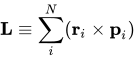
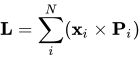







![{\displaystyle <L^{2}>=4\hbar ^{2}N{\bigg (}\mathbf {s'} ^{T}A'B^{-1}A\mathbf {s} +{\frac {1}{4}}\sum _{k,c}(A'B^{-1})_{kc}[\mathbf {v} _{k}\times \mathbf {s'} _{c}]\cdot \sum _{a,b}(AB^{-1})_{ab}[\mathbf {v} _{a}\times \mathbf {s} _{b}]{\bigg )}}](https://wikimedia.org/api/rest_v1/media/math/render/svg/99b83b7b46a1c5936185e4b2abb99d35d109e5cc)
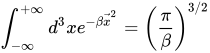




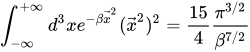
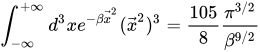







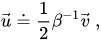
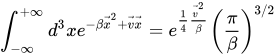












![{\displaystyle {\begin{aligned}\int _{-\infty }^{\infty }\,d{\vec {x}}e^{-{\vec {x}}^{T}B{\vec {x}}+{\vec {v}}^{T}{\vec {x}}}\times \left({\vec {x}}^{T}F{\vec {x}}\right)=N\times \left[{\frac {1}{2}}Trace\left(FB^{-1}\right)+{\frac {1}{4}}{\vec {v}}^{T}B^{-1}{\vec {v}}\right]\end{aligned}}}](https://wikimedia.org/api/rest_v1/media/math/render/svg/25aa438701579fd942c0f7e37aeaeea6898772a3)









