
Complex Analysis/Complex Functions/Continuous Functions
In this section, we
- introduce a 'broader class of limits' than known from real analysis (namely limits with respect to a subset of ) and
- characterise continuity of functions mapping from a subset of the complex numbers to the complex numbers using this 'class of limits'.

Limits of complex functions with respect to subsets of the preimage edit
We shall now define and deal with statements of the form
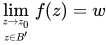
for , and prove two lemmas about these statements.

Definition 2.2.1:
Let be a set, let be a function, let , let and let . If



we define:
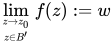
Lemma 2.2.2:
Let be a set, let be a function, let , let and . If


then
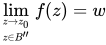
Proof: Let be arbitrary. Since

there exists a such that


But since , we also have , and thus



and therefore

Lemma 2.2.3:
Let , be a function, be open, and . If


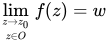
then for all such that :
- Proof
Let such that .
First, since is open, we may choose such that .


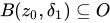
Let now be arbitrary. As
there exists a such that:


We define and obtain:


Continuity of complex functions edit
We recall that a function
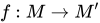
where are metric spaces, is continuous if and only if


for all convergent sequences in .


Theorem 2.2.4:
Let and be a function. Then is continuous if and only if

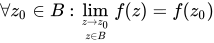
- Proof
Exercises edit
- Prove that if we define
- then is not continuous at . Hint: Consider the limit with respect to different lines through and use theorem 2.2.4.

