Calculus/Some Important Theorems
This section covers three theorems of fundamental importance to the topic of differential calculus: The Extreme Value Theorem, Rolle's Theorem, and the Mean Value Theorem. It also discusses the relationship between differentiability and continuity.
Extreme Value Theorem edit
Classification of Extrema edit
We start out with some definitions.
A global maximum (also called an absolute maximum) of a function on a closed interval is a value such that for all .

![{\displaystyle [a,b]}](https://wikimedia.org/api/rest_v1/media/math/render/svg/9c4b788fc5c637e26ee98b45f89a5c08c85f7935)


![{\displaystyle x\in [a,b]}](https://wikimedia.org/api/rest_v1/media/math/render/svg/026357b404ee584c475579fb2302a4e9881b8cce)
A global minimum (also called an absolute minimum) of a function on a closed interval is a value such that for all .

Maxima and minima are collectively known as extrema.
The Extreme Value Theorem edit
If is a function that is continuous on the closed interval , then has both a global minimum and a global maximum on . It is assumed that are both finite.

The Extreme Value Theorem is a fundamental result of real analysis whose proof is beyond the scope of this text. However, the truth of the theorem allows us to talk about the maxima and minima of continuous functions on closed intervals without concerning ourselves with whether or not they exist. When dealing with functions that do not satisfy the premises of the theorem, we will need to worry about such things. For example, the unbounded function has no extrema whatsoever. If is restricted to the semi-closed interval , then has a minimum value of 0 at , but it has no maximum value since, for any given value , one can always find a larger value of for , for example by forming , where is the average of with 1. The function has a discontinuity at . fails to have any extrema in any closed interval around since the function is unbounded below as one approaches 0 from the left, and it is unbounded above as one approaches 0 from the right. (In fact, the function is undefined for . However, the example is unaffected if is assigned any arbitrary value.)


The Extreme Value Theorem is an existence theorem. It tells us that global extrema exist if certain conditions are met, but it doesn't tell us how to find them. We will discuss how to determine the extrema of continuous functions in the section titled Extrema and Points of Inflection.
Rolle's Theorem edit

If a function is
- continuous on the closed interval
- differentiable on the open interval


then there exists at least one number such that


Rolle's Theorem is important in proving the Mean Value Theorem. Intuitively it says that if you have a function that is continuous everywhere in an interval bounded by points where the function has the same value, and if the function is differentiable everywhere in the interval (except maybe at the endpoints themselves), then the function must have zero slope in at least one place in the interior of the interval.
Proof of Rolle's Theorem edit
If is constant on , then for every , so the theorem is true. So for the remainder of the discussion we assume is not constant on .

Since satisfies the conditions of the Extreme Value Theorem, must attain its maximum and minimum values on . Since is not constant on , the endpoints cannot be both maxima and minima. Thus, at least one extremum exists in . We can suppose without loss of generality that this extremum is a maximum because, if it were a minimum, we could consider the function instead. Let with be a maximum. It remains to be shown that .

By the definition of derivative, . By substituting , this is equivalent to . Note that for all since is the maximum on .
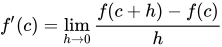

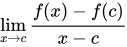

since it has non-positive numerator and negative denominator.
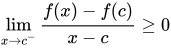
since it has non-positive numerator and positive denominator.
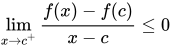
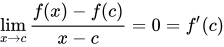
The limits from the left and right must be equal since the function is differentiable at , so .
Exercise edit



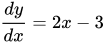


Mean Value Theorem edit

If a function is
- continuous on the closed interval
- differentiable on the open interval
then there exists at least one such that
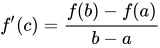
The Mean Value Theorem is an important theorem of differential calculus. It basically says that for a differentiable function defined on an interval, there is some point on the interval whose instantaneous slope is equal to the average slope of the interval. Note that Rolle's Theorem is the special case of the Mean Value Theorem when .
In order to prove the Mean Value Theorem, we will prove a more general statement, of which the Mean Value Theorem is a special case. The statement is Cauchy's Mean Value Theorem, also known as the Extended Mean Value Theorem.
Cauchy's Mean Value Theorem edit
If are

- continuous on the closed interval
- differentiable on the open interval
then there exists a number such that

If and , then this is equivalent to


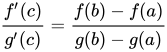
To prove Cauchy's Mean Value Theorem, consider the function

Since both and are continuous on and differentiable on , so is .



Since (see the exercises), Rolle's Theorem tells us that there exists some number such that . This implies that


which is what was to be shown.
Exercises edit








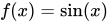
![{\displaystyle [0,\pi ]}](https://wikimedia.org/api/rest_v1/media/math/render/svg/3e2a912eda6ef1afe46a81b518fe9da64a832751)

Differentiability Implies Continuity edit
If exists then is continuous at . To see this, note that . But



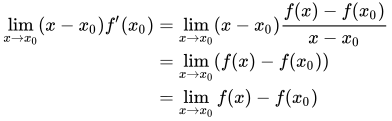
This implies that or , which shows that is continuous at .

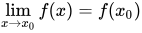

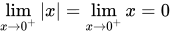
The converse, however, is not true. Take , for example. is continuous at 0 since and and , but it is not differentiable at 0 since but .