
Advanced Structural Analysis/Part I - Theory/General Properties of Materials/Measures/Elasticity/Broad Implications

Broad Implications edit
As is the case with many elementary physical laws, Hooke's law, stating the linear correlation between load and deformation, spans the small and simple, and the big and complex. For instance, the theory is a good approximation of simple test specimens subjected to axial loading. Naturally, it is also an accurate physical model for linear springs. And it is even valid for very complex structures, so long as they respond linearly. These are all trivial and perhaps self-evident statements, yet they are powerful and important.
Load and Stress edit
To expand on this, let's consider an initially stress free quasi-static linear-elastic mechanical system that is subjected to one load which has some fixed direction and point of application. The global equilibrium of the system is sustained by a pattern of internal stresses in the structure. The specific shape of the stress pattern is required to achieve equilibrium at each point in the structure. That is, if the stress magnitude at some point differed from the equilibrium state by a factor , the system would automatically strive to reach the unique pattern of equilibrium. One could however obtain a new equilibrium state that abides the new condition at by altering the stress levels in the material surrounding by the same factor . A state of equilibrium is thus reached if


\begin{equation} \sigma_i = k \sigma_{i0} \end{equation}
If the refactoring of the stress magnitudes is propagated throughout the system, including the point at which the load is applied, global equilibrium will be achieved. Consequently, also the magnitude of the load itself would have to be altered by the factor in this scenario. Hence we can write
(2)

Equation () and () yields
(3)
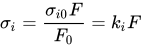
Where is a constant.

Equation () is only true if the normalized stress pattern is unaffected by the magnitude of in the considered interval. If instead, the system is nonlinear, i.e. responds differently depending on the magnitude of , equation () is not be true/reliable.
Load and Strain edit
Moreover, Hookes law and equation () gives us



Load and Displacement edit
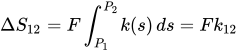
Let's consider a path that runs through a continuous linear elastic body. has two endpoints and .


The relative change in distance in some direction between the two points can be formulated
Displacement and Strain edit
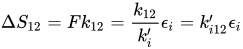
From equation () and () we get
Displacement and Stress edit
From equation () and () we get

Generalization edit
Moving on to a more general point of view, we state the following definition
(3)

Where is a constant and and are some linearly dependent structural measures at and , respectively.


From equation (3) and the superposition principle we conclude that
(4)

The independent parameters of (4) can be obtained by performing tests/calculations. It follows that it is easy to, for instance, scale linear test results according to different safety factors.

It is important to know whether or not the structure is linear before drawing any critical conclusions from the theory of elasticity. Common sources of non-linear behavior in a structure are material, geometric, contact and dynamic effects.