
Abstract Algebra/Algebras
In this section we will talk about structures with three operations. These are called algebras. We will start by defining an algebra over a field, which is a vector space with a bilinear vector product. After giving some examples, we will then move to a discussion of quivers and their path algebras.
Algebras over a Field edit
Definition 1: Let be a field, and let be an -vector space on which we define the vector product . Then is called an algebra over provided that is a ring, where is the vector space addition, and if for all and ,





- ,
- and ,
- .




The dimension of an algebra is the dimension of as a vector space.
Remark 2: The appropriate definition of a subalgebra is clear from Definition 1. We leave its formal statement to the reader.
Definition 2: If is a commutative ring, is called a commutative algebra. If it is a division ring, is called a division algebra. We reserve the terms real and complex algebra for algebras over and , respectively.


The reader is invited to check that the following examples really are examples of algebras.
Example 3: Let be a field. The vector space forms a commutative -algebra under componentwise multiplication.

Example 4: The quaternions is a 4-dimensional real algebra. We leave it to the reader to show that it is not a 2-dimensional complex algebra.

Example 5: Given a field , the vector space of polynomials is a commutative -algebra in a natural way.
![{\displaystyle F[x]}](https://wikimedia.org/api/rest_v1/media/math/render/svg/39bc9f9d8679fc385df3bccf9694283b796f3216)
Example 6: Let be a field. Then any matrix ring over , for example , gives rise to an -algebra in a natural way.

Quivers and Path Algebras edit
Naively, a quiver can be understood as a directed graph where we allow loops and parallell edges. Formally, we have the following.
Definition 7: A quiver is a collection of four pieces of data, ,

- is the set of vertices of the quiver,
- is the set of edges, and
- are functions associating with each edge a source vertex and a target vertex, respectively.



We will always assume that is nonempty and that and are finite sets.
Example 8: The following are the simplest examples of quivers:
- The quiver with one point and no edges, represented by .
- The quiver with point and no edges, .
- The linear quiver with points, .
- The simplest quiver with a nontrivial loop, .





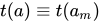
Definition 9: Let be a quiver. A path in is a sequence of edges where for all . We extend the domains of and and define and . We define the length of the path to be the number of edges it contains and write . With each vertex of a quiver we associate the trivial path with and . A nontrivial path with is called an oriented loop at .











The reason quivers are interesting for us is that they provide a concrete way of constructing a certain family of algebras, called path algebras.
Definition 10: Let be a quiver and a field. Let denote the free vector space generated by all the paths of . On this vector space, we define a vector product in the obvious way: if and are paths with , define their product by concatenation: . If , define their product to be . This product turns into an -algebra, called the path algebra of .







Lemma 11: Let be a quiver and field. If contains a path of length , then is infinite dimensional.

Proof: By a counting argument such a path must contain an oriented loop, , say. Evidently is a linearly independent set, such that is infinite dimensional.

Lemma 12: Let be a quiver and a field. Then is infinite dimensional if and only if contains an oriented loop.
Proof: Let be an oriented loop in . Then is infinite dimensional by the above argument. Conversely, assume has no loops. Then the vertices of the quiver can be ordered such that edges always go from a lower to a higher vertex, and since the length of any given path is bounded above by , there dimension of is bounded above by .


Lemma 13: Let be a quiver and a field. Then the trivial edges form an orthogonal idempotent set.
Proof: This is immediate from the definitions: if and .


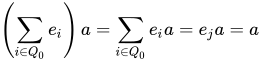
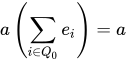
Corollary 14: The element is the identity element in .

Proof: It sufficed to show this on the generators of . Let be a path in with and . Then . Similarily, .


To be covered:
- General R-algebras